Gold Price Forecast: XAU/USD buyers refuse to give up amid global trade war and recession risks
- Gold price finds its feet above $3,000 after hitting one-month lows early Monday.
- US recession fears and dovish Fed bets again drag the US Dollar and US Treasury yields lower.
- China continues to boost its Gold reserves, underpinning the Gold price.
- Technically, Gold price remains a ‘buy-the-dips’ trade so long as 50-day SMA at $2,944 holds.


Gold price is holding the quick turnaround from one-month lows of $2,971, consolidating the recent downward spiral. The extension of the risk-off market profile into Asia this Monday revives the safe-haven demand for Gold price.
Gold price recovery appears on track
The buying interest in the traditional safe-haven Gold price has resurged in Asian trading on Monday, as risk-off flows dominate, with investors being offered no respite from fears ignited by US President Donald Trump over a global trade war and recession.
China announced on Friday an additional 34% retaliatory tariff on all goods imported from the US, following Trump's reciprocal tariff move on Liberation Day, April 2.
Trump said late Sunday that he is not willing to make any deal with China unless the trade deficit is solved. Speaking further on the stock market carnage, he said that "sometimes you have to take medicine.”
His comments prompted Gold price to open the week with a big leg lower, reaching the lowest in a month below the $3,000 threshold. However, buyers quickly jumped in on the narrative that the increased risks of a US recession due to Trump’s tariff war would outweigh inflation concerns, prompting the US Federal Reserve (Fed) to deliver aggressive interest rate cuts this year.
Markets now price in a 54% chance the Fed could cut as soon as May, with big banks predicting cuts at every meeting through January, even though Chair Jerome Powell on Friday said the central bank was in no hurry on rates.
Goldman Sachs now forecasts a total of 130 basis points (bps) in Fed rate cuts for 2025, up from 105 bps previously projected.
Against this backdrop, the US Dollar recovery remained in check alongside the US Treasury bond yields, allowing Gold buyers to find their feet so far. Gold price is also drawing support from the latest data from the People’s Bank of China (PBOC), which showed that China increased its state Gold reserves for the fifth consecutive month.
Gold held by the PBOC rose by 0.09 million troy ounces last month, according to data released on Monday.
However, it remains to be seen if Gold price manages to sustain the tepid recovery, especially after Friday’s ‘sell everything’ carnage, which led traders to cover their losses and margin calls in other assets by booking profits in their Gold positions.
Trump’s updates on trade policies and potential retaliation by the European Union (EU) or other countries will be closely monitored, in the absence of high-impact US economic data.
All in all, any downside in Gold price appears limited if markets take a breather from the ongoing bloodbath, focusing their attention to the US inflation data due later this week.
Gold price technical analysis: Daily chart
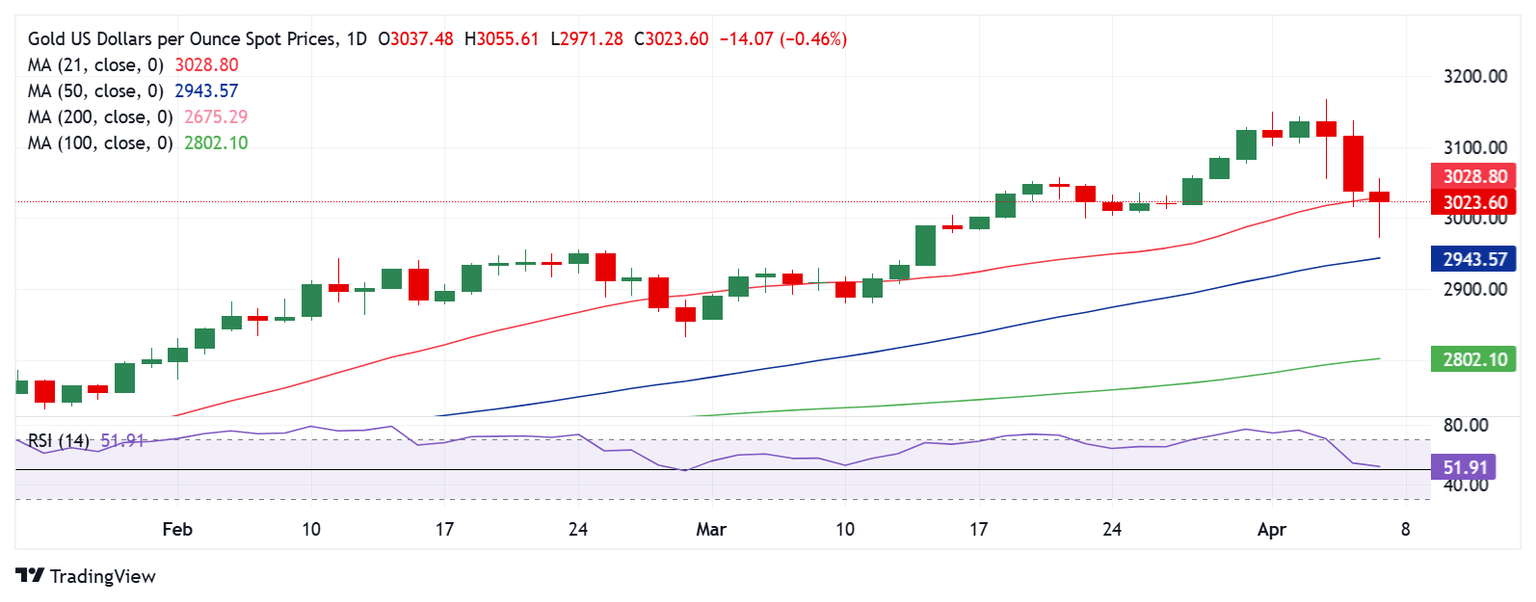
So long as the 14-day Relative Strength Index (RSI) holds above the 50 level, the bullish bias in Gold price will likely remain intact.
Gold price needs to defend the 21-day Simple Moving Average (SMA) at $3,029 on a daily closing basis to resume its record rally.
Buyers will then look to the $3,100 barrier, above which the record high of $3,168 will come into play again.
A failure to resist above the 21-day SMA at $3,029 will re-open the downside toward the $3,000 mark.
The next support aligns at the one-month low of $2,971, below which the 50-day SMA at $2,944 will challenge bullish commitments.
(This story was corrected on April 6 at 05:30 GMT to say in the first bullet that "Gold price finds its feet above $3,000 after hitting one-month lows early Monday." Also, "the record high of $3,168," not $3,068.)
US-China Trade War FAQs
Generally speaking, a trade war is an economic conflict between two or more countries due to extreme protectionism on one end. It implies the creation of trade barriers, such as tariffs, which result in counter-barriers, escalating import costs, and hence the cost of living.
An economic conflict between the United States (US) and China began early in 2018, when President Donald Trump set trade barriers on China, claiming unfair commercial practices and intellectual property theft from the Asian giant. China took retaliatory action, imposing tariffs on multiple US goods, such as automobiles and soybeans. Tensions escalated until the two countries signed the US-China Phase One trade deal in January 2020. The agreement required structural reforms and other changes to China’s economic and trade regime and pretended to restore stability and trust between the two nations. However, the Coronavirus pandemic took the focus out of the conflict. Yet, it is worth mentioning that President Joe Biden, who took office after Trump, kept tariffs in place and even added some additional levies.
The return of Donald Trump to the White House as the 47th US President has sparked a fresh wave of tensions between the two countries. During the 2024 election campaign, Trump pledged to impose 60% tariffs on China once he returned to office, which he did on January 20, 2025. With Trump back, the US-China trade war is meant to resume where it was left, with tit-for-tat policies affecting the global economic landscape amid disruptions in global supply chains, resulting in a reduction in spending, particularly investment, and directly feeding into the Consumer Price Index inflation.
Premium
You have reached your limit of 3 free articles for this month.
Start your subscription and get access to all our original articles.
Author
Dhwani Mehta
FXStreet
Residing in Mumbai (India), Dhwani is a Senior Analyst and Manager of the Asian session at FXStreet. She has over 10 years of experience in analyzing and covering the global financial markets, with specialization in Forex and commodities markets.