Gold Price Forecast: XAU/USD bulls seem reluctant amid overbought RSI, ahead of US NFP report
- Gold struggles to capitalize on modest intraday gains as traders keenly await the US NFP report.
- Rising Fed rate cut bets keep the USD bulls on the defensive and lend support to the commodity.
- Persistent trade-related uncertainties further act as a tailwind for the safe-haven precious metal.

Gold (XAU/USD) builds on the previous day's bounce from the vicinity of the $3,500 psychological mark and gains some follow-through positive traction on Friday. The intraday uptick, however, lacks bullish conviction as traders opt to wait for more cues about the Federal Reserve's (Fed) rate-cut path before positioning for the next leg of a directional move for the non-yielding yellow metal. Hence, the focus will remain glued to the release of the closely-watched US monthly employment details, due later during the North American session.
The popularly known Nonfarm Payrolls (NFP) report is expected to show that the economy added 75K new jobs in August, compared to 73K in the previous month, and the Unemployment Rate edged higher to 4.3%, from 4.2% in July. Weaker data would provide further evidence of softening labor market conditions and fuel speculations about a jumbo interest rate cut by the Fed this month. In fact, the Automatic Data Processing (ADP) reported on Thursday that private-sector employment in the US increased by 54,000 jobs in August.
The reading was below the 106,000 (revised from 104,000) increase recorded in July and expectations of 65,000. Separately, a report from the US Department of Labour (DOL) showed that the number of US citizens filing jobless claims increased to 237K for the week ending August 30. higher than the 230K estimated and the previous week’s 229K. This also marked the highest level since June and overshadowed the upbeat US ISM Services PMI, which rose to 52 in August from 50.1 in July, and did little to impress the USD bulls.
On the trade-related front, US President Donald Trump signed an executive order on Thursday formalizing the lower tariffs on Japanese automobile imports and other products that were announced in July, boosting sentiment. However, Trump has asked the Supreme Court for an immediate hearing in hopes of overturning an appeals court ruling that deemed most of his tariffs illegal. This keeps trade-related uncertainties in play and should further lend some support to the safe-haven Gold price, warranting caution for bearish traders.
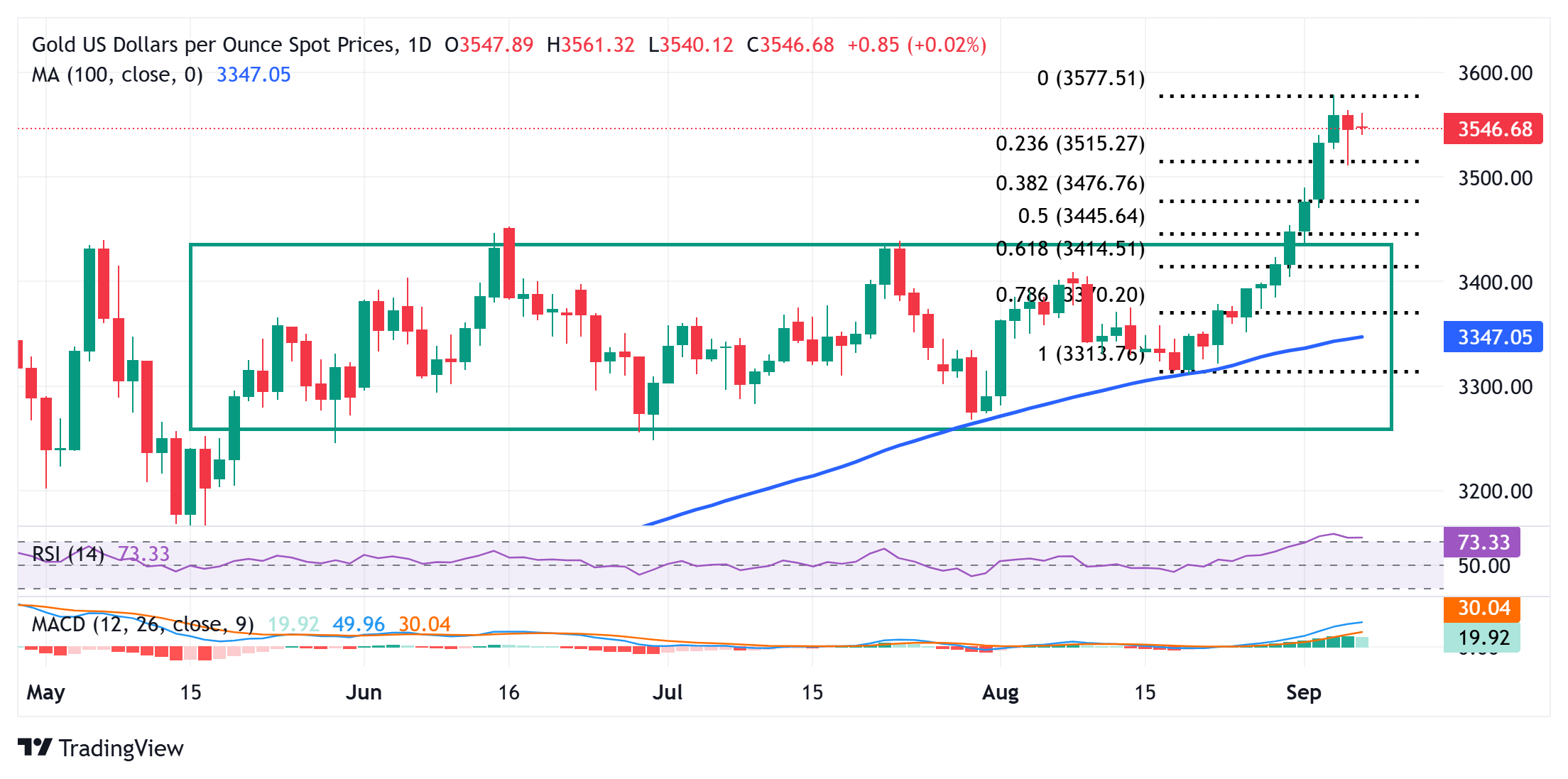
Gold daily chart
Technical outlook
This week's breakout through a multi-month-old range and the overnight bounce from the 23.6% Fibonacci retracement level of the rally from the vicinity of the $3,300 mark suggest that the path of least resistance for the Gold price is to the upside. That said, the overbought Relative Strength Index (RSI) on the daily chart is holding back the XAU/USD bulls from placing fresh bets. Hence, it will be prudent to wait for some near-term consolidation or a modest pullback before positioning for a further appreciating move.
Meanwhile, the intraday high, around the $3,561-$3,562 area, now seems to act as an immediate hurdle, above which the Gold price could climb to retest the all-time peak, around the $3,578-3,579 zone touched on Wednesday. The momentum could extend further towards conquering the $3,600 mark, which is also the trading range breakout target.
On the flip side, any corrective pullback might continue to find decent support near the 23.6% Fibo. retracement level, ahead of the $3,500 psychological mark. Some follow-through selling could pave the way for a deeper corrective slide to the $3,440 area, or the trading range resistance breakpoint. A convincing break below the latter will suggest that the Gold price has topped out and shift the near-term bias in favor of bearish traders.
Author

Haresh Menghani
FXStreet
Haresh Menghani is a detail-oriented professional with 10+ years of extensive experience in analysing the global financial markets.














