Gold Price Forecast: XAU/USD bulls pause ahead of US PCE data, trading range breakout in play
- Gold price touches a three-week high on Friday amid rising bets for a March Fed rate cut.
- A modest USD uptick caps gains for the XAU/USD ahead of the crucial US PCE Price Index.
- The fundamental backdrop favours bullish traders and supports prospects for further gains.

Gold price (XAU/USD) rises to a near three-week high, around the $2,055 region earlier this Friday, albeit struggles to capitalize on the move amid a modest US Dollar (USD) uptick. In fact, the USD Index (DXY), which tracks the Greenback against a basket of currencies, reverses a part of the previous day's slide to a near five-month trough touched in the aftermath of a downward revision of the US GDP print. The third and final reading from the US Bureau of Economic Analysis showed that the world's largest economy expanded by a 4.9% annualized pace vs. a 5.2% rise in the second estimate. The markets were quick to price in a greater chance that the Federal Reserve (Fed) will start cutting rates as early as March 2024 and 155 basis points (bps) of easing by the end of next year.
Traders, however, seem reluctant to place aggressive USD bearish bets and prefer to wait for the release of the US Core Personal Consumption Expenditure (PCE) Price Index, due later during the early North American session. The headline index is expected to inch down to a 2.8% YoY rate in November, from the 3% previous. Meanwhile, the core figure, which excludes volatile food and energy prices and is considered as the Fed's preferred inflation gauge, is anticipated to fall to 3.3% YoY from 3.5% in October. Given market expectations for more rapid interest rate cuts by the Fed in 2024, the immediate market reaction to softer readings is more likely to be minimal. In contrast, a stronger report might prompt some USD short-covering move and weigh on the USD-denominated Gold price.
Any meaningful downside for the precious metal, however, seems limited amid the prospects of a global rate-cutting cycle. This, in turn, suggests that the path of least resistance for the non-yielding yellow metal is to the upside and a corrective decline might still be seen as a buying opportunity. Nevertheless, the Gold price remains on track to register modest gains for the second week in a row.
Technical Outlook
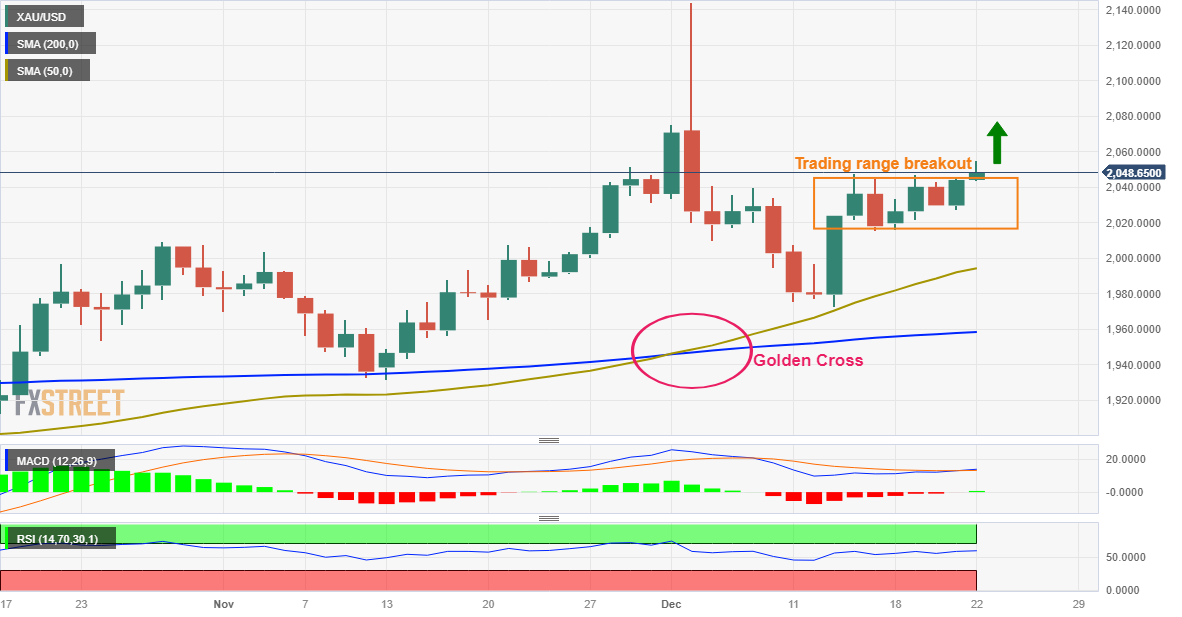
From a technical perspective, a move beyond the $2,047-2,048 hurdle, representing the top end of over a one-week-old trading range, favours bullish traders. Adding to this, the occurrence of a golden cross, with the 50-day Simple Moving Average (SMA) crossing the 200-day SMA from below, supports prospects for additional gains. The constructive outlook is reinforced by the fact that oscillators on the daily chart are holding in the positive territory. Hence, some follow-through move towards testing the next relevant hurdle, around the $2,072-2,073 region, looks like a distinct possibility, above which the Gold price could aim to reclaim the $2,100 round figure.
On the flip side, any meaningful corrective pullback could find decent support and attract fresh buyers near the $2,028-2,027 area. This should help limit the downside for the XAU/USD near the $2,017 horizontal zone. That said, a convincing break below the latter might prompt some technical selling and make the Gold price vulnerable to accelerate the slide towards the $2,000 psychological mark. This is closely followed by the 50-day SMA, currently around the $1,994 area, below which the downward trajectory could get extended further towards last week's swing low, around the $1,973 region, en route to a technically significant 200-day SMA, near the $1,958 zone.
Author

Haresh Menghani
FXStreet
Haresh Menghani is a detail-oriented professional with 10+ years of extensive experience in analysing the global financial markets.















