Gold Price Forecast: XAU/USD bounces but not out of the woods yet
- Gold price could come up for air ahead of Wednesday’s US inflation data.
- China’s deflation worries could limit the Gold price rebound.
- Gold price remains a ‘sell on bounce’ trade amid a bearish daily technical setup.

Gold price is seeing a dead cat bounce from a fresh one-month low of $1,923 set on Tuesday. The United States Dollar (USD) is retreating from near multi-week highs while the US Treasury bond yield licks wounds, motivating Gold buyers to attempt a modest comeback.
China’s deflation woes, banking fears to support US Dollar
Risk sentiment played the key driver so far this week that was devoid of top-tier economic data releases from the United States. The US Dollar extended its upbeat momentum, as risk-off flows dominated for the second straight day on Tuesday, as China’s growth concerns joined resurfacing global banking woes. Markets traded with caution at the start of the week, positioning themselves for the key Chinese and US inflation data.
A bigger-than-expected drop in China’s exports and imports on Tuesday flared up worries over the dwindling Chinese post-Covid economic recovery, adding to the safe-haven demand for the Greenback at the expense of the Gold price. In American trading, risk-aversion intensified after the US banking sector stocks tumbled on the downgrading of several lenders by Moody's Investor Services, which reignited fears about the health of US banks. Further, the Italian government set a one-off 40% tax on profits made by banks from higher interest rates, triggering a 3.50% sell-off in the regional banking shares.
Investors continued to scout for safety on the above headlines, driving the US Dollar Index to the highest level in four weeks to 102.80. The flight to safety-led decline in the US Treasury bond yields, however, capped the additional upside in the US Dollar, allowing Gold price to witness a late rebound.
Early Wednesday, investors remains cautious, digesting the mixed Chinese inflation data, with the country’s Consumer Price Index (CPI) falling 0.3% in July from a year ago, slightly better than the -0.4% expected but reported the first decline since February 2021. Meanwhile, China’s Producer Price Index (PPI) dropped for a 10th consecutive month. China’s deflation fears intensify, helping limit the pullback in the US Dollar. Therefore, any recovery attempts in the Gold price are likely to remain short-lived.
Attention now turns toward Thursday’s all-important United States CPI data for a fresh direction on the US Dollar, as well as, the Gold price, as it will provide fresh hints on the US Federal Reserve (Fed) interest rate path for the balance of this year.
Gold price technical analysis: Daily chart
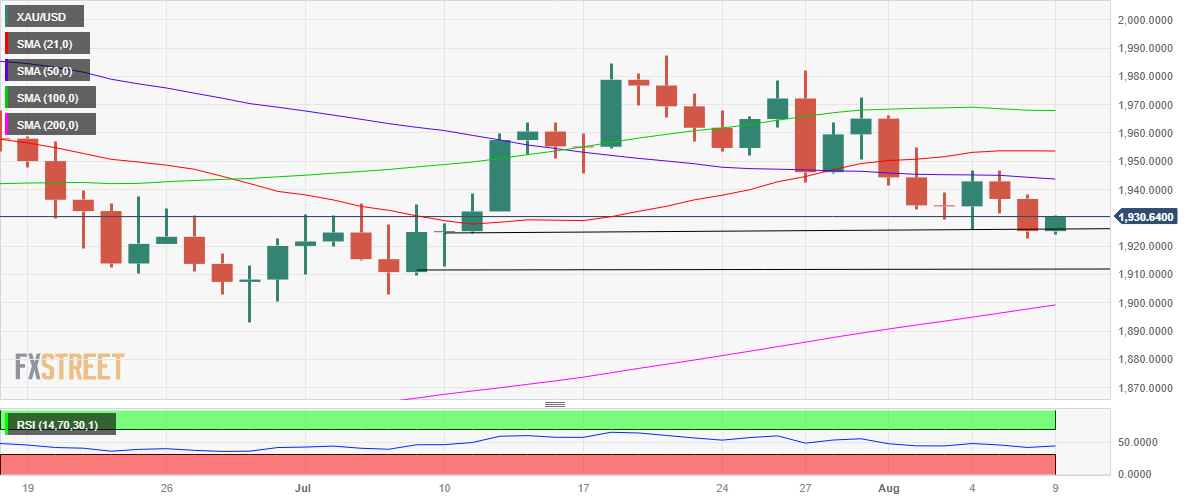
Technically, Gold price could see a rebound toward the downward-sloping 50-Daily Moving Average (DMA) at $1,944, as the 14-day Relative Strength Index (RSI) indicator is showing some signs of recovery.
Ahead of the 50 DMA barrier, Gold buyers need to take out the previous day’s high of $1,938 on the road to recovery.
With the 14-day RSI still below the midline, Gold sellers are likely to impede the recovery mode, driving Gold price back toward the monthly low of $1,923. However, Gold price needs a daily close below the July 11 low of $1,924 to see a sustained downtrend.
The next relevant cushion is seen at around $1,910 demand area, below which floors will open up toward the $1,900 threshold.
All in all, Gold price is likely to range between $1,920 and $1,950 in the lead-up to the key US CPI event risk due Thursday.
Author

Dhwani Mehta
FXStreet
Residing in Mumbai (India), Dhwani is a Senior Analyst and Manager of the Asian session at FXStreet. She has over 10 years of experience in analyzing and covering the global financial markets, with specialization in Forex and commodities markets.

















