Euro positioning reaches 343-report extreme as COT data points toward a potential medium-term floor

Euro positioning has reached a 343-report extreme in Large Speculators and a 510-report extreme in Commercials, while soybean meal and palladium add to a week of meaningful positioning developments across the 40th COT report.
The euro has been in focus for several weeks now, but the 40th Commitments of Traders report puts a specific number to what is becoming a historically notable positioning situation. Large Speculators — primarily funds and professional money managers — are currently sitting at a 343-report extreme in their net euro positioning, while Commercials have reached a 510-report extreme on the other side. These are significant lookbacks, and they deserve careful interpretation rather than a straightforward directional call.
Euro positioning remains stretched while a floor is unconfirmed
A 343-report extreme in Large Speculators and a 510-report extreme in Commercials are not numbers to dismiss lightly. But one of the key disciplines when reading COT extremes is resisting the urge to treat them as immediate reversal signals. Extremes can widen — sometimes considerably — before price responds.
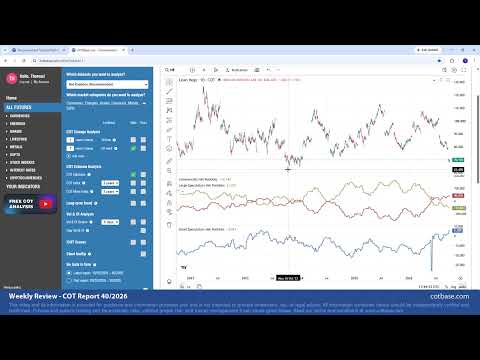
My view at this stage is that the euro could find its floor sometime later this year or into early next year, but I would want to see further widening of the COT extreme, or ideally confirmation from traditional technical analysis, before treating this as a high-conviction long setup. There is a price level visible on the chart that has historically acted as resistance and may now be functioning as support.
That is worth monitoring. It is a plausible first line of defence, but it is not yet confirmed.
What the current data does establish is that positioning is historically stretched. The current extreme needs to be read in the context of the wider positioning trend, rather than as a sudden one-week change.
In my view, further widening would strengthen the medium-term case for a floor, but the timing still depends on how price responds. For now, the appropriate posture is to watch rather than act, and to remain alert to the COT extreme widening further before any bottom is confirmed.
COT analysis works best alongside traditional support and resistance work. The euro illustrates that principle clearly this week.
Soybean meal declines support the bearish positioning signal
Soybean meal has featured in recent reviews with an all-time COT extreme in Large Speculators. The question in recent weeks has been whether the market would begin to react. Based on the 40th report, it appears the reaction is now underway.
Price has started to decline, which is consistent with what the bearish COT extreme has been signalling. There had been some uncertainty about whether Commercials were producing a capitulation signal — a scenario where their positioning would suggest the extreme is unsustainable.
I do not believe that is what we are seeing. Instead, the market is behaving in a way that appears to be validating the underlying signal, and if the decline continues, we should see Large Speculators begin to reduce their extreme positioning. A reduction in the extreme as price falls would provide further evidence that the bearish signal is playing out.
This is still a developing situation, but the early price response is encouraging from an analytical perspective.
Palladium and platinum changes suggest near term strengthening
Two metals feature in this week's list of larger-than-average changes in Commercials' net positions: platinum with a 26% change and palladium with a 20% change. Both are pointing toward potential near-term strengthening, and both carry supporting readings from iCOT scores.
Palladium is the more interesting of the two from a positioning context. The 5-year stress chart shows that a bearish COT extreme was present in early 2026, which offered a useful defensive signal for anyone positioned long at the time.
Since then, the market has moved lower and is now at a bullish COT extreme — one that could still grow. The current larger-than-average change signal suggests the potential for a near-term bounce, but I would not treat this as a trend reversal call. Downside pressure could continue even as short-term positioning supports a temporary recovery.
Platinum tells a broadly similar story. The change is clearly larger than average and the iCOT scores are supportive, but the 5-year positioning picture does not show the kind of extreme that would give high conviction in a structural turn. The change signal is the most relevant tool here for short-term orientation.
The Mexican peso signals a possible bounce after a month of decline
The Mexican peso tops this week's list by size of Commercials' net position change, at 43% — possibly the largest single-week change visible on the one-year chart. This follows approximately a month of declining prices.
The COT change signal is bullish, and iCOT scores are supporting that reading. In the context of the 5-year chart, it is worth noting that a bearish COT extreme was present not long ago and appeared to act as a successful signal at a significant resistance zone.
The market has been reacting to that signal. The current change reading suggests we could see a short-term bounce or period of consolidation, but the broader directional context remains bearish. This is better read as a tactical signal within a downtrend than as evidence of a structural reversal.
Positioning favours patience as price confirmation develops
The euro is the headline development from COT report 40. A 343-report extreme in Large Speculators and a 510-report extreme in Commercials represent historically stretched positioning, but that alone does not confirm a floor or a long trade.
The analytical message is to watch for further COT widening, monitor the price levels that may now act as support, and wait for traditional analysis to align before drawing firmer conclusions. Soybean meal is the commodity story worth following closely — the price decline appears to be confirming what the all-time COT extreme has been pointing to for several weeks.
Watch the full COT analysis for Report 40 of 2026, including the chart walkthroughs and ICOT score detail.
This content was partially created by an AI tool.
Author

Thomas Lukacs
COTBase.com
Thomas Lukacs is the founder and CEO of COTbase.com.