Gold Price Forecast: XAU/USD battles 50-day SMA on the road to recovery
- Gold price builds on Wednesday’s rebound from weekly lows early Thursday.
- The US Dollar stays pressured alongside Treasury yields amid looming trade concerns.
- Gold price bounces off 38.2% Fibo support; will it find acceptance above 50-day SMA?

Gold price extends the rebound from weekly lows of $3,283 in Asian trading on Thursday, helped by increased concerns surrounding US President Donald Trump’s latest tariff announcements and falling US Treasury bond yields.
Gold price awaits US data amid tariff talks
Gold price staged a decent comeback in Wednesday’s American trading even as risk sentiment remained slightly in a sweeter spot, courtesy of Nvidia hitting $4-trillion valuation.
A broadly weaker US Dollar (USD), amid falling US Treasury bond yields and renewed concerns over a likely trade war, helped Gold price find its footing.
US Treasury bond yields succumbed to resurfacing economic growth concerns and strong demand for the Treasury in the $39 bln 10-year note sale.
President Trump on Wednesday issued August 1 tariff notices to seven minor trading partners, with a 20% tariff on goods from the Philippines, 30% on goods from Sri Lanka, Algeria, Iraq, and Libya, and 25% on Brunei and Moldova.
He later announced a new 50% tariff on US copper imports and a 50% duty on goods from Brazil, both effective on August 1.
Lingering trade tensions offset the hawkish Minutes of the US Federal Reserve’s (Fed) July meeting, rendering positive for the bright metal.
The Minutes “showed that only "a couple" of Fed officials believed interest rate cuts could happen as early as this month, with most favouring reductions later this year,” per Reuters.
All eyes now remain on Trump’s tariff talks, mid-tier US economic data releases and speeches from a few Fed policymakers due later this Thursday for fresh trading directives in Gold price.
In the meantime, the sustained weakness in the US Dollar and sluggish Treasury bond yields could continue to lend support to the non-yielding Gold price.
Gold price technical analysis: Daily chart
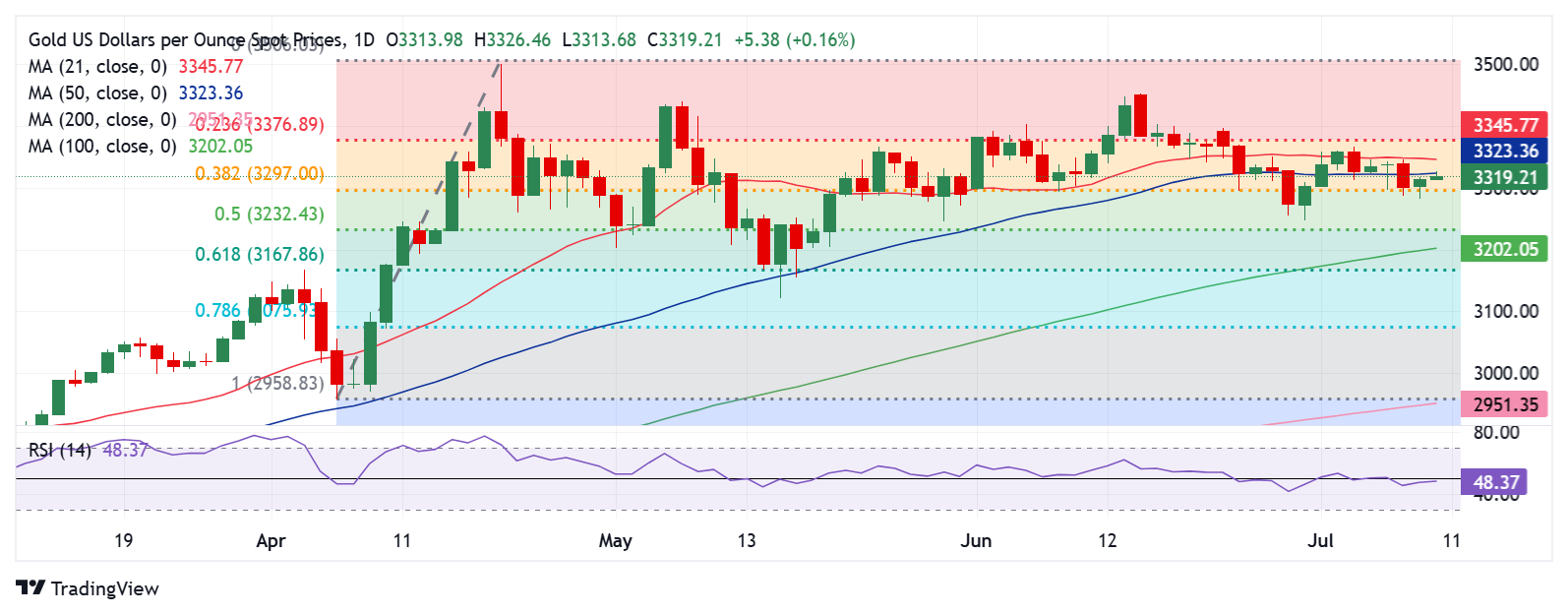
Despite Tuesday’s range breakdown, Gold price managed to recapture the critical 38.2% Fibonacci Retracement (Fibo) level of the April record rally at $3,297 on Wednesday, having briefly tested offers underneath that level.
The Gold price upswing could be justified by the recovery in the 14-day Relative Strength Index (RSI). However, the leading indicator still holds below the midline, currently near 48.50, suggesting a lack of bullish conviction.
Therefore, buyers need to take out the support-turned-resistance of the 50-day Simple Moving Average (SMA) at $3,323 on a sustained basis to initiate a meaningful recovery toward the 21-day SMA at $3,346.
Further up, the 23.6% Fibo level of the same advance at $3,377 could offer stiff resistance to Gold buyers.
On the other hand, a rejection at the 50-day SMA will likely reinforce selling pressure, sending Gold price back to test the 38.2% Fibo support at $3,297.
Acceptance under that level could open up additional downside toward the monthly low of $3,248.
Gold FAQs
Gold has played a key role in human’s history as it has been widely used as a store of value and medium of exchange. Currently, apart from its shine and usage for jewelry, the precious metal is widely seen as a safe-haven asset, meaning that it is considered a good investment during turbulent times. Gold is also widely seen as a hedge against inflation and against depreciating currencies as it doesn’t rely on any specific issuer or government.
Central banks are the biggest Gold holders. In their aim to support their currencies in turbulent times, central banks tend to diversify their reserves and buy Gold to improve the perceived strength of the economy and the currency. High Gold reserves can be a source of trust for a country’s solvency. Central banks added 1,136 tonnes of Gold worth around $70 billion to their reserves in 2022, according to data from the World Gold Council. This is the highest yearly purchase since records began. Central banks from emerging economies such as China, India and Turkey are quickly increasing their Gold reserves.
Gold has an inverse correlation with the US Dollar and US Treasuries, which are both major reserve and safe-haven assets. When the Dollar depreciates, Gold tends to rise, enabling investors and central banks to diversify their assets in turbulent times. Gold is also inversely correlated with risk assets. A rally in the stock market tends to weaken Gold price, while sell-offs in riskier markets tend to favor the precious metal.
The price can move due to a wide range of factors. Geopolitical instability or fears of a deep recession can quickly make Gold price escalate due to its safe-haven status. As a yield-less asset, Gold tends to rise with lower interest rates, while higher cost of money usually weighs down on the yellow metal. Still, most moves depend on how the US Dollar (USD) behaves as the asset is priced in dollars (XAU/USD). A strong Dollar tends to keep the price of Gold controlled, whereas a weaker Dollar is likely to push Gold prices up.
Author

Dhwani Mehta
FXStreet
Residing in Mumbai (India), Dhwani is a Senior Analyst and Manager of the Asian session at FXStreet. She has over 10 years of experience in analyzing and covering the global financial markets, with specialization in Forex and commodities markets.