Gold Price Forecast: XAU/USD awaits the US PCE inflation for fresh impetus
- Gold returns to the red below $3,750 early Friday, eyeing US PCE inflation.
- US Dollar sits at three-week highs as US economic resilience counters Trump’s fresh tariffs.
- Technically, Gold remains a ‘buy-the-dips’ trade but the upcoming US data holds the key.
Gold is back on its corrective journey below $3,750 in Friday’s Asian trades, after having staged a tepid bounce on Thursday. All eyes now remain on the US core Personal Consumption Expenditures (PCE) Price Index due later in the day for a fresh directional impetus.
Will US PCE inflation revive the Gold record rally?
Reduced bets for aggressive interest rate cuts by the US Federal Reserve (Fed) this year offset renewed jitters fuelled by US President Donald Trump’s latest round of tariffs, helping the US Dollar (USD) holds its recent uptrend at the expense of Gold.
Encouraging US data released on Thursday highlighted the economic resilience, pouring cold water on aggressive Fed easing expectations.
US Gross Domestic Product rose by an upwardly revised rate of 3.8% from April through June, higher than 3.3% initially reported.
Meanwhile, the Labour Department reported 218,000 seasonally adjusted filings for the week ending September 20, down 14,000 from the prior week’s upwardly revised figure and below the consensus estimate of 235,000.
Additionally, Durable Goods Orders rebounded firmly by 2.9% in August versus the previously revised -2.7% and -0.5% expected.
Trump on Thursday announced tariffs of up to 100% on imports of branded and patented pharmaceutical drugs, starting October 1. Trump also slapped 50% tariffs on imports of kitchen cabinets and bathroom vanities, 30% on upholstered furniture, and 25% on heavy trucks.
Markets weigh the latest Trump’s tariffs, while gearing up for the critical US PCE inflation data due later this Friday. The data will confirm whether the Fed will remain on track for two rate cuts this year.
The Fed’s preferred inflation measure, the core PCE Price Index, is expected to rise by 2.9% in August, at the same pace seen in July. The headline annual PCE inflation is set to tick higher to 2.7% in the same period, against July’s 2.6%.
An upside surprise to the core PCE print could bolster the USD rally and weigh further on the non-interest-bearing Gold price. A sudden increase in price pressure could further temper expectations of more Fed cuts.
On the other hand, a softer-than-expected US core PCE reading would be welcomed by the Fed
In the lead-up to the US PCE showdown, the FXStreet Fed Sentiment Index extends its foothold in the hawkish zone, trading near 114 as of writing, up from around 105 levels seen a day ago.
Gold price technical analysis: Daily chart
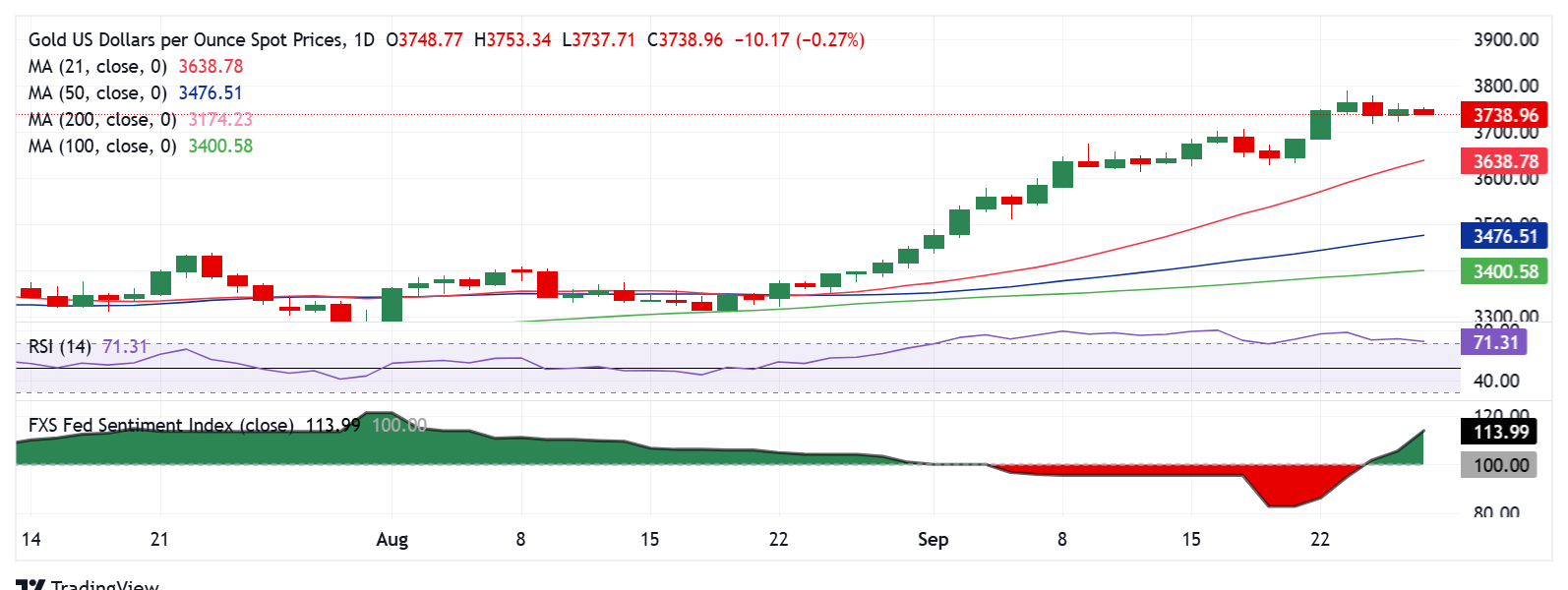
Technically, the bearish pressures seem to have eased a bit as the 14-day Relative Strength Index (RSI) moves out of the extreme overbought region.
The leading indicator currently trades at 71.50, down from 78 levels seen at the start of the week.
If the pullback regains momentum, the initial support is seen at the $3,700 threshold, below which Monday’s low of $3,684 will offer some comfort.
Further down, the $3,650 psychological barrier could come to the rescue of buyers.
On the other hand, buyers need acceptance above the $3,750 psychological level to revive the record rally.
The next topside hurdle is located at the lifetime high of $3,791, followed by the $3,800 barrier.
A sustained and decisive break above the latter could fuel a fresh advance toward the $3,850 psychological level.
Inflation FAQs
Inflation measures the rise in the price of a representative basket of goods and services. Headline inflation is usually expressed as a percentage change on a month-on-month (MoM) and year-on-year (YoY) basis. Core inflation excludes more volatile elements such as food and fuel which can fluctuate because of geopolitical and seasonal factors. Core inflation is the figure economists focus on and is the level targeted by central banks, which are mandated to keep inflation at a manageable level, usually around 2%.
The Consumer Price Index (CPI) measures the change in prices of a basket of goods and services over a period of time. It is usually expressed as a percentage change on a month-on-month (MoM) and year-on-year (YoY) basis. Core CPI is the figure targeted by central banks as it excludes volatile food and fuel inputs. When Core CPI rises above 2% it usually results in higher interest rates and vice versa when it falls below 2%. Since higher interest rates are positive for a currency, higher inflation usually results in a stronger currency. The opposite is true when inflation falls.
Although it may seem counter-intuitive, high inflation in a country pushes up the value of its currency and vice versa for lower inflation. This is because the central bank will normally raise interest rates to combat the higher inflation, which attract more global capital inflows from investors looking for a lucrative place to park their money.
Formerly, Gold was the asset investors turned to in times of high inflation because it preserved its value, and whilst investors will often still buy Gold for its safe-haven properties in times of extreme market turmoil, this is not the case most of the time. This is because when inflation is high, central banks will put up interest rates to combat it. Higher interest rates are negative for Gold because they increase the opportunity-cost of holding Gold vis-a-vis an interest-bearing asset or placing the money in a cash deposit account. On the flipside, lower inflation tends to be positive for Gold as it brings interest rates down, making the bright metal a more viable investment alternative.
Author

Dhwani Mehta
FXStreet
Residing in Mumbai (India), Dhwani is a Senior Analyst and Manager of the Asian session at FXStreet. She has over 10 years of experience in analyzing and covering the global financial markets, with specialization in Forex and commodities markets.