Gold price forecast: Will tariffs and ETF demand drive XAU/USD higher?
- Gold prices faced resistance despite tariff threats, failing to reach previous highs.
- Gold ETFs saw their largest single-day increase since 2022, indicating strong demand.
- US economic data had a short-term impact on prices, but haven demand remains elevated.

Gold prices failed in their attempt to print a fresh weekly high today despite the latest tariff threats by US President Donald Trump. Markets rallied to peak just above the $3030/oz but fell short of yesterday's highs around $3036/oz.
ETF flows record largest daily increase since 2022
In last week's Gold article titled Gold Price Outlook: ETF Flows, Central Bank Buying, and XAU/USD Price Targets , we did take a look at Gold ETF flows. This is now back in focus following a significant uptick in ETF flows yesterday.
Gold exchange-traded funds (ETFs) added 23 tonnes of gold in a single trading session, marking the largest one-day increase since 2022. During the first quarter of 2025, gold-backed ETFs have gained around 155 tonnes overall, pushing total holdings to their highest level since September 2023. If this pace continues, it could also play a role in supporting higher gold prices.
As mentioned last week, despite the significant inflows this year current holdings still remain below the record levels reached in 2020. This leaves the door open for further additions which at this stage cannot be ruled.
Uncertainty surrounding US President Trump’s trade policies remains a key factor, and concerns over trade and tariffs are likely to keep boosting gold prices and keep demand elevated.
Tariff talk and US data
Gold benefitted earlier in the day after United States (US) President Donald Trump mentioned on Tuesday that Copper tariffs will be implemented in the coming weeks, which is far sooner than markets were anticipating.
US data followed in the US session and saw Gold prices drop back below the $3020/oz handle.
Orders for durable goods made in the US went up by $2.7 billion, or 0.9%, in February 2025 compared to the previous month. This followed a bigger-than-expected rise of 3.3% in January and surprised analysts who had predicted a 1% drop. The total value of orders reached $289.3 billion.
The positive data helped the US Dollar and seemed to weigh on Gold prices. However as i have said over the past few weeks, data releases appear to be having short-term effects on the Gold price in particular with haven demand remaining elevated.
This trend is likely to continue with US PCE data on Friday. Is there a chance of a pullback in Gold prices? The answer is yes, most definitely. However, any such move may prove short-lived and present an opportunity for buyers to join the trend once more.
Technical analysis - Gold (XAU/USD)
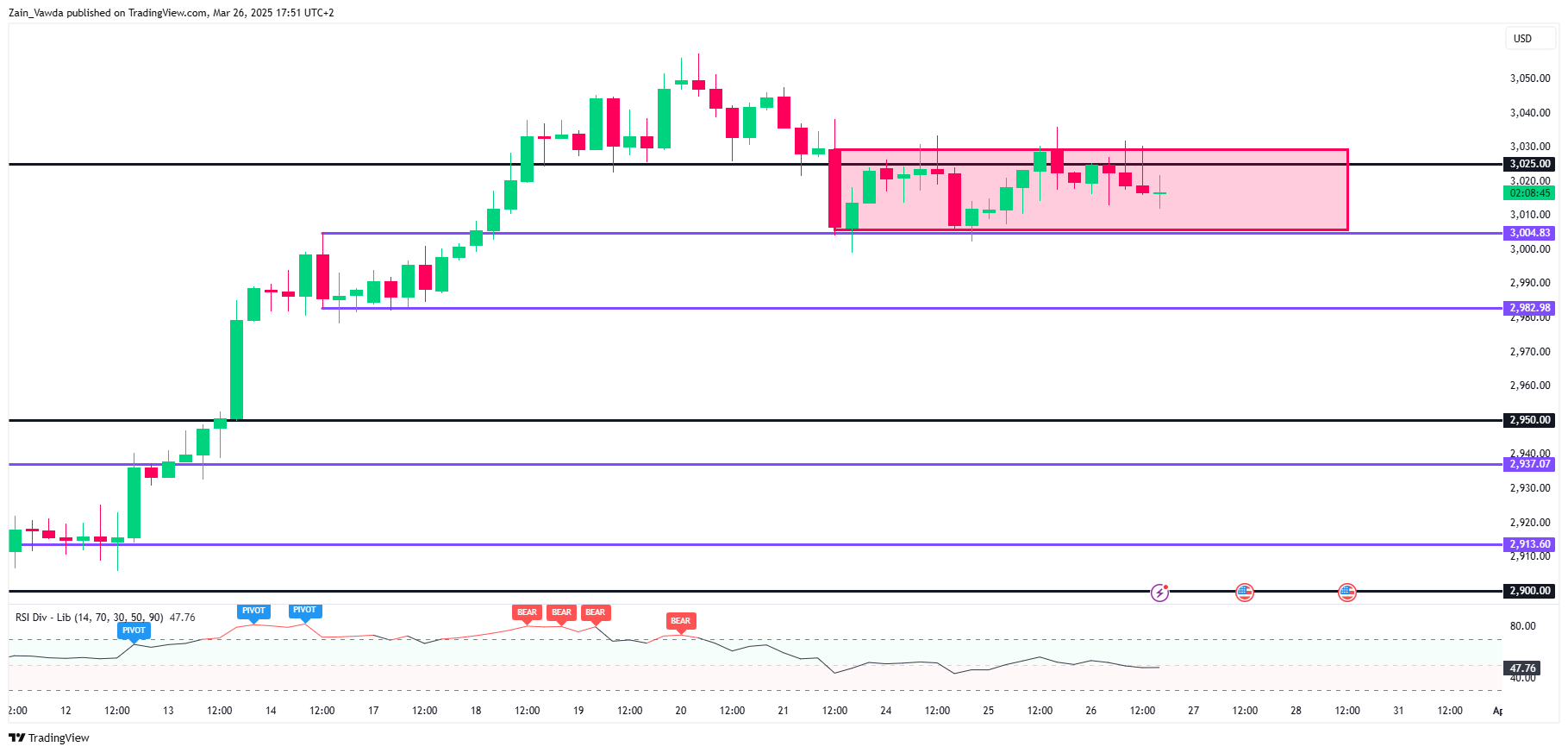
From a technical analysis standpoint, Gold prices have failed to record a daily candle close above the 3025 resistance handle since Monday.
This does leave the precious metal vulnerable to further downside but this has been limited so far.
Looking at the four-hour chart (H4) below, Gold does appear to be rangebound between the 3004 and 3030 handles respectively.
A four-hour candle close above or below this block of consolidation could lead to a sharp move for Gold prices.
Immediate support rests at 2982 and 2950 if the lows at 3004 are breached.
On the upside immediate resistance rests in the 3025-3030 range before the 3050 and 3075 handles come into focus.
Gold (XAU/USD) Four-Hour Chart, March 26, 2025
Support
- 3004
- 2982
- 2950
Resistance
- 3025
- 3050
- 3075
Author

Zain Vawda
MarketPulse
Zain is a seasoned financial markets analyst and educator with expertise in retail forex, economics, and market analysis.