Gold Price Forecast: Tide turns in favor of XAU/USD buyers on rising tariff tensions
- Gold rises for the third straight day and looks to book weekly gains on Friday.
- The US Dollar rebounds sharply as President Trump announces new tariffs and fuels trade war fears.
- Gold price regains 50-day SMA as the daily RSI climbs back above the midline.

Gold price remains on track for weekly gains, extending its recovery into a third consecutive day on Friday. Traders keep an eye on trade developments amid a data-quiet US calendar ahead.
Gold price eyes more upside as trade war fears return
The safe-haven flows resurface in Asian trading on Friday as markets turn cautious following US President Trump’s announcements on the tariff front.
To begin with, Trump threatened a 35% tariff rate for goods imported from Canada, starting August 1.
He also announced more tariffs and said he planned to impose blanket levies of 15% or 20% on most trade partners.
Late Thursday, the President said the European Union (EU) could receive a letter on tariff rates by Friday, squashing the optimism over the progress of trade talks between Washington and the old continent.
Signs of instability in Trump’s trade policies sag investors’ confidence yet again, reviving the haven demand for the US Dollar (USD) and Gold price.
However, Gold buyers remain undeterred by the USD resurgence as traders also remain unnerved ahead of next week’s US Consumer Price Index (CPI) data release, which could offer fresh hints on the scope and timing of the interest rate cuts by the Federal Reserve (Fed).
In the absence of any top-tier US economic data, markets will continue monitoring trade headlines for any retaliatory tariffs from the US’ major trading partners.
The end-of-the-week flows and pre-US CPI repositioning could also drive the Gold price action.
Gold price technical analysis: Daily chart
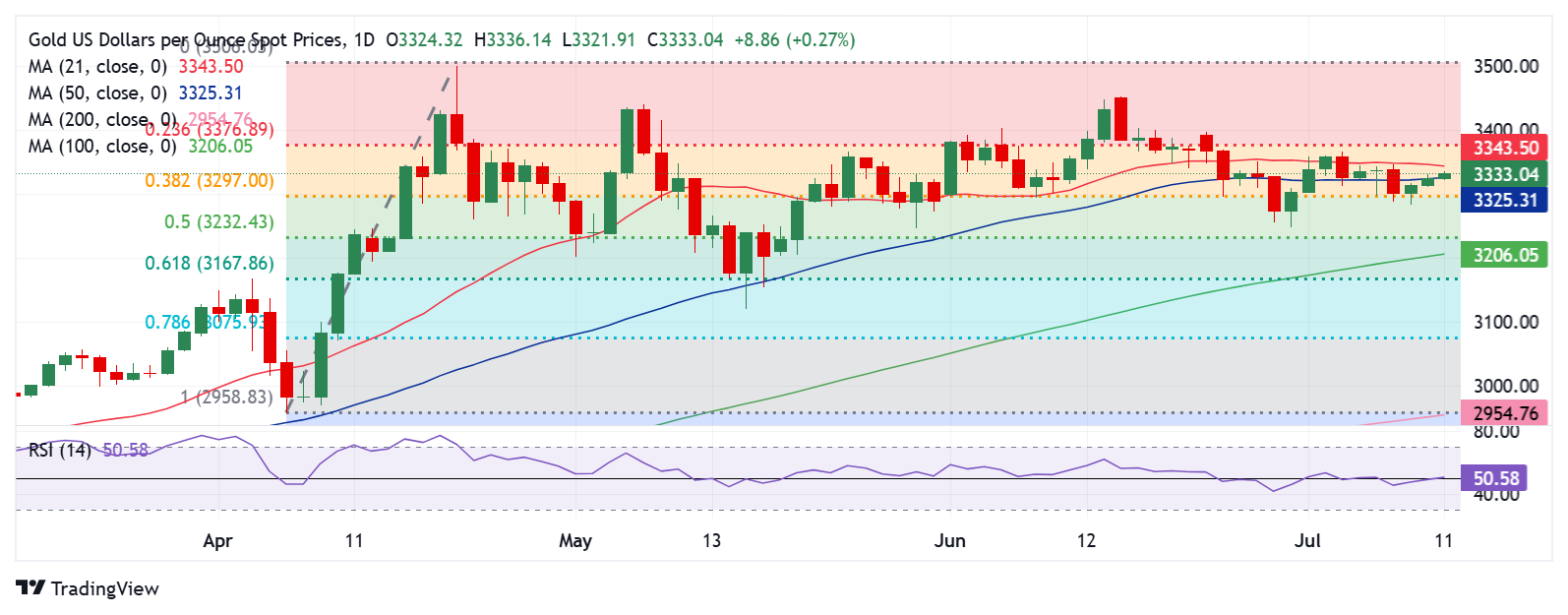
Gold price is building on the bounce from the critical 38.2% Fibonacci Retracement (Fibo) level of the April record rally at $3,297 early Friday, recapturing the 50-day Simple Moving Average (SMA) at $3,325.
The 14-day Relative Strength Index (RSI) has also pierced above the midline, currently near 50.50, indicating a positive shift in sentiment around the bright metal.
Buyers need a daily candlestick closing above the 50-day SMA at $3,323 to take on the 21-day SMA at $3,344.
Further up, the 23.6% Fibo level of the same advance at $3,377 could offer stiff resistance to Gold buyers.
However, a failure to settle Friday above the 50-day SMA will likely reinforce selling pressure, sending Gold price back to test the 38.2% Fibo support at $3,297.
Acceptance under that level could accelerate declines toward the monthly low of $3,248.
Gold FAQs
Gold has played a key role in human’s history as it has been widely used as a store of value and medium of exchange. Currently, apart from its shine and usage for jewelry, the precious metal is widely seen as a safe-haven asset, meaning that it is considered a good investment during turbulent times. Gold is also widely seen as a hedge against inflation and against depreciating currencies as it doesn’t rely on any specific issuer or government.
Central banks are the biggest Gold holders. In their aim to support their currencies in turbulent times, central banks tend to diversify their reserves and buy Gold to improve the perceived strength of the economy and the currency. High Gold reserves can be a source of trust for a country’s solvency. Central banks added 1,136 tonnes of Gold worth around $70 billion to their reserves in 2022, according to data from the World Gold Council. This is the highest yearly purchase since records began. Central banks from emerging economies such as China, India and Turkey are quickly increasing their Gold reserves.
Gold has an inverse correlation with the US Dollar and US Treasuries, which are both major reserve and safe-haven assets. When the Dollar depreciates, Gold tends to rise, enabling investors and central banks to diversify their assets in turbulent times. Gold is also inversely correlated with risk assets. A rally in the stock market tends to weaken Gold price, while sell-offs in riskier markets tend to favor the precious metal.
The price can move due to a wide range of factors. Geopolitical instability or fears of a deep recession can quickly make Gold price escalate due to its safe-haven status. As a yield-less asset, Gold tends to rise with lower interest rates, while higher cost of money usually weighs down on the yellow metal. Still, most moves depend on how the US Dollar (USD) behaves as the asset is priced in dollars (XAU/USD). A strong Dollar tends to keep the price of Gold controlled, whereas a weaker Dollar is likely to push Gold prices up.
Premium
You have reached your limit of 3 free articles for this month.
Start your subscription and get access to all our original articles.
Author

Dhwani Mehta
FXStreet
Residing in Mumbai (India), Dhwani is a Senior Analyst and Manager of the Asian session at FXStreet. She has over 10 years of experience in analyzing and covering the global financial markets, with specialization in Forex and commodities markets.