Gold Price Forecast: The XAU/USD record rally remains uninterrupted, where next?
- Gold’s record rally remains uninterrupted so far this Thursday, as $4,250 appears within reach.
- Safe-haven flows and a broadly weaker US Dollar keep pushing Gold northward.
- Gold closed Wednesday above the upper boundary of a rising channel on the daily chart; RSI remains heavily overbought.
Gold maintains its record-setting advance early Thursday, after having settled Wednesday above the $4,200 threshold.
Gold could see some profit-taking ahead of Fedspeak
Amidst sustained US Dollar (USD) weakness and persistent demand for safe havens, Gold – a traditional store of value - extends its record run into the fourth consecutive day on Thursday.
Gold buyers remain defiant as the ongoing trade spat between the United States (US) and China keeps investors on edge, while uncertainty over the US economic prospects in the face of the government shutdown also dent the sentiment around the Greenback.
US Trade Representative Jamieson Greer on Wednesday said that “China's export restrictions were a "global supply-chain power grab" and the US and its allies would not accept the restrictions,” per Reuters.
Meanwhile, a US Treasury official noted that the government shutdown could cost the economy $15 billion per week.
Furthermore, markets’ affirmation of two Federal Reserve (Fed) interest rate cuts this year and concerns about the US labor market amongst the Fed officials bolster the non-yielding Gold at the expense of the buck.
Markets continue to price in roughly 95% probabilities of rate cuts at the Fed’s October and December monetary policy meetings, the CME Group’s FedWatch Tool shows.
Looking ahead, speeches from Fed policymakers remain of note in the absence of high-impact US economic releases.
Meanwhile, US-China trade developments and shutdown talks could be closely eyed for further trading incentives in Gold.
Gold price technical analysis: Daily chart
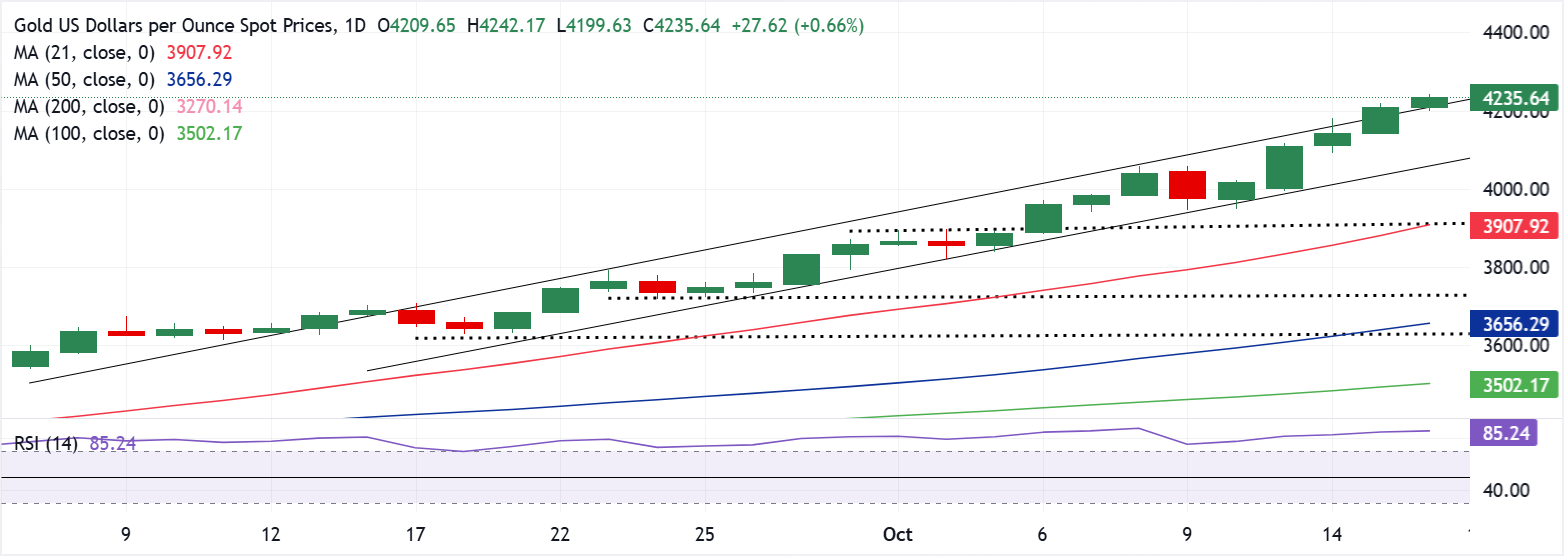
The short-term technical outlook for Gold remains more or less the same, with the ‘hot run’ triggering timely bouts of profit-taking, justified by the 14-day Relative Strength Index (RSI) lurking within the extreme overbought zone, currently near 85.
Meanwhile, Gold settled on Wednesday above the upper boundary of the month-long rising channel, then at $4,184.
However, it remains to be seen if the uptrend sustains, as the natural tendency of the rising channel formation is a break to the downside.
As buyers seem unstoppable for now, the $4,250 psychological level will be next on tap, above which doors will open toward $4,300.
Conversely, rejection at higher levels could trigger a pullback toward the channel support at $4,062.
Ahead of that, the previous day’s low of $4,140 could lend temporary support to buyers.
US-China Trade War FAQs
Generally speaking, a trade war is an economic conflict between two or more countries due to extreme protectionism on one end. It implies the creation of trade barriers, such as tariffs, which result in counter-barriers, escalating import costs, and hence the cost of living.
An economic conflict between the United States (US) and China began early in 2018, when President Donald Trump set trade barriers on China, claiming unfair commercial practices and intellectual property theft from the Asian giant. China took retaliatory action, imposing tariffs on multiple US goods, such as automobiles and soybeans. Tensions escalated until the two countries signed the US-China Phase One trade deal in January 2020. The agreement required structural reforms and other changes to China’s economic and trade regime and pretended to restore stability and trust between the two nations. However, the Coronavirus pandemic took the focus out of the conflict. Yet, it is worth mentioning that President Joe Biden, who took office after Trump, kept tariffs in place and even added some additional levies.
The return of Donald Trump to the White House as the 47th US President has sparked a fresh wave of tensions between the two countries. During the 2024 election campaign, Trump pledged to impose 60% tariffs on China once he returned to office, which he did on January 20, 2025. With Trump back, the US-China trade war is meant to resume where it was left, with tit-for-tat policies affecting the global economic landscape amid disruptions in global supply chains, resulting in a reduction in spending, particularly investment, and directly feeding into the Consumer Price Index inflation.
Author

Dhwani Mehta
FXStreet
Residing in Mumbai (India), Dhwani is a Senior Analyst and Manager of the Asian session at FXStreet. She has over 10 years of experience in analyzing and covering the global financial markets, with specialization in Forex and commodities markets.
















