Gold Price Forecast: Strong recovery might face roadblock as oil price extends gains
- Gold price recovers further to near $4,140, extending its winning streak for the third trading day.
- Rising oil prices due to escalating energy supply disruption fears could derail Gold’s recovery.
- The ECB is expected to leave policy rates unchanged on Thursday.

Gold price (XAU/USD) extends its winning streak for the third trading day on Wednesday, trading 1.5% higher to near $4,140 during the Asian session. The precious metal recovered strongly in the past few trading days from its three-week low of $3,959.80 as traders scaled back Federal Reserve’s (Fed) interest rate hike expectations for the monetary policy meeting next week.
The scenario of traders trimming hawkish Fed bets bodes poorly for interest-bearing assets, which eventually improves the appeal of non-yielding assets, such as Gold.
However, Gold’s recent rebound could be derailed as oil prices have extended their gains due to intensifying fears of global energy supply disruption.
On Tuesday, two oil tankers carrying Saudi crude to Asia reversed course in the Red Sea after threats from Yemen's Iran-aligned Houthis, Reuters reports. The closure of Bab el-Mandeb Strait, a vital passage to the Red Sea, at a time when the route of the Strait of Hormuz is already hijacked, has escalated fears of further supply disruption.
Higher energy prices have de-anchored inflation expectations again, a scenario that could force global central banks to tighten their monetary conditions further.
Meanwhile, hopes of diplomacy between the US and Iran remain alive, as Iran's Interior Minister Eskandar Momeni visited mediator Pakistan and asked Islamabad to continue its efforts.
This week, investors will pay close attention to the European Central Bank’s (ECB) monetary policy announcement on Thursday, in which the central bank is expected to leave interest rates unchanged. Investors will closely listen to the monetary policy statement and ECB President Christine Lagarde’s press conference to get fresh cues regarding whether there could be second-round effects of inflation in the near term
Gold technical analysis
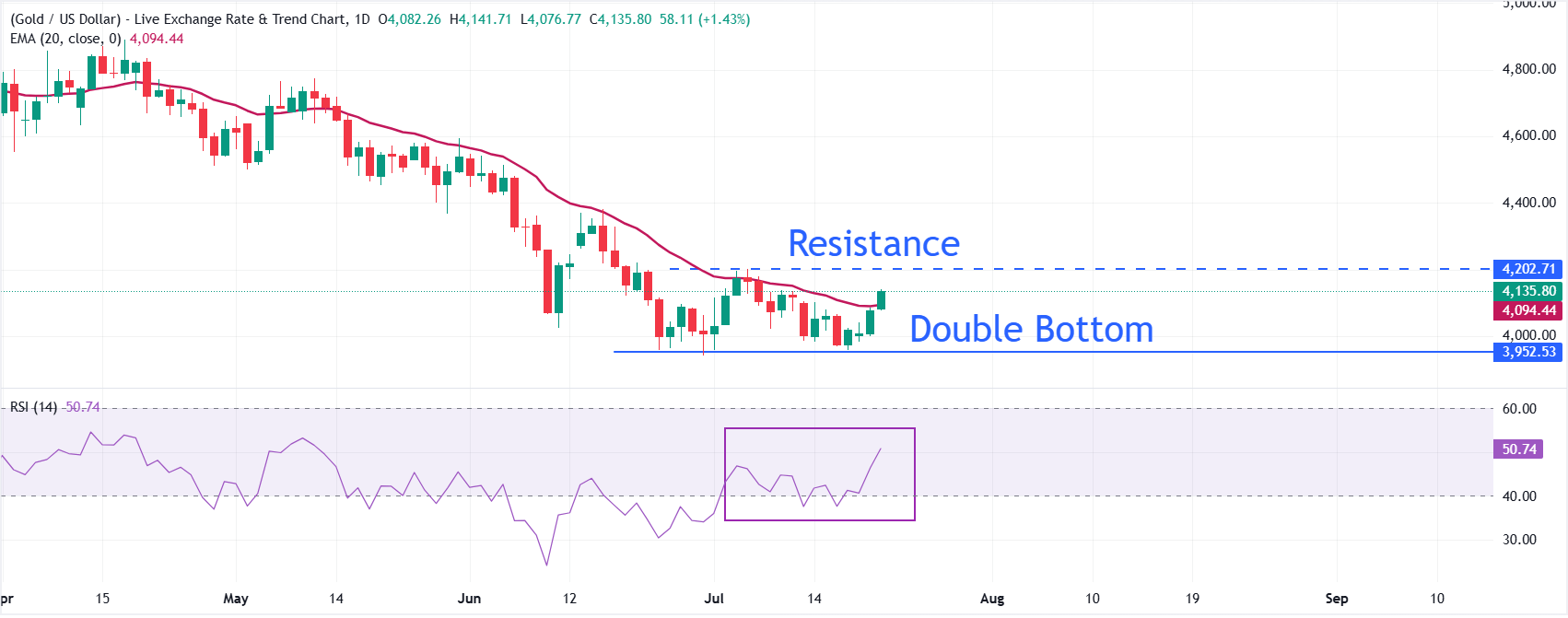
XAU/USD trades higher at around $4,135.20 at press time. The metal extends its recovery above the 20-period exponential moving average (EMA) at $4,094.38, reinforcing a mildly bullish near-term bias as price remains supported by this dynamic trend floor. The yellow metal recovered strongly after attracting significant bids while revisiting its key lows around $3,950.
Momentum is stabilizing, with the Relative Strength Index (RSI) at 50.70, hinting that selling pressure has faded without yet reaching overbought territory.
On the downside, initial support is seen at the 20-period EMA at $4,094.38, followed by the June 30 low at $3,941.76. Looking up, a decisive move above the July 6 high at $4,202.61 will result in a breakout of the Double Bottom formation. Such a scenario would strengthen the odds of a bullish reversal and open the room for further upside towards $4,300.
(The technical analysis of this story was written with the help of an AI tool. Know more.)
Gold FAQs
Gold has played a key role in human’s history as it has been widely used as a store of value and medium of exchange. Currently, apart from its shine and usage for jewelry, the precious metal is widely seen as a safe-haven asset, meaning that it is considered a good investment during turbulent times. Gold is also widely seen as a hedge against inflation and against depreciating currencies as it doesn’t rely on any specific issuer or government.
Central banks are the biggest Gold holders. In their aim to support their currencies in turbulent times, central banks tend to diversify their reserves and buy Gold to improve the perceived strength of the economy and the currency. High Gold reserves can be a source of trust for a country’s solvency. Central banks added 1,136 tonnes of Gold worth around $70 billion to their reserves in 2022, according to data from the World Gold Council. This is the highest yearly purchase since records began. Central banks from emerging economies such as China, India and Turkey are quickly increasing their Gold reserves.
Gold has an inverse correlation with the US Dollar and US Treasuries, which are both major reserve and safe-haven assets. When the Dollar depreciates, Gold tends to rise, enabling investors and central banks to diversify their assets in turbulent times. Gold is also inversely correlated with risk assets. A rally in the stock market tends to weaken Gold price, while sell-offs in riskier markets tend to favor the precious metal.
The price can move due to a wide range of factors. Geopolitical instability or fears of a deep recession can quickly make Gold price escalate due to its safe-haven status. As a yield-less asset, Gold tends to rise with lower interest rates, while higher cost of money usually weighs down on the yellow metal. Still, most moves depend on how the US Dollar (USD) behaves as the asset is priced in dollars (XAU/USD). A strong Dollar tends to keep the price of Gold controlled, whereas a weaker Dollar is likely to push Gold prices up.
Author

Sagar Dua
FXStreet
Sagar Dua is associated with the financial markets from his college days. Along with pursuing post-graduation in Commerce in 2014, he started his markets training with chart analysis.