Gold Price Forecast: Risk aversion keeps XAU/USD afloat

XAU/USD Current price: $2,339.50
- The US Consumer Price Index was up by more than anticipated in March.
- Risk aversion took over financial markets as US CPI backs Fed’s stance on monetary policy.
- XAU/USD corrects extreme overbought conditions but could still extend gains.
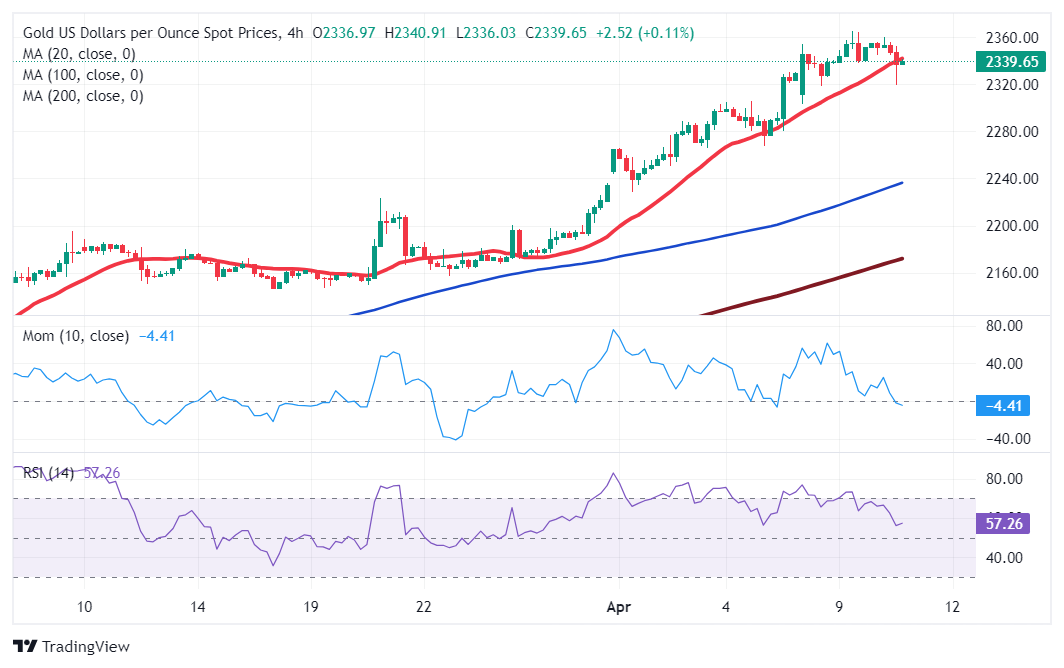
Spot Gold shed some ground on Wednesday as the US Dollar got an unexpected boost from risk aversion XAU/USD losses, however, are modest compared to other USD rivals, as Gold benefited from its safe-haven condition.
Hell broke loose when the United States (US) reported stubbornly high March inflation. According to the Bureau of Labor Statistics (BLS), the Consumer Price Index (CPI) rose by 0.4% MoM and 3.5% YoY, surpassing expectations and ticking higher from February. Core annual inflation was up by 3.8%, matching February’s figure but above the 3.7% expected. The news sent the USD skyrocketing amid risk aversion, as the figures backed the Federal Reserve (Fed) case of keeping interest rates higher for longer.
Wall Street plummeted, while government bond yields soared to fresh multi-week highs as market players anticipate two rate cuts in the US. Furthermore, the odds of the first cut taking place in July are growing.
The Fed is about to publish the Federal Open Market Committee (FOMC) meeting minutes, but this now seems old news and would likely have a limited impact on the USD price. More relevantly, the US will publish the March Producer Price Index (PPI) on Thursday, while the European Central Bank (ECB) will announce its decision on monetary policy at the same time.
XAU/USD short-term technical outlook
The daily chart for XAU/USD shows it is correcting extreme overbought conditions, and there is room for additional slides, albeit would still be considered corrective. Technical indicators held within extreme readings while the pair develops above firmly bullish moving averages. The pair bottomed at $2,319.28, with a break below it opening the door for another leg south.
The 4-hour chart shows the pair battling around a firmly bullish 20 Simple Moving Average (SMA) while the longer ones maintain their upward slopes over $100.00 below the current level. At the same time, the Momentum indicator fell sharply but lost its bearish impulse around its 100 level, while the Relative Strength Index (RSI) stabilized around 56, indicating limited selling interest after the dust settled.
Support levels: 2.327.65 2,319.20 2,303.80
Resistance levels: 2,354.70 2,365.25 2,380.00
Author

Valeria Bednarik
FXStreet
Valeria Bednarik was born and lives in Buenos Aires, Argentina. Her passion for math and numbers pushed her into studying economics in her younger years.
















