Gold Price Forecast: Is XAU/USD primed to retest lifetime highs?
- Gold holds the previous bounce from three-day lows, re-attempts $3,650 early Friday.
- US Dollar stalls its recovery from post-Fed plunge, eyes Fedspeak, trade headlines.
- Gold looks to retest record highs as the daily RSI returns to the bullish zone.

Gold is testing offers near $3,650 early Friday, holding Thursday’s late rebound from three-day lows near $3,627.
Gold: On track for fifth straight week of gains
Gold eyes a fifth consecutive weekly gains despite the less dovish-than-expected US Federal Reserve (Fed) policy announcements on Wednesday and Thursday’s encouraging US economic data, which helped the US Dollar (USD) stage a decent recovery.
The Fed lowered interest rates by the expected 25 basis points (bps), while the Summary of Economic Projections (SEP), the so-called Dot Plot chart, showed that the Fed policymakers project two additional rate cuts this year.
However, Fed Chairman Jerome Powell, in his post-policy meeting press conference, adopted a measured rhetoric on further policy easing. Powell called the rate cut a risk management policy action and maintained the bank’s ‘meeting-by-meeting’ stance.
Meanwhile, data on Thursday showed that Initial claims for state unemployment benefits decreased 33,000 to a seasonally adjusted 231,000 for the week ended September 13, partially reversing a surge in the prior week to the highest level since October 2021.
The Philadelphia Federal Reserve Manufacturing Index surged to 23.2 in September, a significant leap from the estimated rebound of 2.3.
The USD’s upswing could also be attributed to a short-covering spree as markets perceived the recent declines as excessive.
Looking ahead, Gold could build on the rebound if the recent bullish momentum in the USD loses steam. However, the renewed US-China trade optimism could remain supportive of the Greenback, capping Gold’s move higher.
Additionally, Gold could also be influenced by the USD dynamics, induced by the USD/JPY pair in the aftermath of the no rate change decision expected by the Bank of Japan (BoJ) this Friday.
In the absence of top-tier US data releases, trade updates and broader market sentiment will play a pivotal role in Gold price action.
Gold price technical analysis: Daily chart
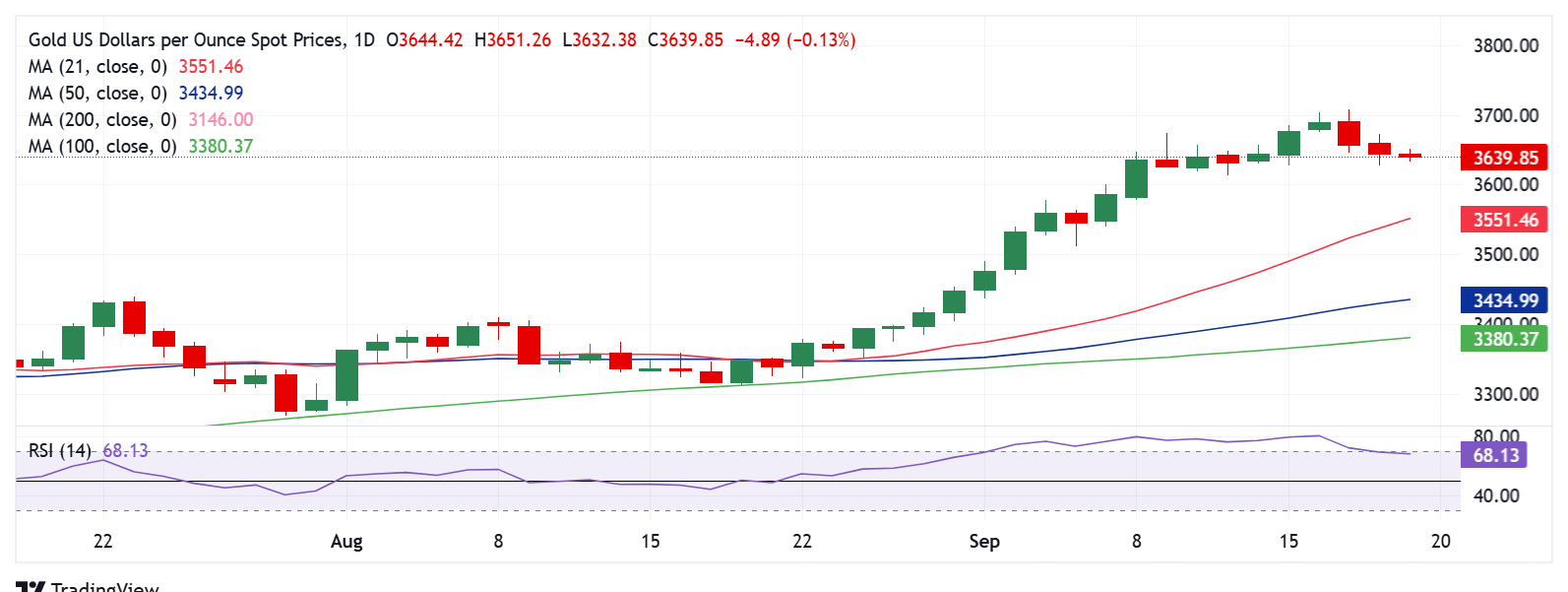
The daily chart shows that the 14-day Relative Strength Index (RSI) has finally eased from the overbought region, returning to the bullish zone.
If dip-buying emerges and gathers strength, Gold could retest the record high at $3,708. A daily candlestick closing above that level will open doors toward the $3,750 region.
The immediate resistance, however, is seen at the $3,650 level.
Alternatively, Gold could challenge this week’s low at $3,627 yet again if the corrective decline picks up.
Further down, the $3,600 round figure will be tested, below which the previous week’s low of $3,578 will be next on sellers’ radars.
Gold FAQs
Gold has played a key role in human’s history as it has been widely used as a store of value and medium of exchange. Currently, apart from its shine and usage for jewelry, the precious metal is widely seen as a safe-haven asset, meaning that it is considered a good investment during turbulent times. Gold is also widely seen as a hedge against inflation and against depreciating currencies as it doesn’t rely on any specific issuer or government.
Central banks are the biggest Gold holders. In their aim to support their currencies in turbulent times, central banks tend to diversify their reserves and buy Gold to improve the perceived strength of the economy and the currency. High Gold reserves can be a source of trust for a country’s solvency. Central banks added 1,136 tonnes of Gold worth around $70 billion to their reserves in 2022, according to data from the World Gold Council. This is the highest yearly purchase since records began. Central banks from emerging economies such as China, India and Turkey are quickly increasing their Gold reserves.
Gold has an inverse correlation with the US Dollar and US Treasuries, which are both major reserve and safe-haven assets. When the Dollar depreciates, Gold tends to rise, enabling investors and central banks to diversify their assets in turbulent times. Gold is also inversely correlated with risk assets. A rally in the stock market tends to weaken Gold price, while sell-offs in riskier markets tend to favor the precious metal.
The price can move due to a wide range of factors. Geopolitical instability or fears of a deep recession can quickly make Gold price escalate due to its safe-haven status. As a yield-less asset, Gold tends to rise with lower interest rates, while higher cost of money usually weighs down on the yellow metal. Still, most moves depend on how the US Dollar (USD) behaves as the asset is priced in dollars (XAU/USD). A strong Dollar tends to keep the price of Gold controlled, whereas a weaker Dollar is likely to push Gold prices up.
Author

Dhwani Mehta
FXStreet
Residing in Mumbai (India), Dhwani is a Senior Analyst and Manager of the Asian session at FXStreet. She has over 10 years of experience in analyzing and covering the global financial markets, with specialization in Forex and commodities markets.