Gold Price Forecast: ‘Buy the dips’ in XAU/USD, as focus shifts to Fedspeak, US data
- Gold price reverses the two-day rebound, as traders turn cautious ahead of Fedsepak, US data.
- US Dollar holds firm even as US Treasury yields struggle, as dour mood stays supportive.
- Gold price appears a good dip-buying trade whilst above the $2,147 confluence support.

Gold price has returned to the red near $2,170 early Wednesday, notwithstanding Tuesday’s uptick to the $2,200 level. The US Dollar (USD) consolidates the previous rebound even though the US Treasury bond yields struggle amidst souring market sentiment.
Gold price turns south after facing rejection at $2,200
The US Dollar has found its lost footing midweek, as markets turn cautious ahead of a bunch of key US economic data in the holiday-shortened week. Asian traders tracked the negative sentiment on Wall Street overnight, shrugging off strong Chinese Industrial Profits data and softer Australian Consumer Price Index (CPI) report.
US indices wiped out gains in the final half hour of trading, as investors tweaked their portfolios after a rally that’s already topped $4 trillion this year. Further, investors stay wary ahead of the quarter-end and the high-anticipated meeting between China’s President Xi Jinping and the US business leaders.
The reduced appetite for risk assets boosts the safe-haven flows into the US Dollar, fuelling a fresh leg down in the Gold price.
However, the downside in Gold price appears cushioned, as the US Treasury bond yields struggle to maintain the upside traction amid sustained bets of a June Federal Reserve (Fed) interest rate cuts. Markets are paying little heed to the recent hawkish commentary from Fed officials, as they expect a 70% probability of the Fed lowering rates in June.
The dovish Fed outlook combined with persisting geopolitical tensions continues to act as a tailwind for the non-yielding Gold price. Russia attacked Ukraine's capital Kyiv with hypersonic missiles on Monday morning. Further, top Russian officials have directly accused Ukraine and the West of being involved in the deadly Moscow concert hall attack, after it was claimed by the Islamic State (IS) group.
Next of note for the bright metal remains the speech by Fed Governor Christoper Waller later on Wednesday. Waller is due to speak about monetary policy at the Economic Club of New York. His responses to media questions on the interest rate outlook will hold the key for a fresh directional move in Gold price.
Gold traders will also position for Thursday’s final Gross Domestic Product (GDP) estimate from the US alongside the weekly Jobless Claims and Personal Spending data. Meanwhile, the US PCE Price Index data due on Friday will likely emerge as the main event risk of this week.
Gold price technical analysis: Daily chart
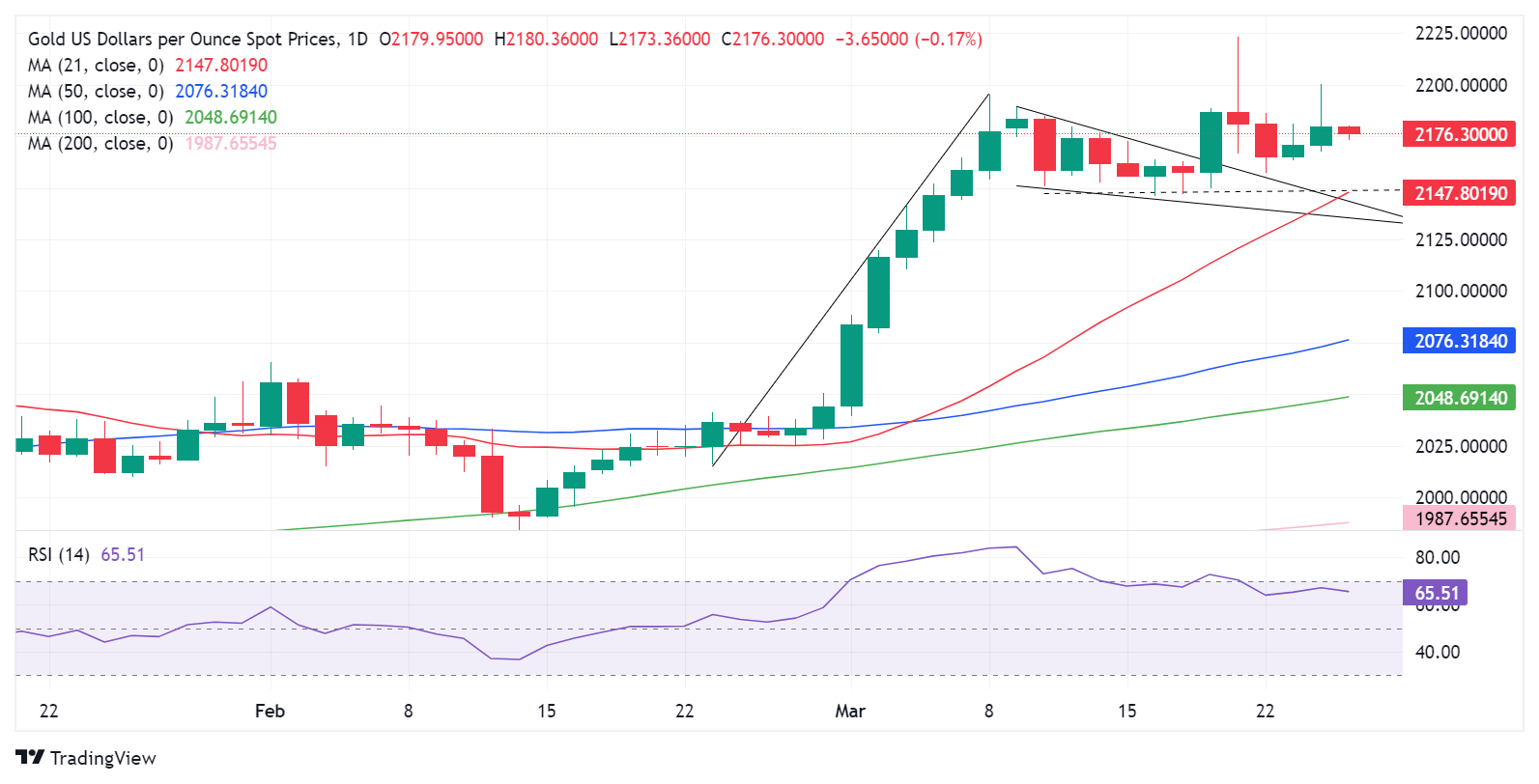
The short-term technical outlook for Gold price remains constructive with every dip seen as a good buying opportunity for traders.
With a Bull Flag in play, Gold price remains on track to test the measured target at $2,251 should the uptrend regain momentum.
Before that level, Gold price needs to recapture the $2,200 threshold on a sustained basis. The record high at $2,223 will be next on buyers’ radars.
The 14-day Relative Strength Index (RSI), is pointing lower while within the positive territory, suggesting ‘buy-the-dip’ trades remain in the offing for Gold price.
Alternatively, immediate support is seen at Friday’s low of $2,157, below which the $2,050 psychological level will be retested.
Further down, the $2,147 support will be a tough nut to crack for Gold sellers. That level is the confluence of the Bull Flag resistance at $2,151, bullish 21-day Simple Moving Average (SMA) and the previous week’s lower range.
Gold FAQs
Gold has played a key role in human’s history as it has been widely used as a store of value and medium of exchange. Currently, apart from its shine and usage for jewelry, the precious metal is widely seen as a safe-haven asset, meaning that it is considered a good investment during turbulent times. Gold is also widely seen as a hedge against inflation and against depreciating currencies as it doesn’t rely on any specific issuer or government.
Central banks are the biggest Gold holders. In their aim to support their currencies in turbulent times, central banks tend to diversify their reserves and buy Gold to improve the perceived strength of the economy and the currency. High Gold reserves can be a source of trust for a country’s solvency. Central banks added 1,136 tonnes of Gold worth around $70 billion to their reserves in 2022, according to data from the World Gold Council. This is the highest yearly purchase since records began. Central banks from emerging economies such as China, India and Turkey are quickly increasing their Gold reserves.
Gold has an inverse correlation with the US Dollar and US Treasuries, which are both major reserve and safe-haven assets. When the Dollar depreciates, Gold tends to rise, enabling investors and central banks to diversify their assets in turbulent times. Gold is also inversely correlated with risk assets. A rally in the stock market tends to weaken Gold price, while sell-offs in riskier markets tend to favor the precious metal.
The price can move due to a wide range of factors. Geopolitical instability or fears of a deep recession can quickly make Gold price escalate due to its safe-haven status. As a yield-less asset, Gold tends to rise with lower interest rates, while higher cost of money usually weighs down on the yellow metal. Still, most moves depend on how the US Dollar (USD) behaves as the asset is priced in dollars (XAU/USD). A strong Dollar tends to keep the price of Gold controlled, whereas a weaker Dollar is likely to push Gold prices up.
Author

Dhwani Mehta
FXStreet
Residing in Mumbai (India), Dhwani is a Senior Analyst and Manager of the Asian session at FXStreet. She has over 10 years of experience in analyzing and covering the global financial markets, with specialization in Forex and commodities markets.