Gold near $5,000, Silver’s surge, and the $350T debt bomb

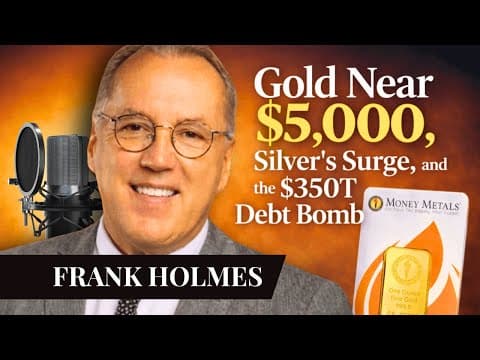
In a recent episode of the Money Metals podcast, host Mike Maharrey sat down with Frank Holmes, Chief Investment Officer at U.S. Global Investors and Executive Chairman of Hive Digital Technologies, to unpack why gold is now “knocking on the door” of $5,000 an ounce and why silver is increasingly being treated like a strategic metal.
Holmes said he’s not surprised by the speed of gold’s rise among precious metals. He argued the world is “reliquefying,” with U.S. rates still looking like they could come down by more than 150 basis points, and with political pressure building for easier monetary conditions that push mortgage rates lower.
He tied that directly to housing, calling it the biggest multiplier in the economy. In his telling, $1 spent on housing can multiply to $12, compared to $4 for government projects, making housing a key lever for job creation and economic ignition.
The $350 trillion problem behind the Gold move
Frank Holmes put the gold story in blunt macro terms. He said total global debt is about $350 trillion, while the global economy is around $120 trillion, meaning debt is more than three times world GDP.
He argued the G20 continues using money-printing approaches faster than GDP growth, increasing the appeal of “alternative assets such as gold and silver.” He added a real-world signal that people can feel: the disappearance of low-value coinage and the growing friction of cash transactions.
Holmes noted the end of pennies and said it’s been decades since a penny had a penny’s worth of copper in it. He suggested nickels, dimes, and quarters could be next, describing stores that are “out of pennies and quarters,” pushing customers toward card-only payments.
He described this as an inflection point, like ice suddenly giving way when temperatures move from 31 degrees to 33 degrees.
Currency war, BRICS expansion, and the fear trade
Holmes argued the gold and silver run isn’t driven by one headline. He described multiple geopolitical and monetary forces moving in parallel, including what he called a currency war and the weaponization of the BRICS bloc.
He pointed out that BRICS was once five countries and is now “what, 15,” and he framed the bloc as increasingly tied to commodity exporters and trade strategies that pressure America’s influence.
In his view, these tensions feed the “fear trade,” creating the sense that something bigger is shifting under the surface. Greenland and tariffs may dominate headlines, he said, but they’re the “tip of the iceberg” compared to deeper multipolar dynamics.
Silver becomes a strategic metal
Holmes repeatedly returned to silver’s changing role. He said that the precious metal silver isn’t only tied to solar panels anymore. It’s now directly linked to weaponry and national security supply chains, which he argued elevates it into a strategic category.
He connected this to a broader shift in debt spending. Money printing, he said, is no longer mainly about European social welfare programs. It’s increasingly being directed toward national security, rearmament, and rebuilding strategic resilience.
He also referenced Japan’s leadership becoming more openly wary of China, and he described strategic mineral restrictions as a sign of where the conflict pressure is concentrating.
Copper, AI data centers, and the next bottleneck
Holmes pivoted to the AI buildout as another commodity accelerant. He cited what he called the biggest AI data center built in the world, located in Abilene, Texas, and said the build requires massive amounts of copper for conductivity and infrastructure.
He argued copper isn’t just about wiring. It’s embedded in cooling systems, power transfer, and the physical backbone required to move electricity and heat across hyperscale facilities.
He also warned about a new kind of noise hitting the market. He described watching a high-production, AI-generated video packed with dramatic silver narratives and then researching it and finding it was essentially fiction, a Tom Clancy-style story engineered to go viral.
Why Gold is “criminally underinvested” in the West
Maharrey asked Holmes about a claim from his writing, where he said gold is “criminally underinvested.”
Holmes said he’s long pushed a “10% golden rule,” and he cited Ray Dalio as another prominent advocate of 10% exposure, with Dalio at times going to 20% gold. Holmes argued many U.S. advisors still don’t believe in gold and often liquidate it, but that investor demand will eventually force broader participation.
He offered a stark allocation snapshot. In 2012, when Xi Jinping became “dictator for life,” Holmes said about 8% of Americans had exposure to gold. He said that fell to nearly 1%, and today it’s only “a little over 2%,” while tech and healthcare allocations surged.
In that context, Holmes argued gold is not a crowded trade. He expects violent corrections, but he frames pullbacks as buying opportunities given the geopolitical and monetary backdrop.
Gold stocks are acting like growth stocks
Holmes said what’s “really ripping” is gold stocks. He described the sector as deeply undervalued and said many big gold funds saw redemptions last year, even as gold rose and some gold stocks gained 100%.
Now, he said, corrections are being met with net buying rather than capitulation.
He emphasized operating leverage and momentum screens. He gave an example of an Australian gold producer with revenue up 57% and cash flow up 100%, arguing that these kinds of numbers pull gold miners into mainstream growth models.
He said non-specialist investors buy momentum in revenue, cash flow, EBITDA, and free cash flow, and that those buyers don’t care what sector the company is in if the metrics hit.
Gold’s permanent bid: The “love trade” and crisis money
Holmes described a durable buyer in the gold market. He called it the “love trade,” highlighting India and saying Indian women own more than six times the amount of gold in Fort Knox.
He pointed to gold’s portability in times of crisis, referencing people leaving Syria with 24-karat jewelry and recalling that Vietnamese boat people used gold to secure passage out.
For Holmes, the point was simple. Gold can become money fast, it can be worn, and it can be exchanged when legal systems and contracts can’t be trusted.
Price targets: $7,000, $11,000, and $20,000
Asked for a 2026 forecast, Holmes wouldn’t give a precise 12-month call. Instead, he offered valuation frameworks.
Using a rough money supply approach, he said money supply is about $140 trillion, with roughly six billion ounces of known gold, and he said the implied valuation comes out near $20,000 per ounce.
He cited James Turk’s foreign currency model and said Turk’s framework suggests about $11,000.
He then offered his own conservative path. He said $7,000 by the time Trump is retired.
Physical Silver premiums and three tailwinds
Holmes closed by distinguishing futures pricing from physical reality. He said the delivery of silver coins trades at a premium to futures, and that the premium has stayed high for years because there is a shortage of physical silver.
He argued that the silver shortage will worsen because industrial demand for solar remains huge, military demand is rising, and debt spending continues to expand.
Maharrey added that when silver starts moving, investor excitement and FOMO can add momentum on top of fundamentals.
To receive free commentary and analysis on the gold and silver markets, click here to be added to the Money Metals news service.
Author
Joshua D. Glawson
Money Metals Exchange
Joshua D. Glawson is a writer on such topics as philosophy, politics, economics, finance, and personal development. He graduated with a Bachelor in Political Science from the University of California Irvine. His website is JoshuaDGlawson.com.