Gold is not rallying it is replacing faith

Gold did not creep higher. It kicked the door in.
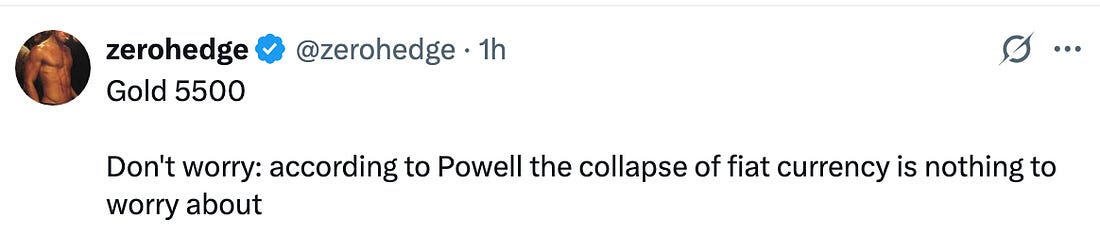
After blowing through $ 5,500 in early Asia, bullion is no longer trading like a commodity. It is trading like a referendum. Not on inflation. Not on rates. On trust.
Gold is not yet pressing north of $ 6,000. What is pressing higher is the narrative ceiling. When prices clear $5500 this decisively, the next leg is no longer spot-driven but expectation-driven. This is the phase in which forecasts begin to chase price rather than guide it. You should expect a flurry of revised calls above $6000 and even $6500 as desks are forced to admit they under-modelled a trade that refused to wait for permission.
This move is not about growth, CPI prints, or whether the Fed trims or holds. Gold is responding to something more structural and more uncomfortable. The slow realization that the anchors of the system are lighter than advertised.
Gold is the inverse of confidence. When belief in policy coherence weakens, gold ceases to behave like a hedge and instead acts as an alternative. That is what we are watching now. This is not fear of recession. There is doubt about fiat stewardship.
The rally has been two years in the making, and prices have more than doubled over that period. But what has changed recently is not the story. It is the participation. This is no longer a central bank-only trade. The private sector has arrived, and it is not renting exposure. It is buying with intent.
Family offices are not trading gold. They are warehousing it. This is not a quarterly allocation tweak. It is balance sheet thinking. When gold becomes a generational insurance asset rather than a tactical hedge, price targets stop acting like ceilings and start behaving like mile markers.
The debasement trade is no longer whispered in macro circles. It has become visible in flows. Investors are not running toward risk. They are stepping away from promises.
ETF inflows tell one half of the story. Eight straight weeks of accumulation. Over 120 tons added. Total holdings now materially higher than a year ago. But the more important shift is sensitivity. The same inflow that once nudged prices now moves markets. Gold is reacting faster because conviction has replaced curiosity.
The other half of the story sits in the plumbing. Official central bank data arrives too late to matter. By the time it prints, the market has already repositioned. That is why traders watch vaults and exports instead of speeches.
When gold piles up in London vaults and exports slow to a crawl, it tells you the metal is being stockpiled, not circulated. A 200+ ton build in LBMA vaults, alongside unusually weak export activity, is not noise. It signals holders who are unwilling to part with inventory at any price that feels transitory.
Nonetheless, when central banks buy, the metal vanishes into deep storage. Those bars get locked in a vault and forgotten, collecting dust for decades.
Silver is telling the same story with more volatility and less patience. ETF inflows have been explosive. Price sensitivity has gone vertical. Physical premiums in China are flashing red. This is not a paper squeeze. It is real demand colliding with thin supply.
Meanwhile, hedge fund positioning is large but not reckless. Options markets are leaning aggressively upside, not because of speculative euphoria, but because nobody wants to stand in front of a confidence trade.
And this is the part that matters. High prices do not cure high prices in gold. Supply does not respond. Mine do not suddenly make supply appear; it's typically a 10-year lag. Rallies end only when demand retreats.
That requires one of three things. A genuine easing in geopolitical risk. A convincing restoration of policy credibility. Or a Fed that tightens from strength rather than necessity.
None of those conditions are visible.
Central bank demand moves in long arcs. Once neutrality is questioned, it stays questioned. Private sector demand fades only when trust is rebuilt, not discussed. And rate hikes only matter if they signal discipline rather than improvisation.
This is why $6000 does not feel extreme. It feels like a clearing price for doubt.
Gold is no longer just a hedge against inflation. It is a hedge against drift. Against fiscal ambiguity. Against systems that ask for patience without offering anchors.
Trust has bent. It has not broken.
Markets always price the bend first.
Author

Stephen Innes
SPI Asset Management
With more than 25 years of experience, Stephen has a deep-seated knowledge of G10 and Asian currency markets as well as precious metal and oil markets.