Gold holds near highs as structural risks outweigh Dollar strength


Gold prices are consolidating near recent highs despite a relatively firm US Dollar, as markets increasingly price structural macro risks rather than simple currency dynamics.
This shift reflects growing focus on systemic macro uncertainty, fiscal sustainability and geopolitical fragmentation. Investors are starting to treat Gold less as a short-term currency trade and more as a strategic macro asset.
The Dollar remains firm, but Gold is not retreating
The US Dollar still matters for Gold price action, but it no longer tells the whole story.
Financial conditions remain tighter than in the ultra-loose cycles of the past, and real yields are still elevated by historical standards. Under the traditional framework of Dollar strength vs Gold, that combination should have created sustained downside pressure on the metal.
Instead, Gold is consolidating near its highs rather than entering a deep retracement. This divergence signals that currency translation is no longer the dominant driver. Markets are embedding a structural risk premium tied to broader macro concerns, rather than reacting mechanically to Dollar moves.
As systemic macro uncertainty rises, the Dollar becomes just one variable within a much wider risk framework.
Gold is trading as a macro hedge, not just a currency inverse
Gold’s behavior increasingly reflects its role as a Gold macro hedge.
Rather than responding purely to Dollar fluctuations, the metal is being accumulated as protection against long-term macro instability. Rising sovereign debt burdens, persistent geopolitical tension and questions around policy credibility are playing a growing role in capital allocation decisions.
This is why Gold is increasingly described as a macro hedge against systemic risk, not just a currency inverse.
When fiscal sustainability and institutional trust become market themes, Gold’s function shifts from tactical hedge to strategic reserve asset. In that context, price pullbacks tend to be absorbed more quickly, as longer-term buyers view weakness as an opportunity to build defensive exposure.
Structural risk premium is supporting price behavior
The resilience in Gold suggests that markets are pricing a structural risk premium linked to deeper macro trends.
Policy credibility is being reassessed in multiple regions as fiscal trajectories stretch further and geopolitical blocs become more fragmented. Trade realignments, sanctions regimes and rising defense spending all contribute to a landscape where macro stability can no longer be taken for granted.
In such an environment, Gold is less sensitive to short-term rate or currency fluctuations and more anchored in long-term portfolio hedging behavior. This shift helps explain why Dollar strength vs Gold has not produced the type of correction seen in previous cycles.
The metal is being valued not only in currency terms, but as protection against regime-level macro risk.
Renko structure shows consolidation, not reversal
The Renko chart, which filters time and focuses purely on price structure, highlights consolidation rather than reversal.
After a strong upward phase, Gold has entered a lateral structure just below recent highs. Instead of sharp downside continuation, price is compressing within a relatively tight range. This kind of formation typically reflects repositioning and distribution at higher levels, not aggressive liquidation.
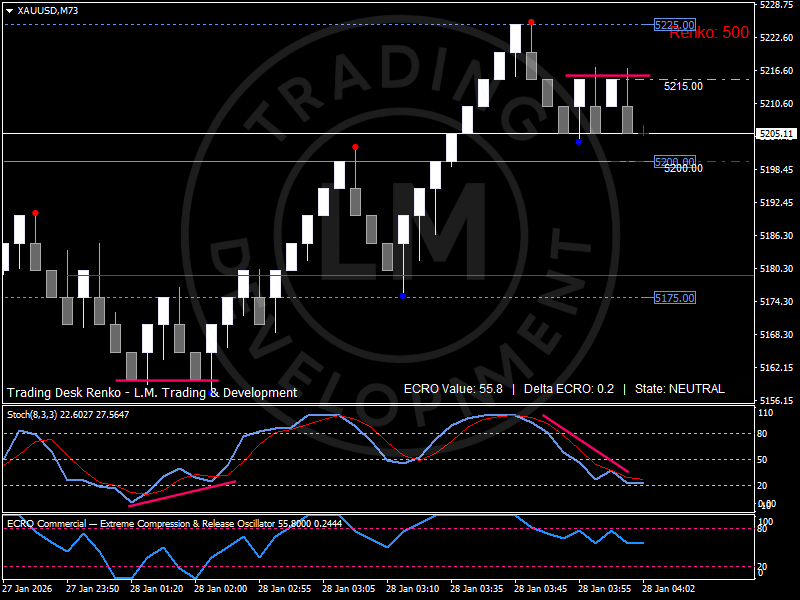
Sellers are present, but they are not overwhelming the broader structure. At the same time, buyers appear willing to defend key zones, suggesting that longer-term positioning remains intact. The market is slowing, not breaking.
This type of Renko structure is consistent with a regime where structural demand remains active even as short-term momentum cools.
Momentum is cooling, but not collapsing
Momentum indicators reinforce this picture of balance rather than breakdown.
The Stochastic oscillator has rolled over from elevated levels, indicating that the prior impulsive leg has lost intensity. However, it is not deeply oversold, and there are no signs of momentum capitulation. This suggests a normalization phase rather than the start of a sustained bearish move.
The ECRO (Extreme Compression & Release Oscillator) reading near mid-range levels points to compression. The market is no longer in a strong release phase, but it is also not in directional exhaustion. Instead, price action reflects temporary equilibrium between buyers and sellers.
The small Delta ECRO reading indicates limited immediate expansion pressure, consistent with a consolidation regime rather than a breakout or breakdown environment.
Together, these signals support the idea that Gold is digesting gains within a broader macro-supported structure, rather than transitioning into a full bearish reversal.
Gold’s macro role is becoming more strategic
Gold’s ability to hold near highs despite a firm Dollar signals a deeper evolution in how the asset is perceived.
Markets are no longer pricing Gold solely through the lens of currency weakness. Instead, they are embedding expectations of persistent systemic macro uncertainty, policy credibility challenges and geopolitical fragmentation. These forces create a structural risk premium that supports Gold beyond traditional FX dynamics.
As long as these themes remain active, downside moves may continue to be absorbed more quickly than in past cycles dominated by Dollar-driven flows.
Outlook
The classic inverse relationship between the Dollar and Gold is not disappearing, but it is losing its dominance.
In this regime, Gold is behaving less like a simple Dollar trade and more like a strategic macro hedge. As long as structural risk drivers remain active, price behavior may continue to reflect long-term allocation flows rather than short-term currency fluctuations.
Author
Luca Mattei
LM Trading & Development
Luca Mattei is a market analyst focusing on FX, metals, and macroeconomic trends. He develops trading tools for retail and professional traders, coding indicators and EAs for MT4/MT5 and strategies in Pine Script for TradingView.

















