Gold eyes higher levels on dovish Fed and global tensions

Gold (XAU/USD) continues to attract bullish momentum as multiple macroeconomic and geopolitical factors align in its favour. The metal touched a fresh daily peak, driven by a weaker US Dollar. Dovish expectations from the Federal Reserve and rising demand for safe-haven assets also supported the move. This bullish sentiment finds further support from a favourable technical setup, indicating a possible continuation of the uptrend.
Gold supported by Dovish Fed outlook and rising global tensions
The gold market currently benefits from softening US economic data and global uncertainties. The Personal Consumption Expenditures (PCE) Price Index, the Fed’s preferred inflation gauge, cooled to 2.1% YoY in April — it’s lowest since early 2021. Core PCE also eased to 2.5%. This signals that inflation is moderating, increasing the likelihood of interest rate cuts later in the year.
Market participants now believe that the Fed will reduce borrowing costs in September. Some are even anticipating another rate cut by December. These expectations have weakened the US Dollar, making gold more attractive to investors holding other currencies. Fed Governor Christopher Waller supported this outlook, suggesting rate cuts remain possible despite inflationary pressures from potential tariffs. Traders are closely watching speeches from key FOMC members this week, particularly Fed Chair Jerome Powell, for further monetary policy clues.
In addition to monetary dynamics, rising geopolitical risks drive gold demand. The war between Russia and Ukraine escalated as Ukraine launched major drone strikes on Russian airbases, damaging over 40 aircraft. This aggressive action comes just before high-level peace talks in Istanbul, raising concerns about prolonged conflict. Tensions between the US and China are also reigniting, and instability in the Middle East persists. These risks curb investor appetite for risk assets and boost gold’s appeal as a safe haven.
Bullish technical breakout strengthens Gold price outlook
The gold chart below shows a strong technical posture on the 4-hour timeframe. The price attempts a breakout from a "Descending Broadening Wedge," a bullish continuation pattern often associated with upward price moves. This breakout aligns with the current rise in price, providing technical confirmation for the bullish bias.
Earlier in the year, gold moved within an "Ascending Broadening Wedge," reflecting growing volatility and bullish strength. After a sharp rise, the price consolidated and eventually formed the descending wedge pattern seen in recent weeks.
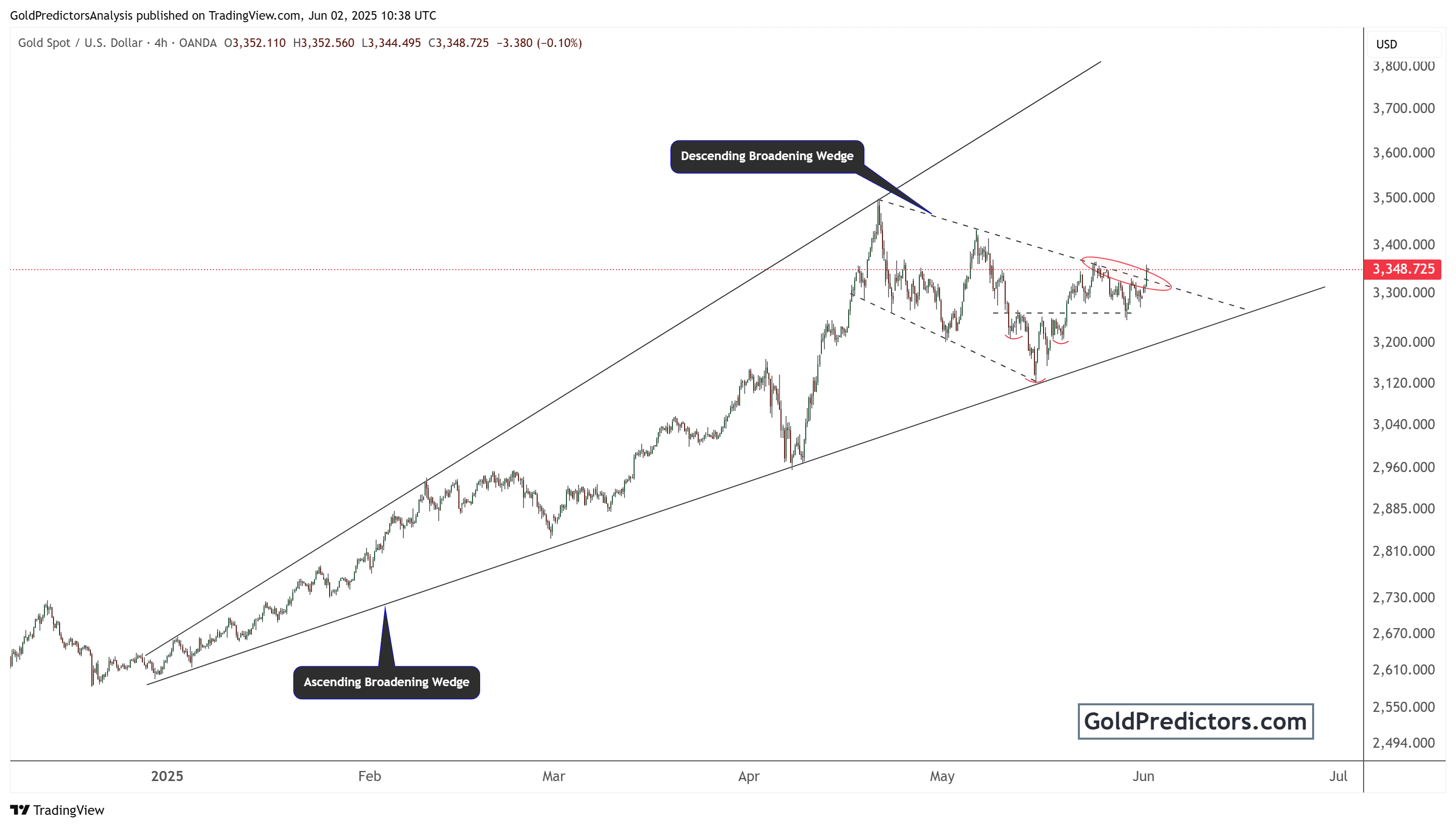
The breakout is occurring near the upper boundary of the descending wedge. The price is currently hovering around $3,343.50, above the resistance line and approaching new highs. If momentum sustains, the next upside targets lie near the $3,400 and $3,500 levels.
The lower support trend line, drawn from March lows, has remained intact, reinforcing the broader bullish trend. A series of higher lows shows steady buying interest, and with the recent consolidation breaking to the upside, buyers appear to be gaining control again. The combination of higher highs and higher lows within major wedge patterns indicates strong bullish momentum. These formations, supported by breakouts, suggest a continuation of the long-term uptrend in gold prices.
Conclusion
Gold continues to build bullish momentum, supported by dovish Fed expectations, rising geopolitical tensions, and a weakening US Dollar. Technical patterns confirm the strength of the uptrend, with breakouts reinforcing buyer dominance. As safe-haven demand grows and inflation pressures ease, gold appears well-positioned to push toward higher levels. Investors remain focused on upcoming Fed signals and global developments, which could further fuel the rally.
Unlock exclusive gold and silver trading signals and updates that most investors don’t see. Join our free newsletter now!
Unlock exclusive gold and silver trading signals and updates that most investors don’t see. Join our free newsletter now!
Author

Muhammad Umair, PhD
Gold Predictors
Muhammad Umair is a financial markets analyst and investor who focuses on the forex and precious metals markets.
















