Gold diggers without mining expertise: ASA

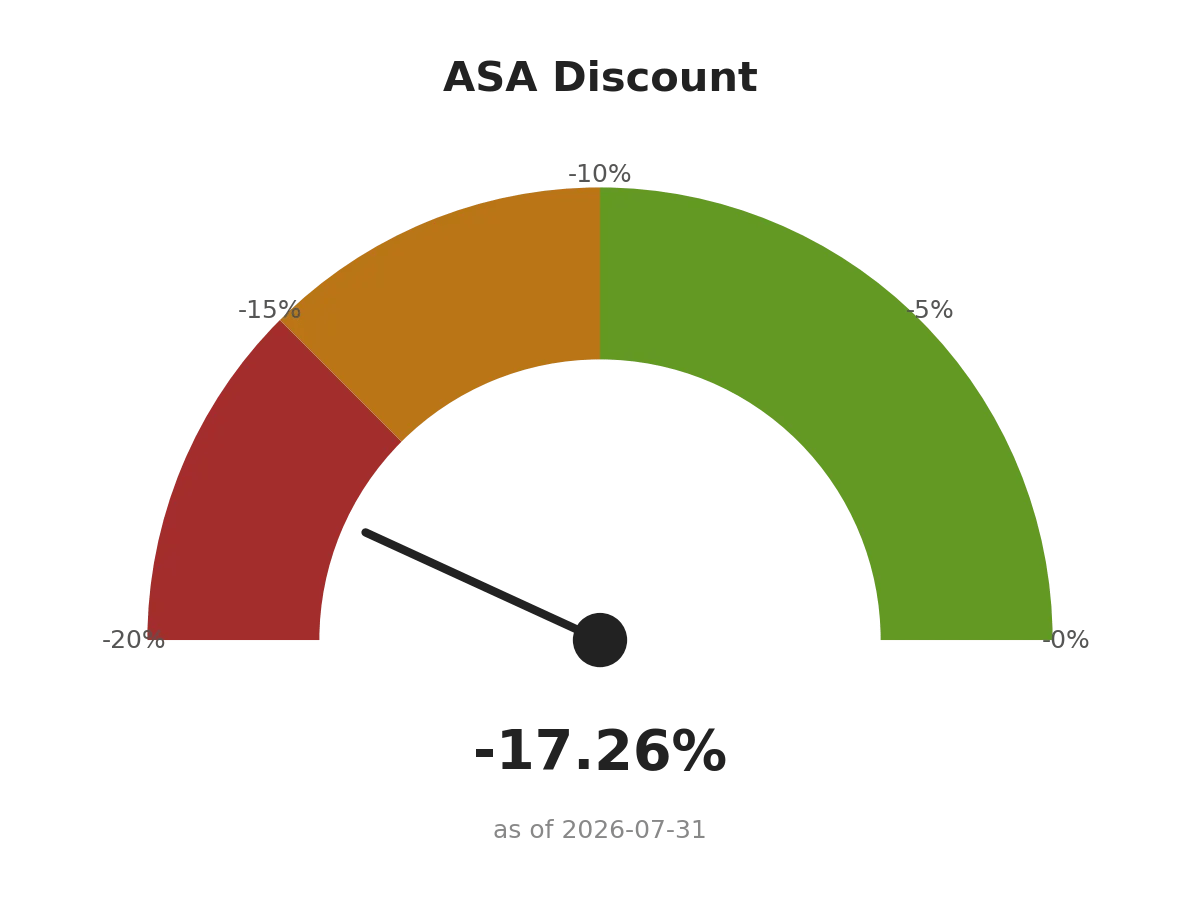
You might be excused to wonder: what the hell is happening at ASA? In ASA Gold & Precious Metals Ltd.’s (NYSE:ASA) semi-annual report, Saba partner Paul Kazarian had the audacity to write: “We thank you for your continued support” having seized management of ASA wearing the hat of “Chair of the Investment Committee”. The first month after pushing out Merk Investments (“Merk”) as ASA’s investment manager had a fitting end, with ASA’s discount widening to -17.26% — that’s how much “support” investors give ASA’s internal Investment Committee currently managing ASA.
How we got here
To understand where this may be headed, start with how we got here. In case you missed it, some context: after a tenure of over seven years of delivering best-in-class performance, literally beating every peer, both absolutely and on a risk-adjusted basis, ASA’s Board, with all Board members hand-picked by Saba and its Chair, a Saba partner, terminated Merk’s Investment Advisory Agreement effective June 30, 2026. The reason? In the semi-annual report, the cited reason was “the Independent Directors’ general reservations related to Merk’s approach to portfolio risk.” Fun fact: the Board commissioned an independent risk analysis by Broadridge (that Merk only got to see the evening before the Board meeting that was to decide on the renewal of the Advisory Agreement); that report supported Merk’s analysis that the Fund’s performance was due to Merk’s investment process rather than excessive risk taking.
In any case, Saba for years complained about the Fund’s discount. As a closed-end fund, ASA does not trade at Net Asset Value (NAV), but based on supply and demand in the market. Throughout Merk’s tenure, the Fund’s discount had gradually been narrowing. Except, that is, until Saba finally disclosed its true intentions in January, 2026, that they would like to have the Board repurpose the Fund into a Saba-managed vehicle. The Fund’s discount really started blowing out in July, 2026 with Merk gone and no further communication from the Board about its intentions. Saba in June, 2026 clarified they would like the Fund to be a Business Development Company under Saba management, with profit sharing for Saba. Note that this is Saba making proposals about the Fund’s future, ever more specific, but ASA’s Board - with all Board members hand-picked by Saba - has remained silent.
What happens to ASA now?
ASA’s Board still has not told shareholders what it intends to do. Saba has shown its cards, however, the Board has not. Saba wants ASA’s mining portfolio liquidated, the Fund repurposed, and a Saba-managed vehicle installed—with management fees and profit sharing for Saba. What does it mean when an Investment Committee with no mining expertise manages a mining fund? What can shareholders expect?
- ASA can temporarily assign the Advisory Agreement to someone else - or have it internally managed - but only for 150 days (late November) without going to shareholders. As I have written, shareholders have had no real voice and a vote at this stage cannot undo the damage that has been done.
- We don’t know what ASA’s Board will do, and it is possible that, in response to public pressure, they will amend their plans. My baseline has been that the Board will want to liquidate ASA’s portfolio, then repurpose the Fund. However, ASA must follow its investment mandate to invest 80% of its holdings in precious metals mining related securities, unless the Board gets shareholder approval to change the Fund’s strategy.
Is the portfolio already changing?
Rather than guess, Merk built a dashboard to watch for style drift in real time. We only have one month of data, so it is too early to draw firm conclusions. For now, the Fund’s portfolio appears to be coasting along. The benchmark GDMNTR listed is the underlying index to GDX, the mining ETF. Source for the data is Bloomberg.
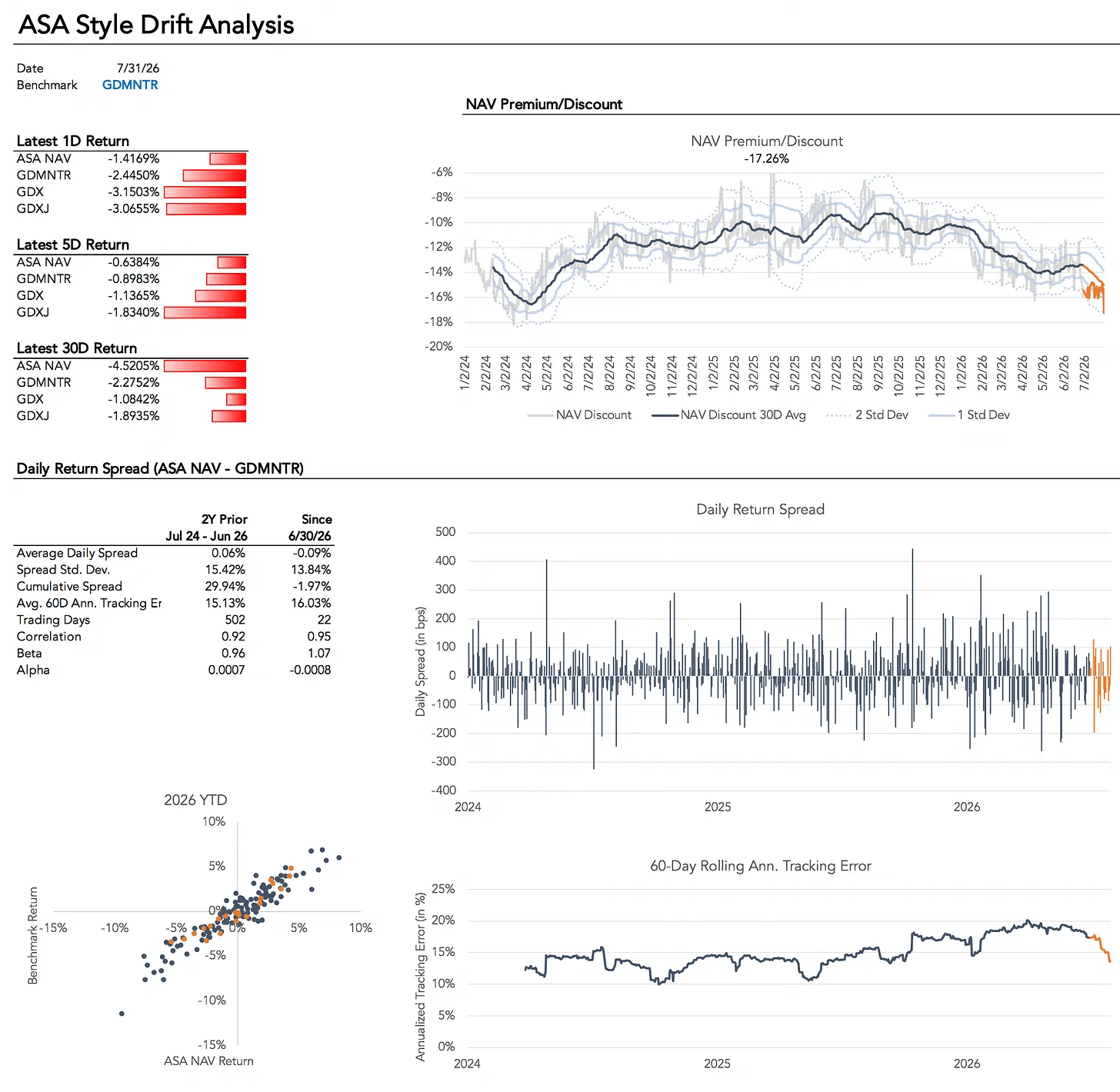
To prepare the portfolio for potential liquidation, I would expect to see a trimming or elimination of some of the least liquid securities to reduce the risk of front-running in the market.
Share repurchase program In limbo?
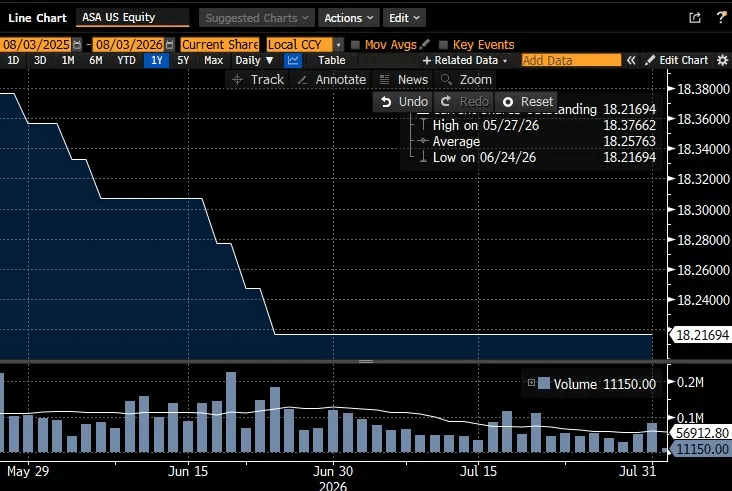
Separately, a bit of a head scratcher is that we have not seen any share repurchases of ASA since Merk stepped down on July 1, 2026. Historically, the most recent calendar quarter’s share repurchases were posted on ASA’s website - this has not yet taken place. Share repurchases are historically also reflected in Bloomberg. Below is a chart of Bloomberg’s report on shares outstanding in ASA, suggesting there might not have been any repurchases in July. In contrast, in April, when Merk was still the investment adviser, the Board felt so strongly about resuming share repurchases when the program was suspended that it issued a Form 8-K to release non-public information into the market that held up the program per Merk’s standard process. So either ASA is processing repurchases sloppily, it has legal reasons to suspend the program, something else is happening, or some combination of these applies. A legitimate reason to suspend the share repurchase program would be that material developments are underway that have not yet been disclosed to shareholders. To be clear, it is possible that repurchases have continued; there may be technical reasons why we don’t see them.
The coattail riders move in
While the Board remains silent and share repurchases may have been paused, a different group of investors appears to be moving in.
Based on my analysis of public filings, it appears some investors have bought ASA in the hope to capture the discount through a future tender offer. What Saba does with the Fund afterward may be secondary to them—but not if Saba restructures ASA first and makes all ASA shareholders bear the related costs before they are given an exit. Saba’s June filing proposed “a limited cash tender offer and a limited tender offer for a proportional share of the portfolio’s remaining assets.” One possibility is that selected portfolio sales are being used to test liquidity and determine which assets could be included in a cash tender—and which might be left behind. That is my interpretation, not an announced Board plan.
As I have written, I believe that ASA must not delay, but offer shareholders an exit at NAV now. Importantly, the Board must not restructure the Fund before allowing investors to exit. It’s in Saba’s interest to potentially do this later, and they may well want to participate in the tender offer themselves (so that they can redeploy their assets for future activism), but they also need the voting power of their shares to support their agenda.
I am not writing this from the sidelines. I own more than 300,000 ASA shares, or about 1.7% of the Fund. After my resignation as COO of ASA, I no longer have to make public filings about my personal transactions in ASA. If the portfolio is “coasting along” and a tender offer is forthcoming, I am currently comfortable holding my nose and continuing to hold my shares. With the discount widening, the upside potential from a tender offer is increasing. Shame on the Board, though, that they have let it come to this stage and not already offered shareholders an exit and informed shareholders of their plans. Saba likes to portray itself as acting in the interest of shareholders, closing discounts. As this episode at ASA should make abundantly clear, Saba seemingly couldn’t care less about other investors, but does like the prospect of amassing more assets to increase its management fees.
Author

Axel Merk
Merk Hard Currency Fund
Axel Merk is the Founder and President of Merk Investments. Merk is an expert on macro trends, hard money, international investing and on building sustainable wealth.