Gold bullish

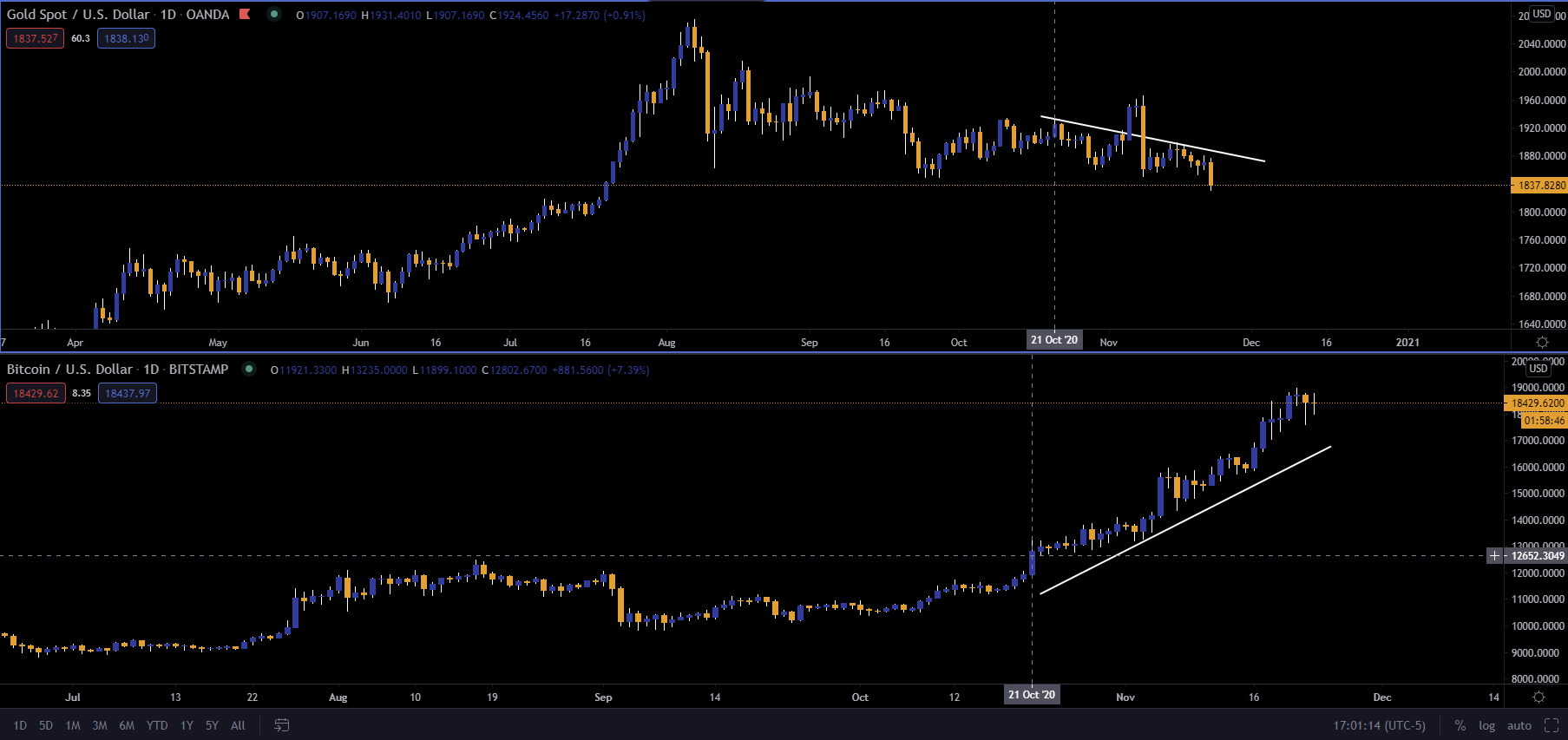
Gold has been trading sideways for a couple of months but today has shown signs of a breakout to the downside. as it closed outside of its consolidation. There has been talk about bitcoin replacing gold for years now and that idea has gained new life recently with bitcoin’s strong performance versus gold. It could be adding to gold’s weakness as capital flows out of gold and into bitcoin. If you look (below) at gold and bitcoin, you can see that bitcoin broke out of its consolidation on October 21st, but gold has not followed. Since then, bitcoin has seen a strong move to the upside, nearing its all-time highs, while gold has stayed stuck in a sideways channel and is now starting to breakdown. Prior to these recent moves, gold and bitcoin had a positive correlation dating back to 2019.
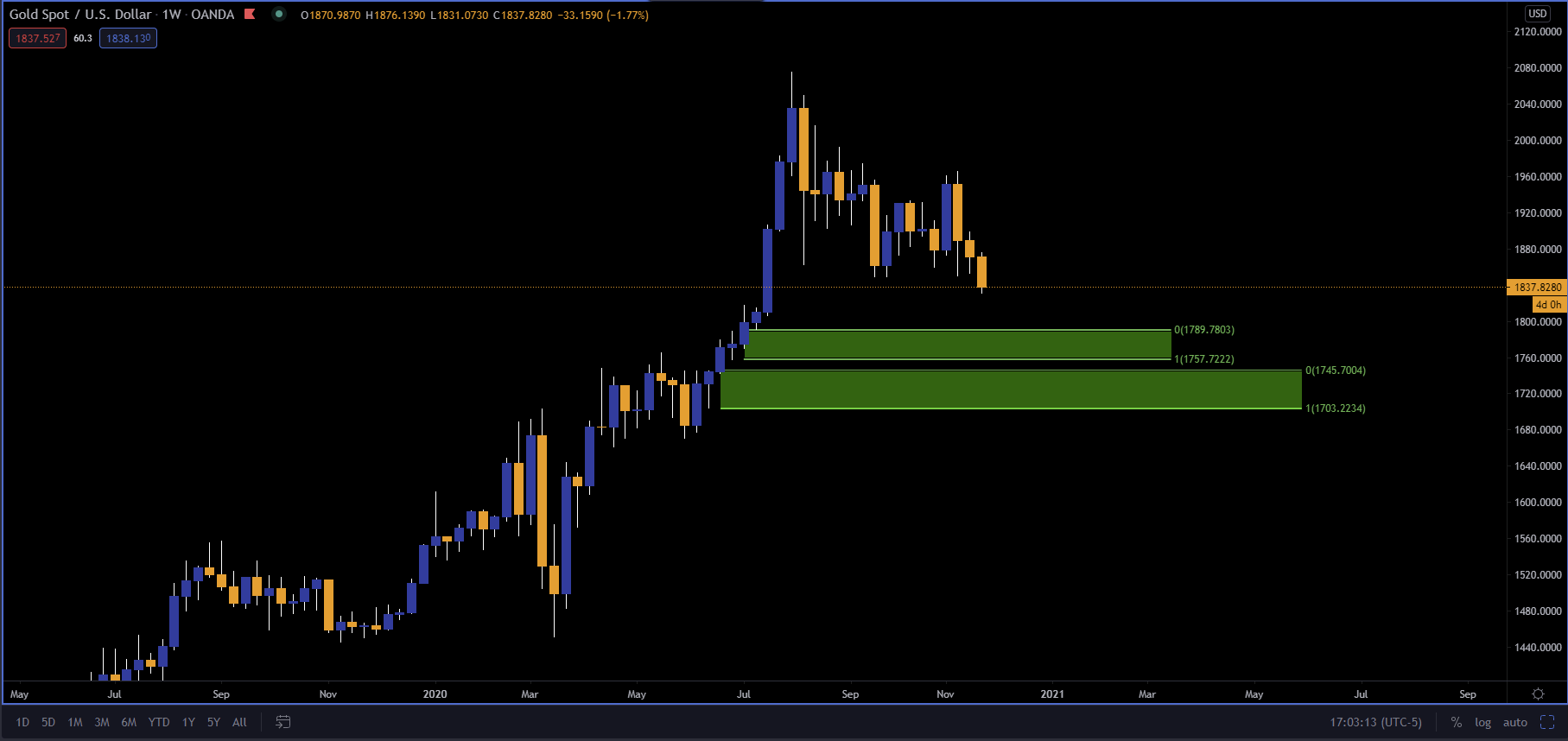
Bitcoin could very well replace gold as a store of value and a medium of exchange (not here to argue that one way or another). However, this process will likely take years and while it may affect gold in the short-term, when retail traders and speculators sell gold for bitcoin to catch momentum moves, I don’t think it will have much of an effect on gold’s price over the medium-to-long term. There are still plenty of gold bugs out there to say the least. Also, I still believe gold will act a hedge against monetary policy failure going forward. So, any pullbacks in gold are only going to create a great buying opportunity. If this breakout to the downside is real, I think in the short-term gold is heading towards that $1750 level (below), maybe even a bit lower. This is an area I will be looking to buy gold. I think once it bottoms around that $1,700-1,750 level, the next stop will be new all-time highs, between the $2,300-2,500 area.
If we take a more macro approach, I see the current economic environment as a win-win for gold. You have two main themes happening right now: inflation versus deflation. Without getting deep into that argument, I just want to point out that both scenarios are a win for gold. If we move into a more inflationary environment, interest rates are going to remain low because the economy and thus the Fed cannot afford rates to rise. There is way too much debt at these low interest rate levels and rising rates would cause a lot of defaults. So, if inflation becomes realistic, the Fed would likely issue YCC (yield curve control) where they would cap rates at a certain level and not allow rates to rise above them, which they accomplish by purchasing the appropriate amount of bonds at that maturity. This action would further push real rates into the negative, which is very positive for gold, as it is an alternative safe investment to bonds.
If we get another deflationary shock to the system (similar to March), government stimulus from both the fiscal and monetary side would come in fast and heavy. I will also point out that stimulus is likely coming, regardless of what happens next, but a deflationary shock would bring on stimulus sooner and the size of the package would likely be much larger. More stimulus would weigh on the USD like it did after the March selloff, lifting gold to higher price levels. Also, in my opinion, the more stimulus the economy requires, the more monetary policy is failing (again as I wrote here), which will be positive for gold as the idea of another gold standard has always been a viable option. It isn’t necessarily the best option, nor do I think it will happen, but as long as it remains AN option, gold will rise as monetary authorities continue to fail in generating global economic growth.
Author

Ryan Miller
Ryan Miller Trading Economics
Ryan Miller received a Bachelors Degree in History from William Paterson University. Through his studies of U.S. history, he developed an interest in the implications the financial markets have on the economy.

















