Gold and Lagarde – Friends or Foes?


A week ago, Lagarde chaired the monetary policy meeting of the Governing Council of the ECB for the first time. An insightful press conference followed in the footsteps. What will her presidency imply for the ECB’s policy and the gold market precisely?
Key Takeaways From First Lagarde Monetary Policy Meeting as ECB President
Last Thursday, the ECB held its December monetary policy meeting. The central bank maintained its stance steady, keeping the interest rates unchanged. However, the ECB has revised slightly down the outlook for real GDP growth for 2020, while the outlook for HICP inflation went slightly up.
But the main change occurred in the position of the President. Christine Lagarde has replaced Mario “whatever it takes” Draghi. Of course, it has happened some time ago, but only now she chaired her first monetary policy meeting and held a post-meeting press conference as the ECB President. What do her remarks and her presidency in general imply for the ECB’s future and the gold market specifically?
First of all, we are now sure that the dovish stance on monetary policy will be prolonged. Lagarde confirmed the status quo on interest rates, quantitative easing, etc. She said that “All right, on the toolbox, I’m not going to revisit the past (…) Policy decisions that were made, stand, and were re-endorsed yet again”.
Moreover, Lagarde communicates with the market pretty well. She reminded the audience in the very beginning that each president has his or her own style of communicating, so the analysts should not overinterpret her words. She also nicely escaped from being compared with Draghi, or being classifying as dove or hawk. Lagarde said that “I’m neither dove nor hawk and my ambition is to be this owl that is often associated with a little bit of wisdom”. Nice rhetoric, Madame, but let’s be honest, we all know that deep down you are a dove.
Indeed, Lagarde was rather candid on the negative interest rates. She did not criticize them and she did not announce any normalization. Instead, when asked about the existence of a “reversal rate”, i.e. a policy rate whose adverse consequences outweigh the positive effects, she replied that it’s not the case in the Eurozone. So, the madness of negative interest rates will continue. Is it really wisdom, Madame?
Last but not least, Lagarde announced that a top-down review of the ECB’s strategy would get underway in January with a view to being completed by the end of 2020. And guess what, she did not say that, but I bet dollars to doughnuts that the review will call for a more symmetric inflation goal. As a reminder, the ECB aims to reach inflation rate at a level sufficiently close to, but below, 2 percent. I can imagine that the phrase “but below” must be a thorn in Lagarde’s side. She already said during the press conference, that inflation at 1.7 percent is not close enough…
Implications for Gold
What does it all mean for the ECB’s monetary policy and the gold market? Well, Lagarde is consensual. Lagarde speaks nicely. Lagarde smiles. But beware of the central banker! Don’t be fooled by Madame Lagarde’s charm. If it looks like a dove, flies like a dove, and coos like a dove, then it probably is a dove. And, indeed, Lagarde is a dove, or actually an ultra dove. So, we expect the status quo on the very easy ECB’s monetary policy to continue, at least until the other members of the Governing Council express their objections.
Unfortunately, from the fundamental point of view, Lagarde’s dovishness is not helpful for the gold prices. Fundamentally, I mean the fact that dovish ECB, or the ECB more dovish than the Fed, should work to weaken the euro against the U.S. dollar. And the dollar’s strength should keep a downward pressure on gold prices.
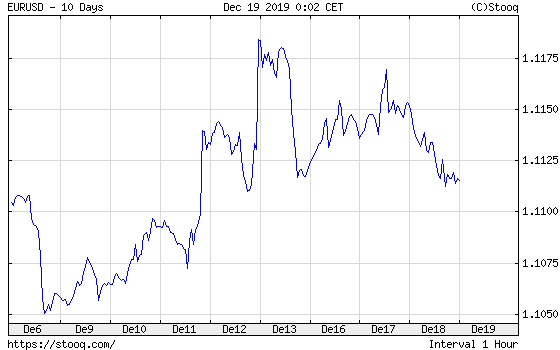
However, please note that the status quo of the ECB was already priced in. The EUR/USD exchange rate was barely influenced by Lagarde’s press conference, as the chart below shows (the later sharp moves were caused by the outcomes of the UK parliamentary elections and Trump’s tweets about trade policy).
Chart 1: EUR/USD exchange rate from December 6 to December 19, 2019
So, technical factors are also important in the gold market and right now, they might actually play first fiddle as we are approaching January, which is historically a positive month for the gold bulls.
Want free follow-ups to the above article and details not available to 99%+ investors? Sign up to our free newsletter today!
Want free follow-ups to the above article and details not available to 99%+ investors? Sign up to our free newsletter today!
Author
Arkadiusz Sieroń
Sunshine Profits
Arkadiusz Sieroń received his Ph.D. in economics in 2016 (his doctoral thesis was about Cantillon effects), and has been an assistant professor at the Institute of Economic Sciences at the University of Wrocław since 2017.

















