|

Gold and interest rates

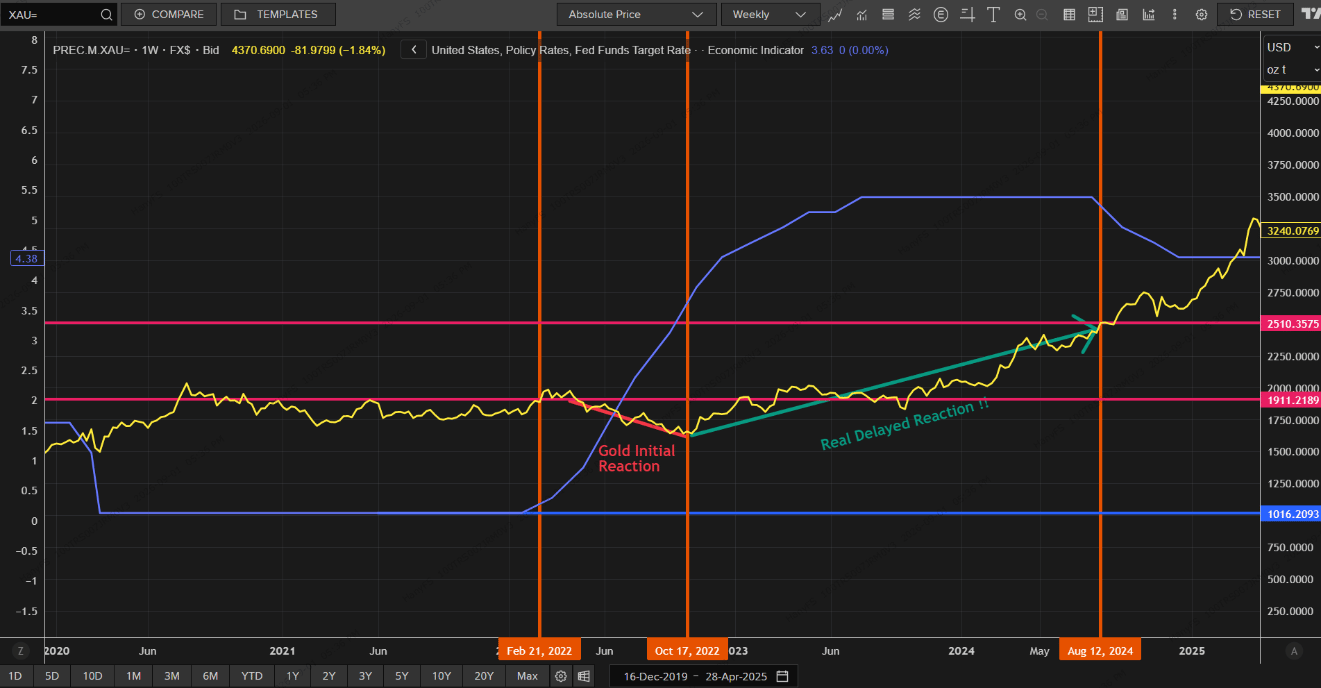
Phase 1 initial reaction: Back in 2022 when the Federal Reserve initiated aggressive rate hikes—raising the target rate from 0.08% in Feb-22 to 3.08% in Oct-22 (a 3.00% absolute increase)—gold experienced immediate downside pressure.

Gold closed at $1,908 in Feb-22 (peaking around $1,937 in Mar-22 amid early geopolitical tensions) before dropping to a low of $1,633 in Oct-22.

This represents a decline of 14.4% ($275 drop), illustrating the traditional inverse reaction where higher opportunity costs and yields weigh down non-yielding bullion.

Phase 2: Delayed Real Reaction & Rally (Oct 2022 – Aug 2024)

Despite the Fed continuing to raise rates aggressively to 5.33% by Aug-23 and holding them at terminal levels through Aug-24 (an overall hike of 5.25 percentage points), gold reversed course and rallied sharply. From the Oct-22 bottom of $1,633, gold climbed to $2,503 by Aug-24. This marks a 53.3% rally (a $870 gain) during sustained rate hikes and elevated rates, accumulating a net gain of $607 (+32%) over the entire timeframe (Apr-22 to Aug-24 baseline).
​Key takeaway

While interest rate hikes create an immediate downward shock on gold, persistent high rates and yields eventually intensify fiscal pressure by inflating debt servicing costs and government deficits. Market expectations of long-term sovereign debt stress ultimate power a delayed, multi-year bull run in gold.

This dynamic starkly contrasts with the Volcker era of the early 1980s, when extreme interest rates near 20% effectively crushed gold prices long-term without triggering fiscal solvency concerns when government debt level was under control!
Author

Hany Saleeb

Hany Saleeb

Independent Analyst

Hany Saleeb is a highly experienced Senior Treasurer. With over a decade of experience in treasury, served as Head of Treasury at BM in France and head of research in Sinai Securities.


More from Hany Saleeb
Share:

Editor's Picks

GBP/USD weakens to two-week lows near 1.3520

GBP/USD trades on the back foot, returning to the low 1.3500s, or two-week troughs, on Tuesday. Cable’s bearish price action follows decent gains in the Greenback at the time when investors assess latest US data releases and the persistent uncertainty in the US-Iran crisis.

EUR/USD remains offered; breaks below 1.1600

EUR/USD now accelerates its daily correction, breaching below the key 1.1600 support level on Tuesday. The pair’s daily correction comes on the back of a decent bounce in the US Dollar despite disappointing US data releases and amid persistent geopolitical concerns.

No reaction from Gold; still targets $4,300

Gold extends Monday’s pessimism and slipped back to nearly three-week lows just above the $4,300 mark per troy ounce on Tuesday. The US Dollar’s rebound couple with rising US Treasury yields weigh on the precious metal despite tensions in the Middle East appear far from abated.

Crypto Today: Bitcoin, Ethereum, XRP struggle to extend gains despite ETF inflows

Bitcoin stalls while holding above $78,000 support as ETF inflows return. Ethereum takes a breather around $2,450 amid sustained institutional support. XRP remains pressured as the 200-day EMA provides immediate support.

Global bond market sell off haunts markets

Global sovereign bonds are selling off as we start a new month. The UK is, unsurprisingly, taking the biggest hit. Two and 10-year yields rose by 10 basis points at one point on Tuesday, and are currently higher by 7 and 8bps respectively.

Diesel’s record $100 warning: The oil shock hiding in plain sight

The Oil market may look calmer than it did a few months ago, but diesel is sending a very different message. The US diesel crack spread, the premium of ultra-low sulphur diesel futures over WTI, recently surged above $100 per barrel for the first time, reaching an intraday record of just over $102.00.















