Gold advances into macro regime as ceasefire reshapes Dollar dynamics

Key takeaways
- Hormuz reopening removes the war premium while disruption remains embedded
- Pricing shifts toward Dollar and real yields as the shock enters macro channels
- Gold holds elevated levels while momentum compresses after the impulse
Gold enters a regime shaped by real disruption
Gold is moving into a phase where the market is digesting the consequences of a genuine disruption in energy and logistics. The ceasefire between the United States Israel and Iran and the restoration of vessel traffic through Hormuz remove the immediate tail risk that had supported the latest advance. The shock is now inside the market structure and is being processed rather than feared.
This shift changes the nature of gold’s behaviour. The metal becomes the lens through which investors interpret the damage already done to flows production schedules and freight conditions. The market is recalibrating around the disruption already absorbed.
Ceasefire resets the Gold driver while the pricing environment absorbs the shock
The reopening of Hormuz allows the market to move from escalation to measurement. Days of lost production and delayed sailings cannot be recovered. Insurance premia and freight costs have already been repriced. Physical flows have been interrupted and the backlog will take time to clear.
Crude oil and Brent have delivered the clearest signal. The collapse in prices shows that the previous spike was driven by access risk rather than structural supply loss. For gold this means that the driver is no longer the probability of further disruption. It is the cost of the disruption that has already occurred.
The time horizon extends as the shock migrates from event driven pricing to macro driven pricing.
The shock moves into the Dollar and rates channel
As the war premium fades the transmission mechanism becomes more familiar. The Dollar softens as safe haven demand rotates and as markets return to the Federal Reserve path. Real yields regain influence and policy uncertainty becomes the dominant variable.
Gold behaves as a macro hedge in this environment. A softer Dollar supports the metal while the memory of the shock remains embedded in inflation expectations and risk perception. The support reflects the broader pricing environment rather than short term reactions.
Market structure and positioning anchor the elevated range
Positioning explains why gold is not unwinding. Long exposure has accumulated through weeks of geopolitical tension and macro instability. This creates a base under the market and the current phase becomes an adjustment of leverage rather than a liquidation of conviction.
Options markets reinforce this structure. Demand for upside protection remains present. Implied volatility and skew show that investors still assign probability to renewed stress through policy shifts or renewed instability in energy flows.
ETF flows and reserve allocation add another layer. Strategic players respond to regime changes rather than short term headlines. A market that has just experienced a sudden closure of a critical energy chokepoint continues to justify gold as a core allocation.
Transmission across oil metals and foreign exchange
The shock is now propagating through the flow network. Oil collapses as the war premium is removed which reduces immediate inflation pressure but does not erase the disruption already transmitted through supply chains freight and insurance.
Silver rallies alongside gold which confirms that flows are moving into metals as a group. Equities respond positively to reduced tail risk. Commodity currencies recover as the market rotates out of panic and into recalibration.
The Dollar becomes the central variable. Its direction will determine whether gold consolidates or rebuilds momentum.
Asia session reveals how desks are managing exposure
The Asia session provides the first clean read on how global desks are handling the transition. Price action shows controlled adjustment. Gold holds near the upper part of the range without disorderly selling. The reaction is measured and consistent with a market that is managing exposure rather than abandoning it.
Flows indicate that leverage is being reduced while core positions remain intact. This is typical of a regime shift where the shock has been absorbed and its consequences continue to influence pricing.
Technical structure and compression after the impulse
The technical structure confirms the transition from expansion to compression. The Renko chart shows a strong impulsive leg followed by a loss of acceleration. The rejection in the area between 4 850 and 4 860 defines the short term top. The inability to reclaim that zone signals fading momentum.
The market rotates around the 4 800 pivot. Resistance is concentrated between 4 825 and 4 850 where repeated attempts fail to extend. Support holds between 4 775 and 4 750 and the broader structure remains intact.
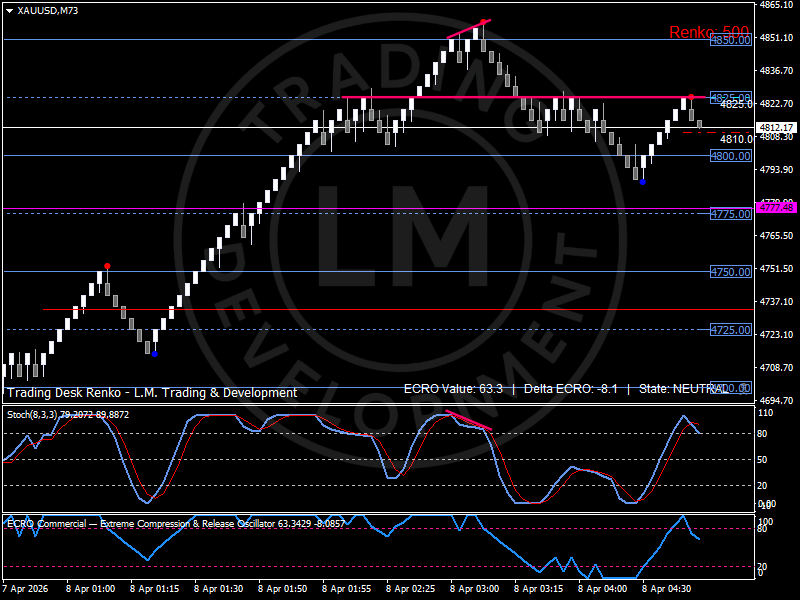
Momentum indicators align with this view. ECRO remains elevated with a negative delta which signals residual energy that is no longer directional. Stochastic levels roll lower from overbought territory and confirm the slowdown in short term momentum.
The phase is a compression after a shock driven impulse. The next move will depend on macro alignment. A stronger Dollar supported by incoming United States data would keep price capped below resistance and reinforce the current range. A softer Dollar would allow pressure to build again on the upper boundary.
Synthesis
Gold is now the asset through which the market reads the consequences of the shock. Energy currencies and policy expectations converge into its pricing. Gold integrates energy currency and policy signals into a single pricing framework. The regime is defined by elevation and sensitivity to macro variables and the memory of the shock remains embedded.
Outlook
The next phase depends on macro confirmation. If the Dollar weakens and real yields remain contained gold can rebuild momentum and challenge the resistance band between 4 825 and 4 850 which would reopen the path toward higher levels.
If the Dollar strengthens and yields move higher price is likely to remain within the current range with pressure building toward the 4 775 support area. A break below 4 775 would signal a deeper compression phase.
If new disruptions emerge in energy or geopolitics the market will reprice risk and shift back into expansion.
Until then gold trades in an elevated range with compression defining the transition phase.
Author

Luca Mattei
LM Trading & Development
Luca Mattei is a market analyst focusing on FX, metals, and macroeconomic trends. He develops trading tools for retail and professional traders, coding indicators and EAs for MT4/MT5 and strategies in Pine Script for TradingView.