Back above 100: Kevin Warsh’s first Fed meeting sparks US Dollar rally
The US Dollar Index (DXY) did a phoenix comeback, rising from its ashes and reconquering 100. The reasons behind the US Dollar rally are pretty clear: the Memorandum of Understanding (MOU) between the United States (US) and Iran, and a hawkish Federal Reserve (Fed).
Both events were long-awaited and much expected. However, the market reacted with surprise when there were no surprises at all.
(Temporal) Peace in the Middle East
After multiple back-and-forths, the United States and Iran signed an agreement to end the Middle East war. President Donald Trump and President Masoud Pezeshkian penciled a 60-day period for tough negotiations in a final deal. In the meantime, the Strait of Hormuz reopened, Iran resumed Oil exports, and US sanctions have been waived, allowing Tehran to put its hands on billions of USD held abroad.
There are still two sticky points: nuclear power and Lebanon. The extent of Iran’s nuclear development is yet to be discussed with the US, while the agreement calls for the immediate end of war on all fronts, including Lebanon, something Israel says cannot happen. US President Trump criticized Israel’s military actions against Hezbollah, but that won’t prevent attacks from continuing.
For the sake of markets, however, the MOU was enough to send crude Oil prices sharply lower, with prices accumulating roughly a 14% loss this month, after shedding a similar amount in May.
That means markets are no longer running after the USD for safety, but now betting on US strength. So far, progress towards the end of the war had a negative impact on the Greenback, while mounting tensions fueled demand for it. The fragile agreement brought back hopes for steady growth in the world’s largest economy, which has proved resilient through the latest crisis. With that in mind, macroeconomic imbalances are clearly skewed in America’s favor.
The damage is done, and policymakers know it
Lower Oil prices are a breath of fresh air, but the damage has been done: inflation levels around the globe are likely to remain above central banks’ goals for some time, and more concerning, inflation at wholesale levels is still on the rise, which means it’s still to fully spill over to consumption.
Rate hikes are the new norm, with some major central banks having already pulled the trigger and others on their way to do so. The US Federal Reserve is among those that so far refrained from acting, but market players have already chipped in a rate hike before the year's end, and that’s a major force behind the latest USD strength.
Federal Reserve Warsh debut
The Fed announced its monetary policy decision on Wednesday and left some bones to chew on the table. The central bank was, as expected, cautious and left interest rates unchanged. But Chair Kevin Warsh's debut was harsher than it looked at first glance.
Warsh has strong beliefs and put them all out at a brief press conference. Warsh has long criticized forward guidance and refrained from providing any. No dots in the plot. A halved accompanying statement and the focus shifting to data.
Warsh emphasized price stability and leaned hawkish, and made it clear that a new communications regime has begun, in which market players won’t be able to speculate about what the Fed will or won’t do: it will all depend on macro figures. Interest rates will go up or down, depending on economic needs and not political desires
Dollar Index at fresh YTD highs
The DXY surged to 100.81, its highest since May 2025. The former 2026 peak at 100.64 posted in March provides support, followed by the psychological 100 threshold. The longer the index holds above it, the higher the chances of a bullish continuation in the foreseeable future. The initial upside hurdle stands at 101.26, a relevant peak from May 2025, with steady gains beyond the level exposing the 102 mark.
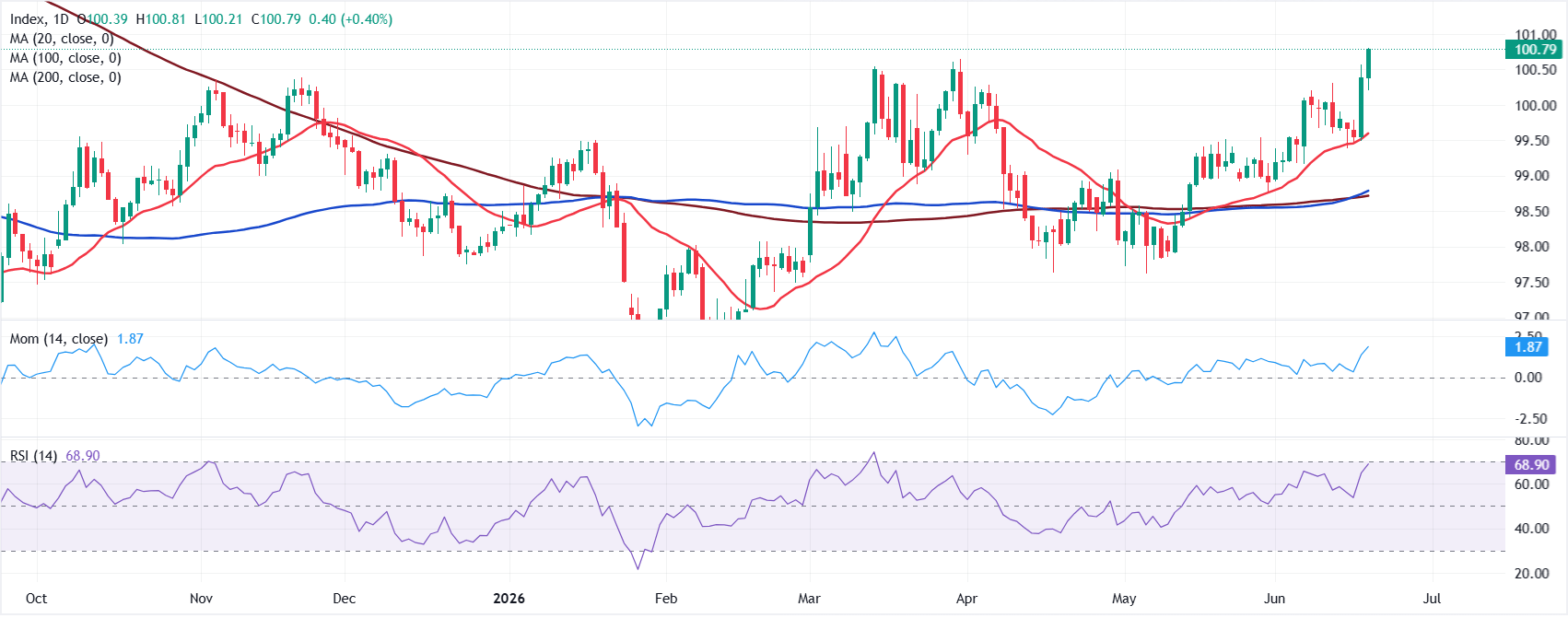
From a technical standpoint, readings in the daily chart support higher highs ahead: a bullish 20-day Simple Moving Average (SMA) accelerated north above the 100- and 200-day SMAs, and now provides dynamic support in the 99.50 area. Technical indicators support the bullish case, maintaining their upward slopes well above their midlines and far from exhaustion levels.
Author

Valeria Bednarik
FXStreet
Valeria Bednarik was born and lives in Buenos Aires, Argentina. Her passion for math and numbers pushed her into studying economics in her younger years.