Global ETF Gold flows flipped back positive in April
After going negative in March after the outbreak of hostilities between the U.S. and Iran, flows of gold into ETFs flipped positive again in April, with all regions reporting inflows of metal.
Net global ETF gold holdings increased by 45 tonnes, totaling $6.6 billion last month. That pushed total ETF gold reserves to 4,137 tonnes, with total assets under management (AUM) to $615 billion, a 1 percent increase.
It was the third-highest month-end ETF gold holdings on record, just below the record high of 4,176 tonnes set in February 2026.
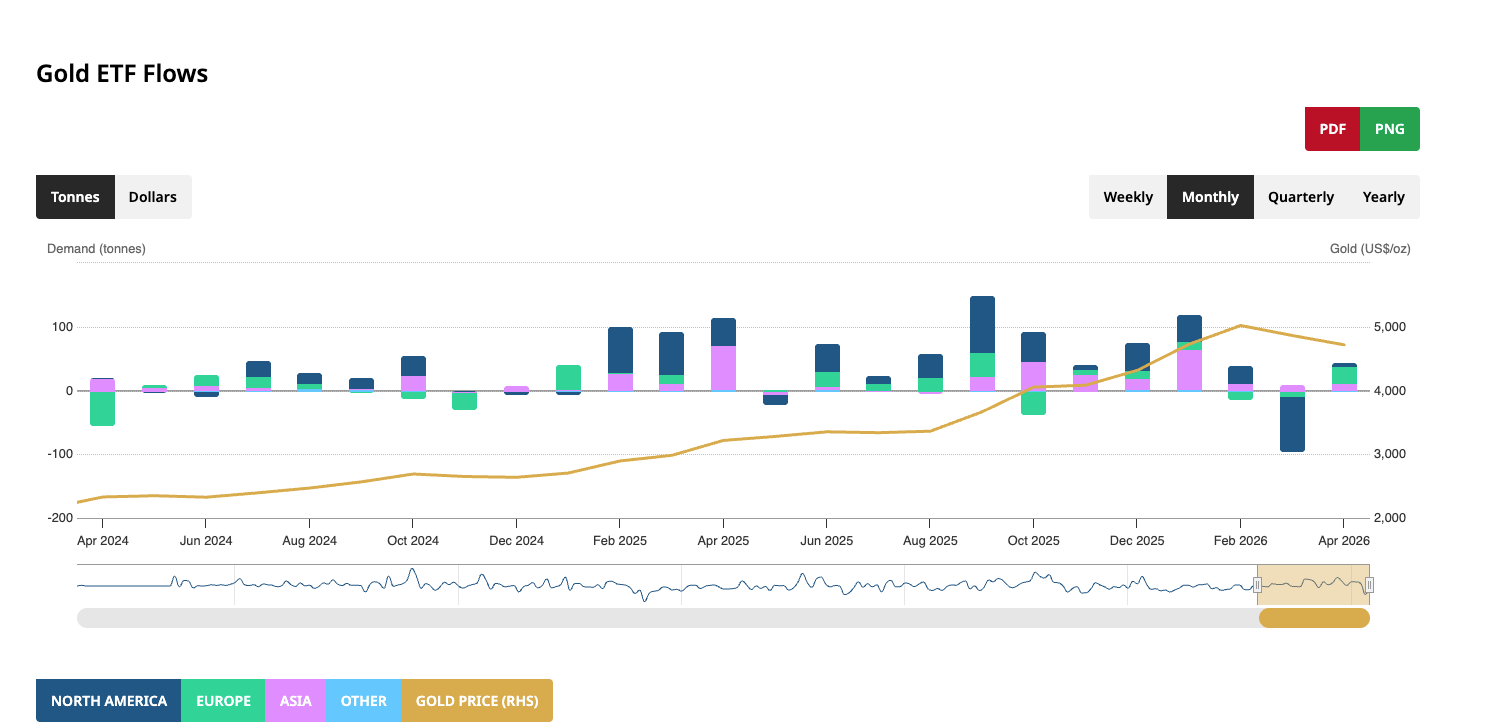
European funds led inflows, adding 26.9 tonnes of gold valued at $3.7 billion last month. That flipped year-to-date flows positive.
Funds in the UK drove regional inflows, with contributions from Swiss and German ETFs. According to the World Gold Council, “Positive flows in the region appeared linked to heightened geopolitical and geoeconomic risks, as investors assessed the inflationary implications of a more protracted Iran conflict and the associated pressure on energy prices. … With local equities retreating and the BoE less hawkish than expected, investor interest in gold likely strengthened as prices recovered and stabilized.”
After shedding 87 tonnes in March, North American funds added 6.1 tonnes of gold valued at $1 billion.
Inflows were concentrated in the first half of the month, with demand softening in the back half, as hope for a quick resolution to the Iran conflict faded.
It appears investors used the liquidity of their gold holdings to cover shorts and strengthen cash positions as markets tanked in the early days of the Iran war. World Gold Council analysts noted that the exodus of gold from ETFs in March corresponded to a “broader macro-pressure and liquidity event rather than a simple oil-only rotation.”
The subsequent easing in pressure helped flows stabilize in early April, although the recovery remained choppy into month-end.
Asia was the only region to record gold inflows in March. That trend continued for the eighth straight month, as Asian funds added 11.3 tonnes of gold valued at $1.8 billion in April.
Asian ETF gold inflows are on pace to match last year’s record total.
Chinese funds led the way, with gold buying supported by geopolitical tensions and falling yields.
Indian funds reported their 11th straight month of gold inflows totaling $297 million.
Funds in other regions, including Australia and Africa, reported a 0.9-tonne increase in gold holdings, led by Australia and South Africa.
ETFs are a convenient way for investors to play the gold market, but owning ETF shares is not the same as holding physical gold.
ETFs are relatively liquid. You can buy or sell an ETF with a couple of mouse clicks. You don’t have to worry about transporting or storing metal. In a nutshell, it allows investors to play the gold market without buying full ounces of metal at the spot price.
Since you are just buying a number in a computer, you can easily trade your ETF shares for another stock or cash whenever you want, even multiple times on the same day. Many speculative investors take advantage of this liquidity.
But while a gold ETF is a convenient way to play the price of gold on the market, you don’t possess any gold. You have paper. And you don’t know for sure that the fund has all the gold either, especially when the fund sees inflows. In such a scenario, there have been difficulties or delays in obtaining physical metal.
Trading volumes
Global gold market trading volumes fell 24 percent month-on-month to $398 billion per day last month. That was above the 2025 average of $361 billion per day.
Over-the-counter volumes dropped by 10 percent in April to $244 billion per day. That was also well above the 2025 average of $180 billion per day.
Exchanges also reported cooler activity, with both the COMEX and the Shanghai Futures Exchange charting lower volumes. Overall, exchange volumes dropped by 38 percent month-on-month to $147 billion per day.
Gold ETF trading volumes dipped, while remaining around their 2025 average of $7 billion.
On the COMEX, net longs declined 4 percent in April to 477 tonnes.
To receive free commentary and analysis on the gold and silver markets, click here to be added to the Money Metals news service.
Author

Mike Maharrey
Money Metals Exchange
Mike Maharrey is a journalist and market analyst for MoneyMetals.com with over a decade of experience in precious metals. He holds a BS in accounting from the University of Kentucky and a BA in journalism from the University of South Florida.