Ghana: A worrying trend in the public finances


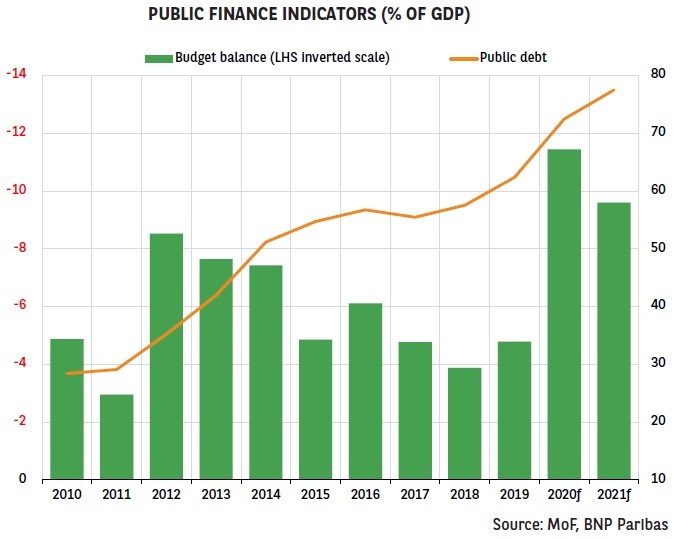
According to the government, the Covid-19 crisis will push the budget deficit up to 11.4% of GDP this year, from the 4.7% initially expected. More importantly, medium-term forecasts do not predict a return of the deficit to below 5% of GDP before 2024. This is a worrying trend.
Covering financing requirements will prove to be challenging. With the bulk of external financing having already materialized, the government will have to turn to the local debt market. However, conditions here are onerous, resulting in interest costs rising to a very high level (50% of government revenue in 2020). Another option would be to make use of monetary financing. The central bank already has an asset purchase programme in place (2.6% of GDP). Increasing this would carry risks for a country vulnerable to portfolio investment flows. Additional uncertainty comes in the form of the general elections to be held at the end of 2020. In the event of a loss of confidence, the cedi could come under renewed pressure, weakening the public finances a little more. Around half of debt is denominated in foreign currency. We estimate that debt will climb to 77.5% of GDP in 2021, from 62.4% in 2019.
Download The Full EcoFlash
Author
BNP Paribas Team
BNP Paribas
BNP Paribas Economic Research Department is a worldwide function, part of Corporate and Investment Banking, at the service of both the Bank and its customers.

















