|

GDP contracts as import surge brings record drag from trade

Summary

The U.S. economy is at a greater risk of recession now than it was a month ago, but this 0.3% contraction in Q1 GDP is not the start of one. It reflects instead the sudden change in trade policy that culminated in the biggest drag from net exports in data going back more than a half-century.
fxsoriginal

Economy falls into the trade gap

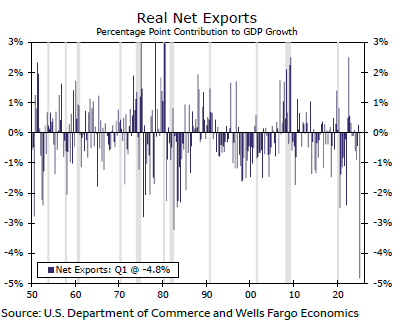
The U.S. economy contracted at a 0.3% annualized rate in the first quarter (chart). If you look at this development through the lens of businesses and households trying to get ahead of the tariffs, many of the big pieces of today's report fall into line. For starters, trade lopped 4.8 percentage points off of first quarter growth. It is rare for a drag that large to come from a comparatively small component of GDP such as net exports. In fact, we haven't seen a drag of this size in data going back to the late 1940s (chart). This is not because trade activity was grinding to a halt, but rather because imports shot up as firms tried to pull forward needed industrial supplies and retailers stocked their shelves with consumer goods.

Consumers pulled forward demand somewhat as well with overall PCE growth coming in stronger than expected at 1.8% during the period. That stronger-than-expected outturn exerted a 1.2 percentage point boost to the headline number which kept the contraction in GDP from being a larger one. While it might be handy to point to pre-tariff spending to explain the stronger consumer numbers, that is not an entirely accurate way to characterize what is happening. While monthly auto sales and anecdotal comments from retailers suggest a jump in March spending, most of the strength in PCE was in service outlays which rose 2.4%, much stronger than the 0.5% gain in goods outlays.

Download The Full Economic Indicator

Author

More from Wells Fargo Research Team
Share:

Markets move fast. We move first.

Orange Juice Newsletter brings you expert driven insights - not headlines. Every day on your inbox.

By subscribing you agree to our Terms and conditions.

Editor's Picks

EUR/USD rebounds after falling toward 1.1700

EUR/USD gains traction and trades above 1.1730 in the American session, looking to end the week virtually unchanged. The bullish opening in Wall Street makes it difficult for the US Dollar to preserve its recovery momentum and helps the pair rebound heading into the weekend.

GBP/USD steadies below 1.3400 as traders assess BoE policy outlook

Following Thursday's volatile session, GBP/USD moves sideways below 1.3400 on Friday. Investors reassess the Bank of England's policy oıtlook after the MPC decided to cut the interest rate by 25 bps by a slim margin. Meanwhile, the improving risk mood helps the pair hold its ground.

Gold stays below $4,350, looks to post small weekly gains

Gold struggles to gather recovery momentum and stays below $4,350 in the second half of the day on Friday, as the benchmark 10-year US Treasury bond yield edges higher. Nevertheless, the precious metal remains on track to end the week with modest gains as markets gear up for the holiday season.

Crypto Today: Bitcoin, Ethereum, XRP rebound amid bearish market conditions

Bitcoin (BTC) is edging higher, trading above $88,000 at the time of writing on Monday. Altcoins, including Ethereum (ETH) and Ripple (XRP), are following in BTC’s footsteps, experiencing relief rebounds following a volatile week.

How much can one month of soft inflation change the Fed’s mind?

One month of softer inflation data is rarely enough to shift Federal Reserve policy on its own, but in a market highly sensitive to every data point, even a single reading can reshape expectations. November’s inflation report offered a welcome sign of cooling price pressures. 

XRP rebounds amid ETF inflows and declining retail demand demand

XRP rebounds as bulls target a short-term breakout above $2.00 on Friday. XRP ETFs record the highest inflow since December 8, signaling growing institutional appetite.