GDP Bounces Back to Trend: Inflation Remains a Challenge

GDP Q2 bounced back to a trend-like 2.6 percent with the help of solid consumer spending and business investment. Flagging inflationary pressures continue to challenge current FOMC dot-plot expectations.
Second Quarter Bounce Back: Real Final Sales Solid
After the perennial residual seasonality issues and despite a negative inventory contribution, second quarter GDP returned to trend at 2.6 percent, annualized.
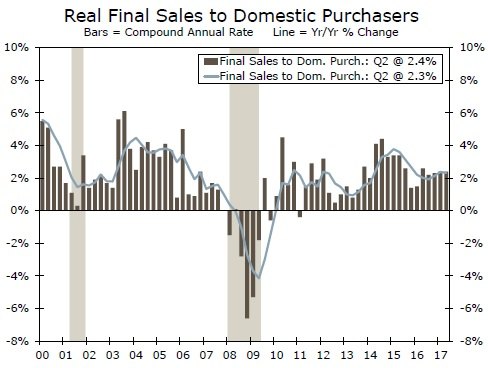
Underlying momentum for the economy is better gauged by real final sales to domestic purchasers, which also came in at 2.4 percent, a reflection of solid consumer spending and continued business equipment spending (top graph). The gains in consumer spending reflect the gains in disposable personal income of 3.2 percent. Spending for durables and nondurables were areas where consumer spending rebounded most notably. Business equipment also contributed to growth at a moderate pace of 8.2 percent, consistent with core capital goods shipments. Core capital goods shipments and orders have been on an improving track, and with business leaders still optimistic that some progress can be made on the fiscal policy front, the outlook for business investment remains constructive.
Structures, government and net exports all added to GDP growth. Moreover, residential investment corrected from the favorable weather induced fast pace of the first quarter when activity was clearly pulled forward. Looking forward, the outlook for residential construction remains constructive as long as the labor market, including wage & salary growth continues to show improvement.
Inflation Remains Tame
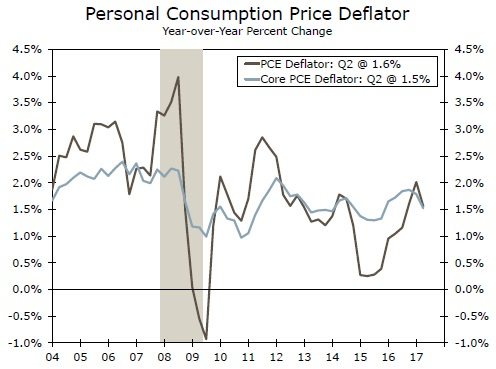
Inflation, as measured by the PCE deflator, has registered soft performances over the prior four months and has grown just 1.6 percent, year over year (middle graph). The figure reinforces the view that the price environment exhibits little upward momentum as we enter the second half of the year. The FOMC will have to grapple with flagging price pressures as they assess the appropriate path for monetary policy. There is a lot of runway left before the December FOMC meeting where we believe the Fed may be in position to hike interest rates again, but a return to a quickening pace of inflation is critical to that call.
Outlook Going Forward
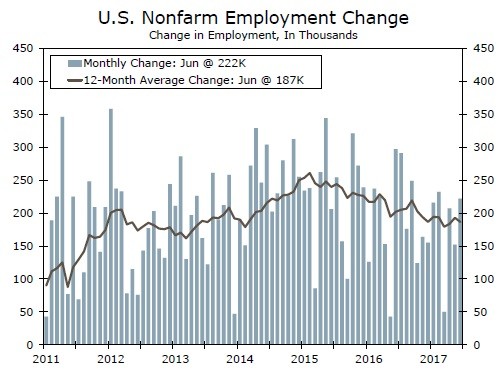
In the first half of the year, GDP growth has averaged just 1.9 percent. Looking ahead to the second half of the year, we expect GDP to accelerate slightly, averaging 2.5 percent. Continued job gains (bottom graph) along with signs that real disposable income is accelerating is supportive of our view of stronger consumer spending in the second half of the year. Global economic data has been surprising to the upside, suggesting that domestic business investment is also likely to slowly accelerate in the second half of the year. Should our forecast for H2 hold, year-over-year GDP growth should expand at a 2.2 percent pace in 2017, faster than the 1.5 percent rate observed in 2016.
Author
Wells Fargo Research Team
Wells Fargo