|

GBP/USD gets trendline rejection, but bulls still in play [Video]

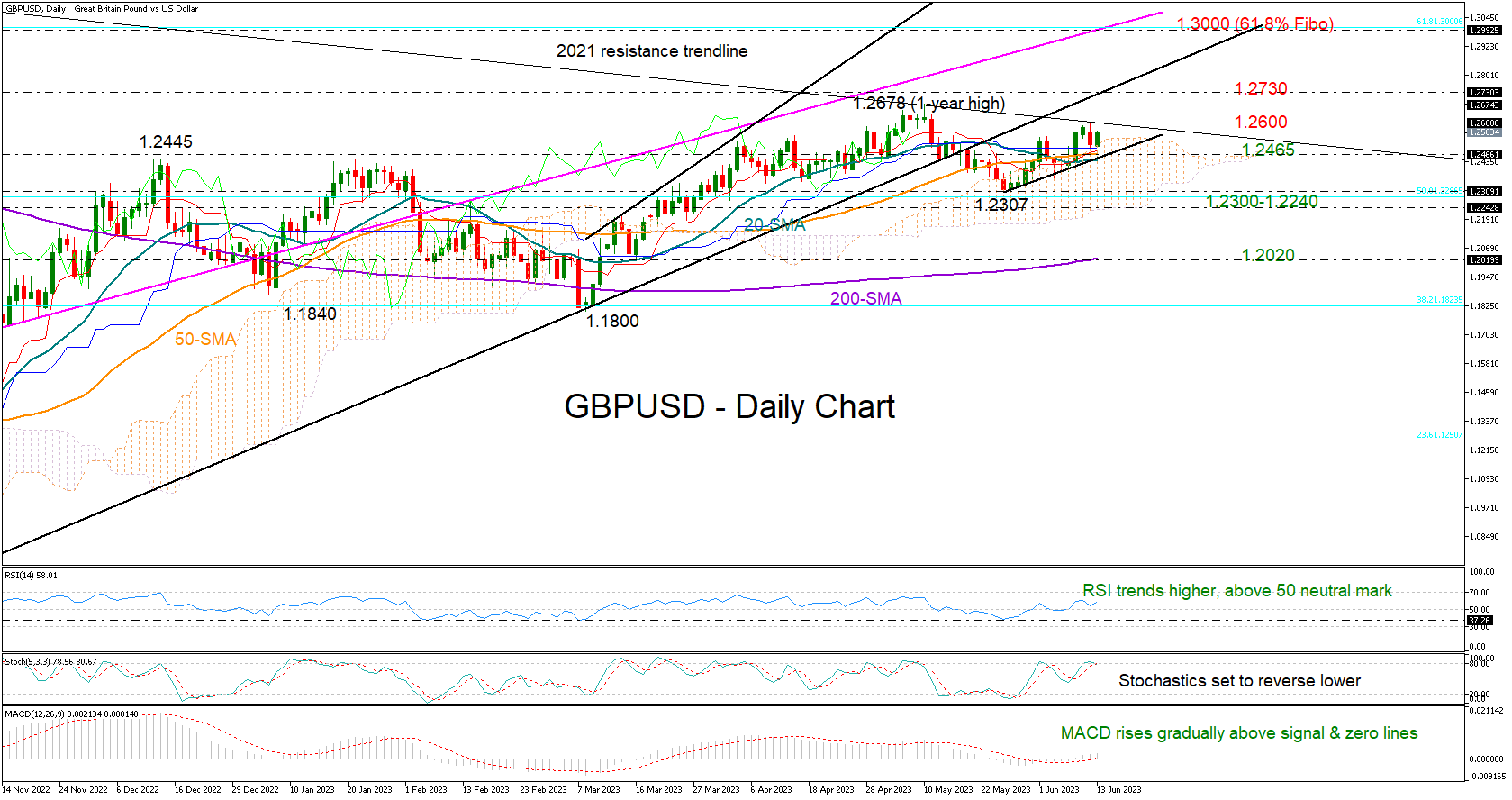
GBPUSD turned red on Monday after marking a one-month high of 1.2598 near the long-term resistance trendline, which has been capping bullish actions since the June 2021 high.

The pair switched back to recovery mode early on Tuesday,  with the technical indicators reflecting appetite for a bullish breakout. The RSI is trending higher and is above its 50 neutral mark, while the MACD is gradually strengthening within the positive region and above its red signal line. The fact that the price has avoided a drop inside the Ichimoku cloud is also making additional gains possible.

Yet, only a clear extension above the resistance trendline and the 1.2600 round level could activate fresh buying orders. If that proves to be the case, the bulls may drive the pair straight up to May’s high of 1.2678 and then towards the broken support trendline from the September 2022 low at 1.2730. A continuation higher could pick up pace towards the 1.3000 zone, where the 61.8% Fibonacci retracement of the 1.4248-1.0324 downtrend is placed.

Alternatively, the pair could seek support somewhere between its 20- and 50-day simple moving averages (SMAs) at 1.2465. Failure to rebound there may press the price into the 1.2300-1.2240 territory, where May’s bearish wave bottomed out. The 50% Fibonacci mark and the cloud’s lower boundary are also positioned in the same region. Therefore, a decisive close lower could spark a notable decline towards the 200-day SMA at 1.2020.

All in all, GBPUSD seems to have some extra bullish power in the tank despite a discouraging start to the week. An advance above 1.2600 could extend the uptrend to new highs.
GBPUSD

Author

Christina Parthenidou

Christina joined Trading Point in May 2017. She holds a master degree in Economics and Business from the Erasmus University Rotterdam with a specialization in International economics.


More from Christina Parthenidou
Share:

Editor's Picks

GBP/USD appears well offered near 1.3160

GBP/USD builds on Tuesday’s losses, although it now manages to pick up some pace and bounce off earlier multi-month troughs near 1.3140. The Greenback’s solid performance and continued political turmoil in the UK are keeping Cable under persistent pressure, with little sign of a meaningful recovery.

EUR/USD trims losses, hovers around 1.1350

EUR/USD now regains some composure and rebounds to the 1.1350 zone on Wednesday, partially reversing the prior pullback to fresh yearly lows near 1.1320. Meanwhile, spot remains on the back foot as the US Dollar continues to draw support from hawkish Fed expectations and uncertainty over the outcome of US-Iran peace negotiations.

Gold pressured near fresh 2026 lows

Gold accelerates its decline and gyrates around the key $4,000 mark per troy ounce on Wednesday, its lowest level since November 2025. In the meantime, tighter-for-longer Fed expectations and a broadly firmer US Dollar continue to weigh on the yellow metal, while uncertainty surrounding a potential US-Iran peace agreement has done little to revive demand for the safe haven space.

Crypto Today: Bitcoin, Ethereum, XRP trade under pressure as September Fed rate-hike odds increase

Bitcoin is trading between $62,000 and $63,000 at the time of writing on Wednesday, weighed down by headwinds stemming from macroeconomic uncertainty and geopolitical tensions in the Middle East.

US-Iran talks: The next 60 days will decide where Oil prices go next
Oil markets received some encouraging news after weeks of rising tensions in the Middle East. But let’s not get ahead of ourselves: we’re far from victory, and markets just seem to have priced out the worst-case scenario. The US and Iran have reportedly made "substantive progress" in talks in Switzerland and agreed on a framework for working toward a broader deal within 60 days.
Regime change: Inside Kevin Warsh's first move to make the Fed unreadable on purpose

The rate did not move. That was the least interesting thing about Kevin Warsh's first meeting in charge of the Fed. The FOMC held its benchmark at 3.50%-3.75% for the fourth straight meeting, exactly as priced, and then the new chair used his first press conference to dismantle the machinery the market has leaned on for a decade.