|

GBP/USD bearish outlook worsens, signals discouraging [Video]

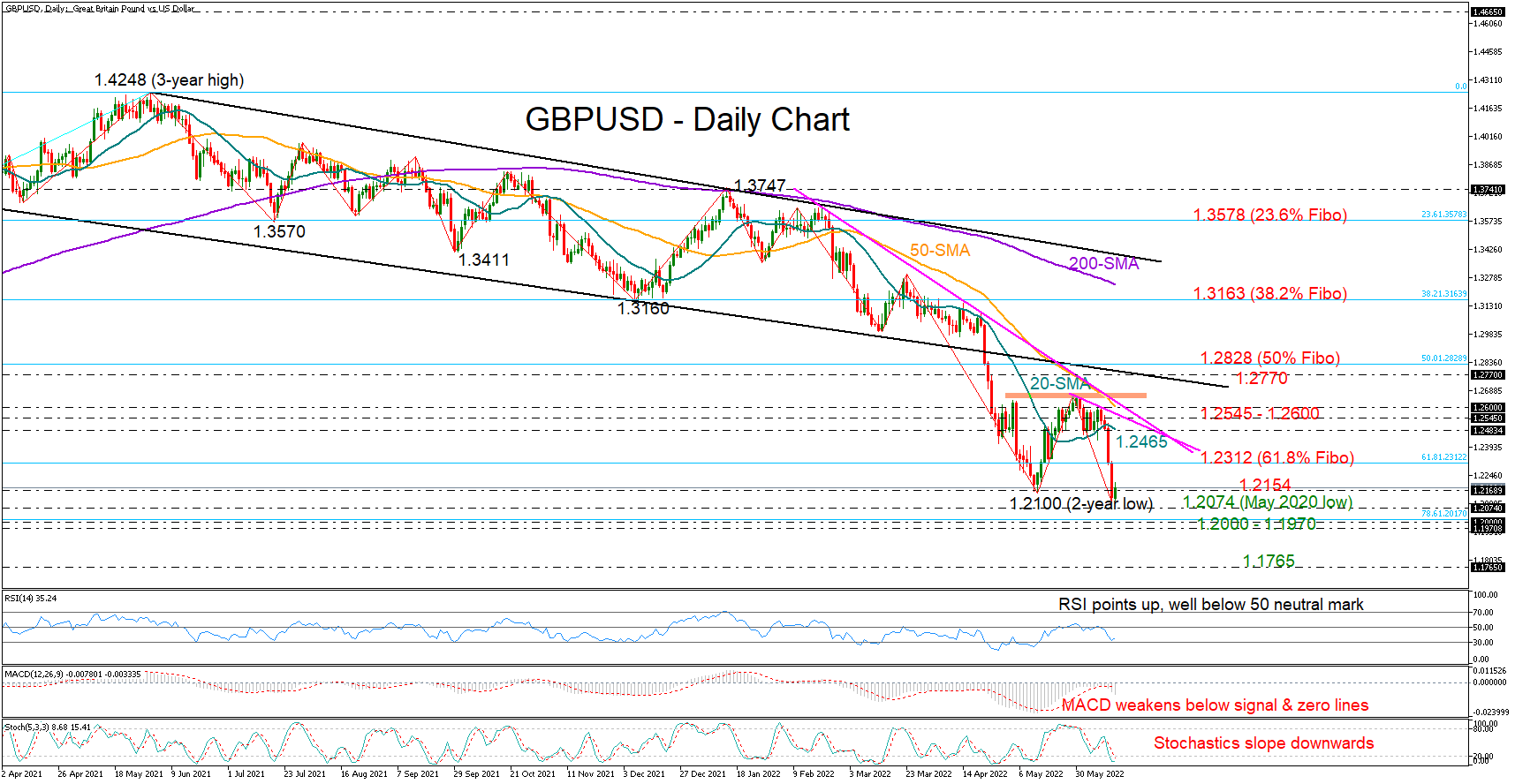
GBPUSD switched to a recovery mode on Monday following last week’s brutal sell-off, which worsened the broad outlook and squeezed the price to a new two-year low of 1.2100.

The previous low of 1.2154 is currently limiting upside pressures as the momentum indicators provide little hope for a meaningful rally. Explaining that, the slight upturn in the RSI is not convincing yet since the indicator remains well dipped in the bearish area, while the negative slope in the Stochastics suggests that the bears have more fuel in the tank. Moreover, the MACD seems to have started a new bearish round below its red signal and zero lines.

If sellers dominate below the 1.2100 round-level, the next pivot point could develop somewhere between the 1.2074 low from May 2020 and the 1.2000 psychological number, where the 78.6% Fibonacci retracement of the 2020 – 2021 uptrend is also placed. The 1.1970 restrictive zone may immediately attract attention before the decline sharpens towards the 1.1765 handle.

In the positive scenario, where the pair snaps the nearby block at 1.2154, the recovery could continue towards the 61.8% Fibonacci of 1.2312. An extension higher could initially pause near the 20-day simple moving average (SMA) at 1.2483 and then face a more challenging battle within the 1.2545 – 1.2600 zone, formed by two tentative descending trendlines and the 50-day SMA. If the latter proves easy to claim and the price crawls above May’s high of 1.2665, the next target could be the bottom-line of the broken bearish channel seen around 1.2770.

In short, although GBPUSD is pushing for some recovery, buying interest is currently looking weak. Hence, the market is expected to face some extra losses before the next bullish phase takes place.
GBPUSD

Author

Christina Parthenidou

Christina joined Trading Point in May 2017. She holds a master degree in Economics and Business from the Erasmus University Rotterdam with a specialization in International economics.


More from Christina Parthenidou
Share:

Editor's Picks

AUD/USD hangs close to monthly lows, still defends 0.7100 ahead of Fed decision

AUD/USD retains its negative bias for the third straight day, defending 0.7100 while trading close to a monthly low in Wednesday's Asian session on Wednesday. The US Dollar stands firm near a two-week high as the anticipated Fed rate hike and oil-driven inflation fears continue to push US bond yields to a multi-year high. Furthermore, escalating Middle East tensions benefit the safe-haven buck and weigh on the risk-sensitive Aussie.

USD/JPY holds firm above 155.00, awaits Fed policy announcements

USD/JPY climbs to a fresh one-week high above 155.00 in the Asian session on Wednesday amid a bullish US Dollar. Oil-driven inflation fears, along with the anticipated Fed rate hike, continue to support surging US bond yields. Moreover, rising US-Iran tensions underpin the USD's reserve currency status. The pair, however, remains below the mid-155.00s as bulls seem hesitant ahead of the Fed decision later today and the BoJ meeting, starting on Thursday.

Gold clings to recovery gains above $4,300, awaits Fed

Gold struggles to capitalize on its modest intraday move higher and remains below the $4,350 level in European trading on Wednesday. The US Dollar pauses for a breather after touching a two-week high and offers some support to the commodity. Traders, however, seem hesitant to place aggressive directional bets and opt to wait on the sidelines heading into the key Fed event risk.

Bitcoin, Ethereum, and Ripple retreat as Fed rate decision looms
Bitcoin (BTC), Ethereum (ETH) and Ripple (XRP) remain under pressure and consolidate at the time of writing on Wednesday after falling more than 3%, 4% and 9%, respectively, as the Clarity Act failed to advance in the Senate on Tuesday.
Fed decision in focus

Starting with the most important, the Fed decision. Heading into the event, data showed a rather punchy US August jobs report, which, you will likely recall, triggered a hawkish Fed rate repricing in rates markets. However, the recent US August CPI print mattered more.

How Japan became the World's Banker and why that era may be ending

Japan's ultra-low interest rates helped finance trillions of dollars in global investments for more than a decade, making the Japanese Yen one of the world’s cheapest sources of funding. With the Bank of Japan expected to tighten policy again this week, that advantage may be entering a new phase. While most major economies raised interest rates, Japan remained the world's outlier.