GBP/USD Weekly Forecast: A near-term move to 1.3000 should not be ruled out
- The Pound Sterling extended its march north past 1.2900 vs. the Greenback.
- GBP/USD entered its second consecutive month of gains.
- The Bank of England is expected to maintain its cautious stance.

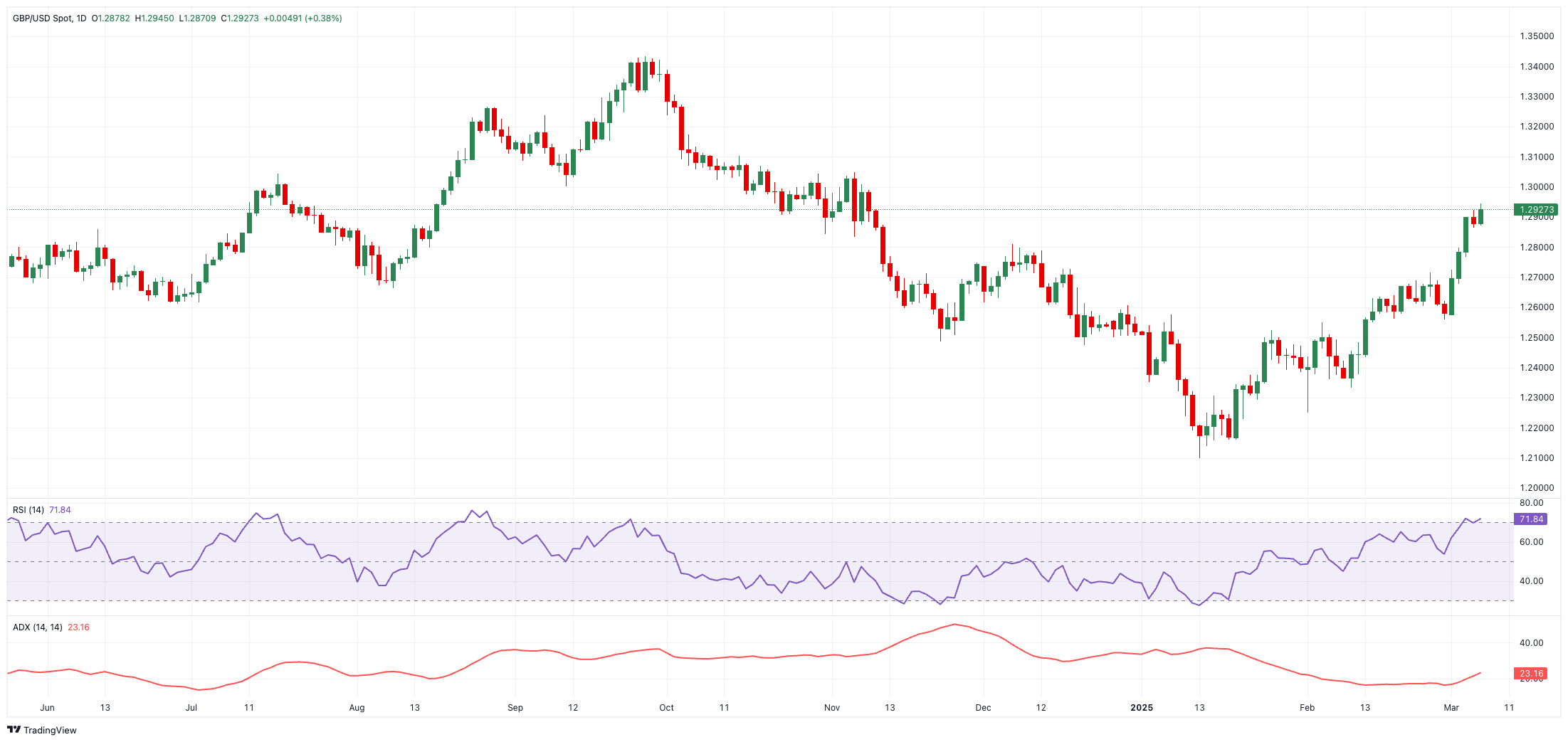
The British pound (GBP) maintained its constructive bias well in place this week, motivating GBP/USD to extend its recovery north of 1.2900 the figure, an area last visited in early November.
The strong move higher in Cable came almost exclusively on the back of the firm and persistent selling impulse in the US Dollar (USD), which remained at the mercy of the White House’s alternating mood regarding the implementation of tariffs.
Also underpinning the solid tone around the sterling, 10-year gilt yields rose to multi-week lows near the 4.80% level, running out of some steam afterwards.
European optimism helps GBP
Extra support for the British pound also came in the form of a generalised improvement in the sentiment on the old continent, which was particularly exacerbated following the pathetic meeting between President Trump and Ukraine’s Volodymyr Zelenskyy at the White Hose.
Indeed, European leaders have united in support of Ukraine, aiming to secure a peace agreement, and have committed to significantly boosting defence spending amid shifting United States (US) priorities under President Donald Trump.
Furthermore, around $1 trillion in new investments—fueled by Germany’s landmark shift in fiscal policy to free up spending on defence and infrastructure, along with increased joint borrowing by the European Union—has dramatically revitalized investor confidence in the region.
Tariff concerns cloud the outlook
In light of the incipient trade war, Megan Greene, a member of the Bank of England’s (BoE) Monetary Policy Committee (MPC), noted that there was uncertainty about the extent to which the United States would implement tariffs and how other countries would respond.
She explained that tariffs could affect the United Kingdom (UK) economy in various ways. Greene stated that if tariffs were imposed on UK goods destined for the US, they would “put downward pressure” on the economy by making it harder for firms to sell to American consumers, although such tariffs might also help lower inflation.
She warned that if supply chains fragmented and had to be reorganized, it would likely hinder UK growth and push inflation higher. Ultimately, Greene asserted that tariffs would depress growth and emphasized the “tonne of uncertainty” surrounding President Trump’s tariff policy, suggesting that the negative impacts on UK economic activity would probably outweigh any potential benefits.
Professor Alan Taylor, also a committee member, concurred by indicating that the risks posed by the tariffs outweighed the upsides—a sentiment he said applied not only to the UK but to countries around the world.
It is worth noting that the United States is the UK’s largest export partner, accounting for more than 15% of all goods exports.
A more prudent Bank of England
Following the February rate cut, BoE policymakers remained cautious regarding the potential next steps by the “Old Lady”.
At this week’s Treasury Select Hearing on the February Monetary Policy Report, Governor Andrew Bailey said that Britain's weakening economy had reduced the likelihood that an anticipated rise in headline inflation this year would result in persistent price pressures.
MPC member Megan Greene stated that the disinflationary trend was probably on track, adding that tariffs would likely weigh on overall growth, though their impact on UK inflation remained unclear.
Finally, Chief Economist Huw Pill remarked that current evidence suggested caution regarding rapid cuts in the Bank Rate, but he acknowledged that further disinflation could enable additional rate reductions later in the year. He also noted that the size and pace of rate cuts would depend on how inflation risks evolved.
Finally, BoE policymaker Catherine Mann said on Thursday that although a near-term increase in inflation was unlikely to cause lasting price issues, she still believed monetary policy should remain restrictive.
On another front, the latest Decision Maker Panel (DMP) revealed that companies anticipate minimal employment growth—just 0.1%—over the coming 12 months. At the same time, businesses now foresee consumer prices rising slightly faster, with inflation expectations nudging up to 3.1% in the three months to February. Firms also indicated they'll hike their own prices by 4.0%, marking a slight acceleration from previous estimates.
All in all, the swaps market anticipates a total of 50 basis points in rate cuts over the coming year.
GBP/USD: Technical view
Pablo Piovano, Senior Analyst at FX Street, notes: “GBP/USD is gearing up for another push higher, with 2025 high of 1.2944 (March 7) squarely in its sights. A decisive break above this level could pave the way for a run at the psychologically significant 1.3000 mark, followed by a test of the November 2024 peak at 1.3047.”
Piovano adds: “On the downside, the 200-day SMA at 1.2787 should offer decent contention ahead of the provisional 100-day SMA at 1.2624. Down from here lies the weekly low of 1.2558 (February 28) and the interim 55-day SMA at 1.2491. Deeper pullbacks would put the February low of 1.2248 (February 3), the 2025 bottom at 1.2099 (January 13), and the weekly low of 1.2069 (October 26) into focus.”
“Meanwhile, the daily RSI remains in overbought territory beyond 71, hinting that the pair may be due for a corrective breather before any sustained move higher. The Average Directional Index (ADX) picked up pace and approached 23, showing some strengthening of the current trend”, Piovano concludes.
Pound Sterling FAQs
The Pound Sterling (GBP) is the oldest currency in the world (886 AD) and the official currency of the United Kingdom. It is the fourth most traded unit for foreign exchange (FX) in the world, accounting for 12% of all transactions, averaging $630 billion a day, according to 2022 data. Its key trading pairs are GBP/USD, also known as ‘Cable’, which accounts for 11% of FX, GBP/JPY, or the ‘Dragon’ as it is known by traders (3%), and EUR/GBP (2%). The Pound Sterling is issued by the Bank of England (BoE).
The single most important factor influencing the value of the Pound Sterling is monetary policy decided by the Bank of England. The BoE bases its decisions on whether it has achieved its primary goal of “price stability” – a steady inflation rate of around 2%. Its primary tool for achieving this is the adjustment of interest rates. When inflation is too high, the BoE will try to rein it in by raising interest rates, making it more expensive for people and businesses to access credit. This is generally positive for GBP, as higher interest rates make the UK a more attractive place for global investors to park their money. When inflation falls too low it is a sign economic growth is slowing. In this scenario, the BoE will consider lowering interest rates to cheapen credit so businesses will borrow more to invest in growth-generating projects.
Data releases gauge the health of the economy and can impact the value of the Pound Sterling. Indicators such as GDP, Manufacturing and Services PMIs, and employment can all influence the direction of the GBP. A strong economy is good for Sterling. Not only does it attract more foreign investment but it may encourage the BoE to put up interest rates, which will directly strengthen GBP. Otherwise, if economic data is weak, the Pound Sterling is likely to fall.
Another significant data release for the Pound Sterling is the Trade Balance. This indicator measures the difference between what a country earns from its exports and what it spends on imports over a given period. If a country produces highly sought-after exports, its currency will benefit purely from the extra demand created from foreign buyers seeking to purchase these goods. Therefore, a positive net Trade Balance strengthens a currency and vice versa for a negative balance.
Author

Pablo Piovano
FXStreet
Born and bred in Argentina, Pablo has been carrying on with his passion for FX markets and trading since his first college years.