GBP/USD Weekly Forecast: Pound Sterling struggles for direction as markets await key US/ UK data
- Pound Sterling wavered in a 130-pips narrow range against the US Dollar, reversing from seven-month lows.
- GBP/USD awaits top-tier US and UK economic data for a fresh directional impetus.
- Technically, Bear Cross on the daily chart and bearish RSI points to more downside for GBP/USD.

The Pound Sterling (GBP) consolidated its recovery from seven-month lows against the US Dollar (USD), as GBP/USD lacked bullish conviction.
Pound Sterling saw a bull-bear tug-of-war
GBP/USD witnessed a bull-bear tug-of-war in the past week, with the recovery sustained by a broad-based US Dollar decline.
Meanwhile, the UK fiscal concerns and increased bets for a Bank of England (BoE) interest rate cut next month remained a drag on the major.
The USD failed to find any inspiration from the end of the longest government shutdown in American history and declined to its lowest level in two weeks against a basket of six major currencies.
The US Senate voted 60-40 on Sunday in the first approval on extending the enhanced Affordable Care Act subsidies early Monday, passing the government funding bill to the House.
On Thursday, the House of Representatives voted 222-209 to end the record shutdown and US President Donald Trump signed it into law.
Risk flows driven by the optimism surrounding the US government reopening, combined with uncertainty over the upcoming economic data undermined the Greenback across the board.
The prudence by Fed officials also failed to provide any relief to USD buyers. During the week, several Fed policymakers remained increasingly divided on how to balance inflation risks against a cooling labor market.
The Fed caution helped markets scale back bets for another 25 basis points (bps) rate cut next month, with the odds of such a move dropping to 51% on Friday versus about 70% seen at the start of the week.
On the other hand, the global market sell-off in the latter part of the week, induced by receding Fed easing bets, dented investors’ sentiment and the risk-sensitive Pound Sterling, capping the GBP/USD pair’s upside.
While the Pound Sterling also suffered from a slowing pay growth and hiring in the United Kingdom (UK). The UK Unemployment Rate rose to 5% in the three months to September, coming in above the 4.9% projected.
Meanwhile, average wage growth was 4.6% in the third quarter, down from 4.7% over the three months to August.
Liz McKeown, Director of Economic Statistics for the Office for National Statistics (ONS), said: "Taken together, these figures point to a weakening labour market.” Weak employment report reinforced hopes of a rate cut by the BoE in December.
The preliminary data published by ONS on Thursday showed that the UK economy grew a meager 0.1% in the third quarter, against a 0.2% increase expected.
Toward the end of the week, the British Pound received another blow after the Financial Times (FT) reported that UK Prime Minister Keir Starmer and Finance Minister Rachel Reeves scrapped plans to raise income tax rates in a massive U-turn less than two weeks from the budget.
Week ahead: High impact UK CPI and Fed Minutes in focus
With the US government shutdown finally ended, markets are eagerly anticipating the release of the missed September economic data in the upcoming week.
As of now, there is no certainty when the data backlog will be cleared. However, if the US Labor Department confirms the Nonfarm Payrolls (NFP) report to be published, it will hog the limelight.
Also in focus will be the Minutes of the Fed’s October meeting and the Consumer Price Index (CPI) from the United Kingdom (UK). Both these events are due on Wednesday.
Heading into the weekend, the UK Retail Sales and the S&P Global preliminary PMI data from both sides of the Atlantic will grab attention on Friday.
Apart from statistics, speeches from the Fed and BoE officials will be closely scrutinized to gauge the path forward on rates from these major central banks.
GBP/USD: Technical outlook
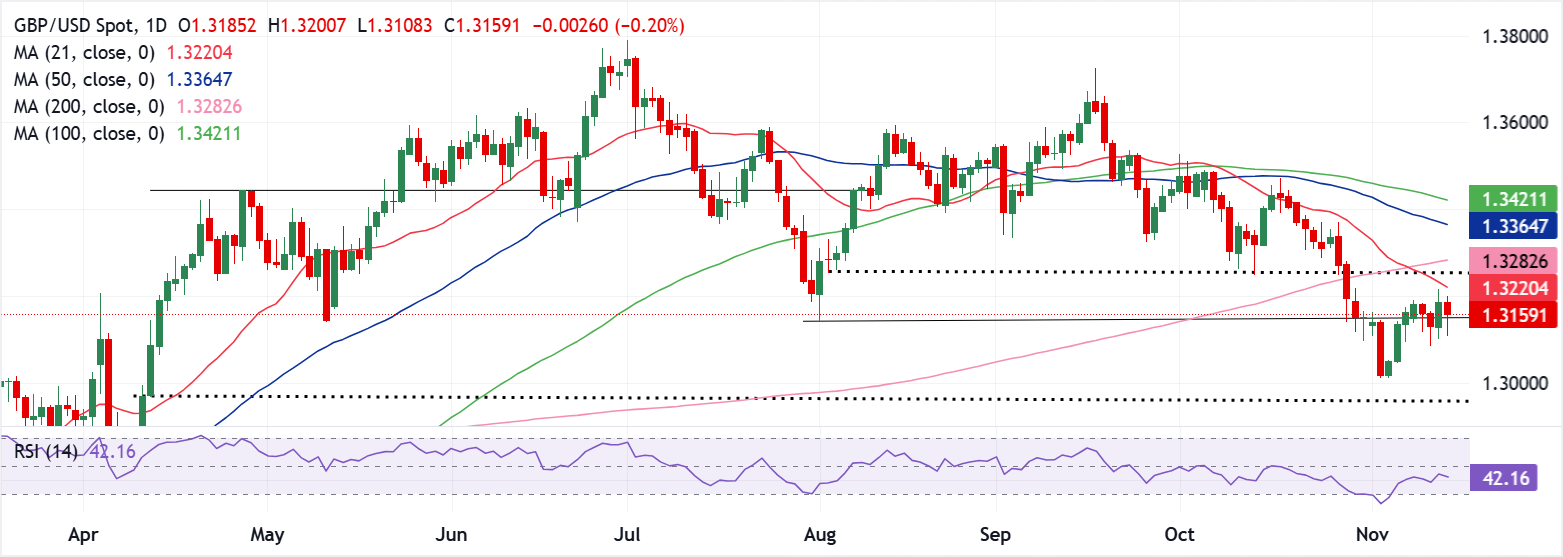
As observed on the daily chart, GBP/USD has paused its recovery from seven-month troughs of 1.3010 just below the downward-sloping 21-day Simple Moving Average (SMA) at 1.3220.
The 14-day Relative Strength Index (RSI) remains well below the midline, currently near 41.50, keeping the bearish potential intact in the pair.
Adding credence to the downside potential, the 21-day SMA and the 200-day SMA Bear Cross remains in play.
GBP/USD must scale the 21-day SMA barrier on a sustained basis to negate the near-term bearish bias.
The next critical supply zone is seen between 1.3255 and 1.3280, where the August 4 low and the 200-day SMA, respectively, align.
Fresh buying opportunities will likely emerge on acceptance above the latter, opening the door toward the 50-day SMA at 1.3365, above which the 100-day SMA at 1.3421 will be tested.
Conversely, if sellers refuse to give in, the immediate support is seen at this week’s low of 1.3085, below which a test of the seven-month low of 1.3010 will be inevitable.
The last line of defense for Pound Sterling buyers is located at the April 11 low of 1.2967.
Pound Sterling FAQs
The Pound Sterling (GBP) is the oldest currency in the world (886 AD) and the official currency of the United Kingdom. It is the fourth most traded unit for foreign exchange (FX) in the world, accounting for 12% of all transactions, averaging $630 billion a day, according to 2022 data. Its key trading pairs are GBP/USD, also known as ‘Cable’, which accounts for 11% of FX, GBP/JPY, or the ‘Dragon’ as it is known by traders (3%), and EUR/GBP (2%). The Pound Sterling is issued by the Bank of England (BoE).
The single most important factor influencing the value of the Pound Sterling is monetary policy decided by the Bank of England. The BoE bases its decisions on whether it has achieved its primary goal of “price stability” – a steady inflation rate of around 2%. Its primary tool for achieving this is the adjustment of interest rates. When inflation is too high, the BoE will try to rein it in by raising interest rates, making it more expensive for people and businesses to access credit. This is generally positive for GBP, as higher interest rates make the UK a more attractive place for global investors to park their money. When inflation falls too low it is a sign economic growth is slowing. In this scenario, the BoE will consider lowering interest rates to cheapen credit so businesses will borrow more to invest in growth-generating projects.
Data releases gauge the health of the economy and can impact the value of the Pound Sterling. Indicators such as GDP, Manufacturing and Services PMIs, and employment can all influence the direction of the GBP. A strong economy is good for Sterling. Not only does it attract more foreign investment but it may encourage the BoE to put up interest rates, which will directly strengthen GBP. Otherwise, if economic data is weak, the Pound Sterling is likely to fall.
Another significant data release for the Pound Sterling is the Trade Balance. This indicator measures the difference between what a country earns from its exports and what it spends on imports over a given period. If a country produces highly sought-after exports, its currency will benefit purely from the extra demand created from foreign buyers seeking to purchase these goods. Therefore, a positive net Trade Balance strengthens a currency and vice versa for a negative balance.
Author

Dhwani Mehta
FXStreet
Residing in Mumbai (India), Dhwani is a Senior Analyst and Manager of the Asian session at FXStreet. She has over 10 years of experience in analyzing and covering the global financial markets, with specialization in Forex and commodities markets.

















