GBP/USD Weekly Forecast: UK Inflation to test Pound Sterling fortunes after hitting fresh two-week high
- GBP/USD hit fresh two-week highs, booking the first weekly gain of 2024.
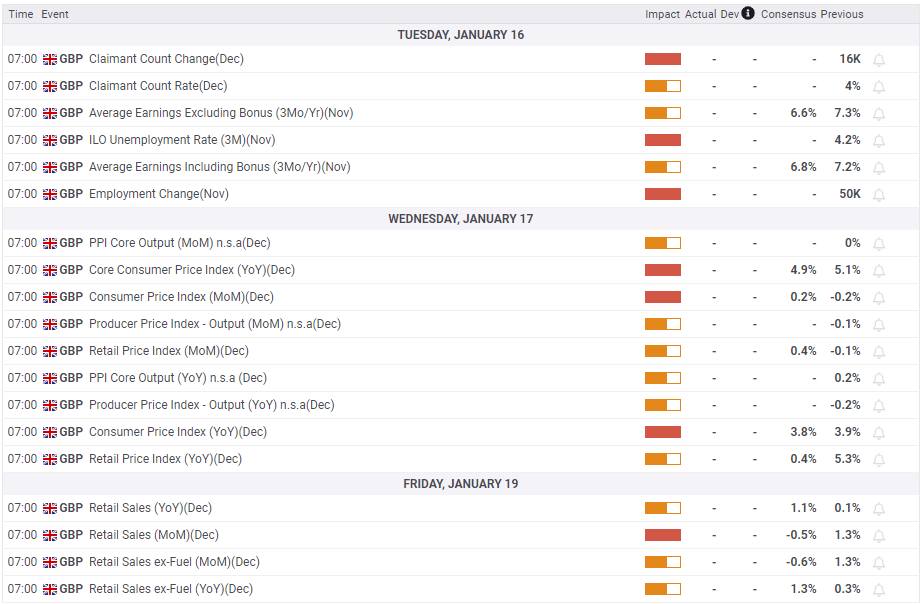
- The focus shifts to top-tier UK employment and inflation data in the week ahead.
- Pound Sterling buyers are likely to face stiff resistance near 1.2900.

The Pound Sterling (GBP) regained the upper hand against the US Dollar (USD) following a muted close to the first week of the new trading year. GBP/USD buyers jumped back into the game, as the monetary policy divergence between the US Federal Reserve (Fed) and the Bank of England (BoE) widened and checked the US Dollar recovery.
US Dollar resumed downtrend, perked up Pound Sterling
The US Dollar demand reduced, as markets continued to price in about a 70% probability that the Fed will cut the interest rate in March even after higher-than-expected US Consumer Price Index (CPI) data in December. Data showed headline CPI rose 0.3% last month, for an annual gain of 3.4%, higher than the expected 0.2% and 3.2%, respectively. Markets are also wagering about 140 pips of Fed rate cuts in 2024.
On the other hand, money markets show traders are close to pricing in four rate cuts by the BoE this year, potentially as early as May, but definitely by June. Speaking before lawmakers in parliament at a Treasury Committee hearing on Wednesday, BoE Governor Andrew Bailey said that he did not wish to comment on the monetary policy "but let's just take the market for a moment - obviously that is feeding through into mortgage costs and I hope that is something that continues."
Additionally, discouraging developments on the plans to prevent a US government shutdown next week weighed on the US Dollar alongside the US Treasury bond yields. A revolt over spending brewed among hard-right House Republicans and Congress heading out of Washington on Thursday for the long holiday weekend negatively affected the sentiment around the Greenback.
However, the upside in the GBP/USD pair was likely capped by escalating geopolitical tensions between the West and Iran-backed Houthi rebels. Following weeks of attacks on ships in the Red Sea by the Iranian-backed Houthi rebels, disrupting global shipping, the US and UK launched airstrikes late Thursday on Houthi targets in Yemen, hitting radar installations, storage sites and missile launchers.
Further, slowing Chinese demand, portrayed by the 2023 exports slump and sustained disinflation in December, sapped investors’ confidence in high beta currencies such as the Pound Sterling.
Furthermore, traders digested the upbeat UK Gross Domestic Product (GDP) data for November and the industrial figures, providing a temporary reprieve to Pound Sterling sellers. Industrial output in the UK rose 0.3% MoM in November 2023, the Office for National Statistics (ONS) showed on Friday. On an annual basis, the reading slipped 0.1%. Meanwhile, the British economy returned to expansion in November, rising 0.3% after contracting 0.3% in October, the latest data published by the Office for National Statistics (ONS) showed on Friday. The market had forecast an expansion of 0.2% in the reported period.
Finally, the US Bureau of Labor Statistics reported on Friday that annual producer inflation, as measured by the change in the Producer Price Index (PPI) for final demand, edged higher to 1% in December from 1.3% in November. The Core PPI remained unchanged on a monthly basis and didn’t allow the USD to stay resilient against its rivals ahead of the weekend.
The week ahead: Top-tier UK data in focus
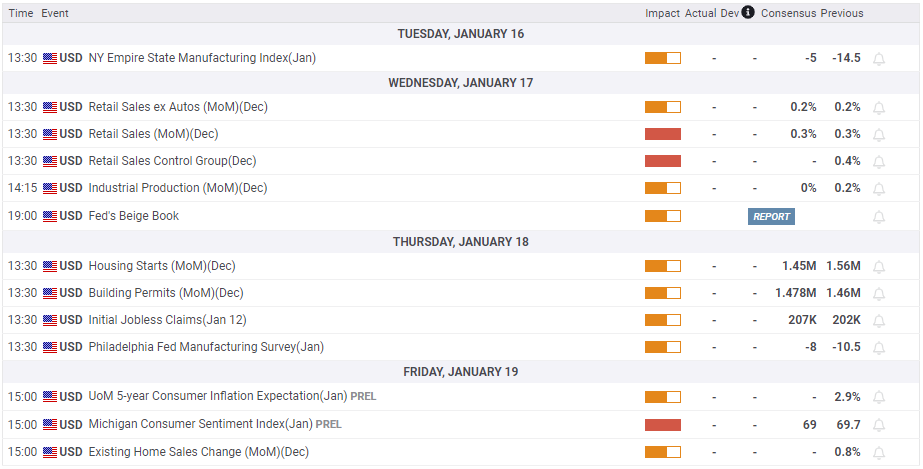
Pound Sterling traders brace for the high-impact employment and inflation data from the United Kingdom (UK) in a holiday-shortened upcoming week. The US markets are closed on Monday, in observance of Martin Luther King Jr. Day.
From the United States economic docket, the first relevant data, the Retail Sales, will feature on Wednesday. The next significant release is on Friday, with the preliminary University of Michigan (UoM) Consumer Sentiment and Inflation Expectations data in the offing.
Besides, speeches from the Fed officials will be closely scrutinized for fresh insights on the timing of the Fed interest rate cuts.
GBP/USD: Technical Outlook
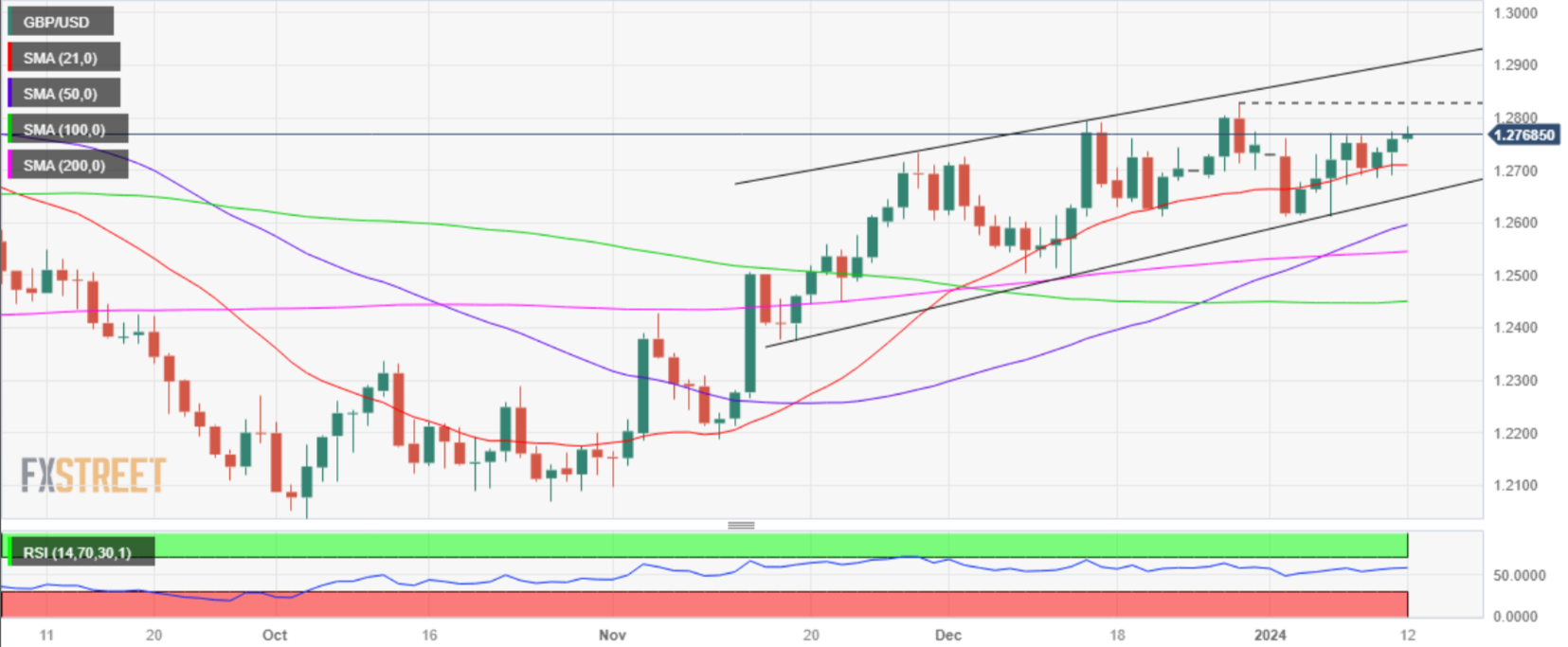
GBP/USD continues to find support at the 21-day Simple Moving Average (SMA) just above 1.2700, as the 14-day Relative Strength Index (RSI) looks north above the 50 level.
The 50- and 200-day SMAs Golden Cross confirmed a week ago also add credence to the Pound Sterling’s bullish potential against the US Dollar.
A firm break above the static resistance near 1.2830 is needed to take on the rising trendline resistance at 1.2900. Acceptance above the latter will yield a rising channel breakout, triggering a fresh uptrend toward the psychological barrier at 1.3000.
If Pound Sterling buyers give in to the bearish pressures, then defending the 21-day SMA at 1.2710 will be critical. A sustained move below the latter will call for a test of the channel support at 1.2651.
Daily closing below the key support could validate a breakdown from a two-month-old rising channel formation, exposing the ascending 50-day SMA support at 1.2596 and the horizontal 200-day SMA at 1.2545.
Pound Sterling FAQs
What is the Pound Sterling?
The Pound Sterling (GBP) is the oldest currency in the world (886 AD) and the official currency of the United Kingdom. It is the fourth most traded unit for foreign exchange (FX) in the world, accounting for 12% of all transactions, averaging $630 billion a day, according to 2022 data.
Its key trading pairs are GBP/USD, aka ‘Cable’, which accounts for 11% of FX, GBP/JPY, or the ‘Dragon’ as it is known by traders (3%), and EUR/GBP (2%). The Pound Sterling is issued by the Bank of England (BoE).
How do the decisions of the Bank of England impact on the Pound Sterling?
The single most important factor influencing the value of the Pound Sterling is monetary policy decided by the Bank of England. The BoE bases its decisions on whether it has achieved its primary goal of “price stability” – a steady inflation rate of around 2%. Its primary tool for achieving this is the adjustment of interest rates.
When inflation is too high, the BoE will try to rein it in by raising interest rates, making it more expensive for people and businesses to access credit. This is generally positive for GBP, as higher interest rates make the UK a more attractive place for global investors to park their money.
When inflation falls too low it is a sign economic growth is slowing. In this scenario, the BoE will consider lowering interest rates to cheapen credit so businesses will borrow more to invest in growth-generating projects.
How does economic data influence the value of the Pound?
Data releases gauge the health of the economy and can impact the value of the Pound Sterling. Indicators such as GDP, Manufacturing and Services PMIs, and employment can all influence the direction of the GBP.
A strong economy is good for Sterling. Not only does it attract more foreign investment but it may encourage the BoE to put up interest rates, which will directly strengthen GBP. Otherwise, if economic data is weak, the Pound Sterling is likely to fall.
How does the Trade Balance impact the Pound?
Another significant data release for the Pound Sterling is the Trade Balance. This indicator measures the difference between what a country earns from its exports and what it spends on imports over a given period.
If a country produces highly sought-after exports, its currency will benefit purely from the extra demand created from foreign buyers seeking to purchase these goods. Therefore, a positive net Trade Balance strengthens a currency and vice versa for a negative balance.
Author

Dhwani Mehta
FXStreet
Residing in Mumbai (India), Dhwani is a Senior Analyst and Manager of the Asian session at FXStreet. She has over 10 years of experience in analyzing and covering the global financial markets, with specialization in Forex and commodities markets.















