GBP/USD Weekly Forecast: Further gains appear likely in the near term
- The Pound Sterling clinched its second week in a row of gains, nearing 1.3600.
- The cautious stance from the Bank of England continues to support the currency.
- Investors’ attention now gyrates to the release of crucial UK inflation figures.

The Pound Sterling (GBP) extended its multi-day march north against the US Dollar (USD) this week, lifting GBP/USD to levels just shy of the 1.3600 hurdle. The uptick in Cable was also underpinned by the equally strong recovery in 10-year gilt yields, which rose to levels last seen in early June, past 4.70% on Friday.
The US Dollar and the BoE underpin the rally
GBP/USD closed in the red in only two days since the beginning of August, gaining more than 4 cents since lows around 1.3140 recorded on August 1, and currently navigating around the 38.2% Fibo retracement of the July-August steep decline.
Cable’s strong rebound comes in part due to the renewed weakness surrounding the Greenback so far this month, as progress on the trade front, coupled with expectations of further rate cuts by the Federal Reserve (Fed), left the US Dollar on the defensive. In the same direction, persistent threats from US President Donald Trump to the Fed’s independence also added an extra layer of bearishness to the currency’s near-term outlook.
Contributing to the pick-up in the upside impulse of the British Pound, the latest close decision by the Bank of England (BoE) to lower its policy rate to 4.00% seems to have kicked back the spectre of a more aggressive easing cycle.
In fact, the ‘Old Lady’ finds itself caught in a tug-of-war, with both markets and its own policymakers split on what could come next.
On one side, the United Kingdom’s (UK) labour market has been losing steam, squeezed by Chancellor Rachel Reeves’ recent employer tax hike and fallout from US President Trump’s trade war. On the other, inflation is moving in the wrong direction. The BoE has lifted its forecast for a September peak to 4% from 3.7%, warning that rising prices — especially for food — could feed into wage demands and embed longer-term cost pressures.
Furthermore, in its latest projections, the central bank pushed back its timeline for returning inflation to the 2% target, now not expected until Q2 2027 — three months later than previously thought.
Meanwhile, markets now price in nearly 28 basis points of easing through the March 2026 monetary policy meeting, consistent with roughly a quarter-point rate cut in the next seven months.
What’s next for GBP?
On the domestic calendar, all the attention is expected to be on the publication of the July Inflation Rate, seconded by the preliminary gauges of business activity in the form of S&P Global Manufacturing and Services PMIs.
Expanding the view, the Jackson Hole Symposium should keep the central banks’ galaxy at the centre of the debate, with Chief Jerome Powell due to speak on August 22 and BoE’s Governor Andrew Bailey on August 23.
Also of note will be the release of the FOMC Minutes of the July 29-30 meeting, as well as usual comments from Fed officials.
What are techs saying?
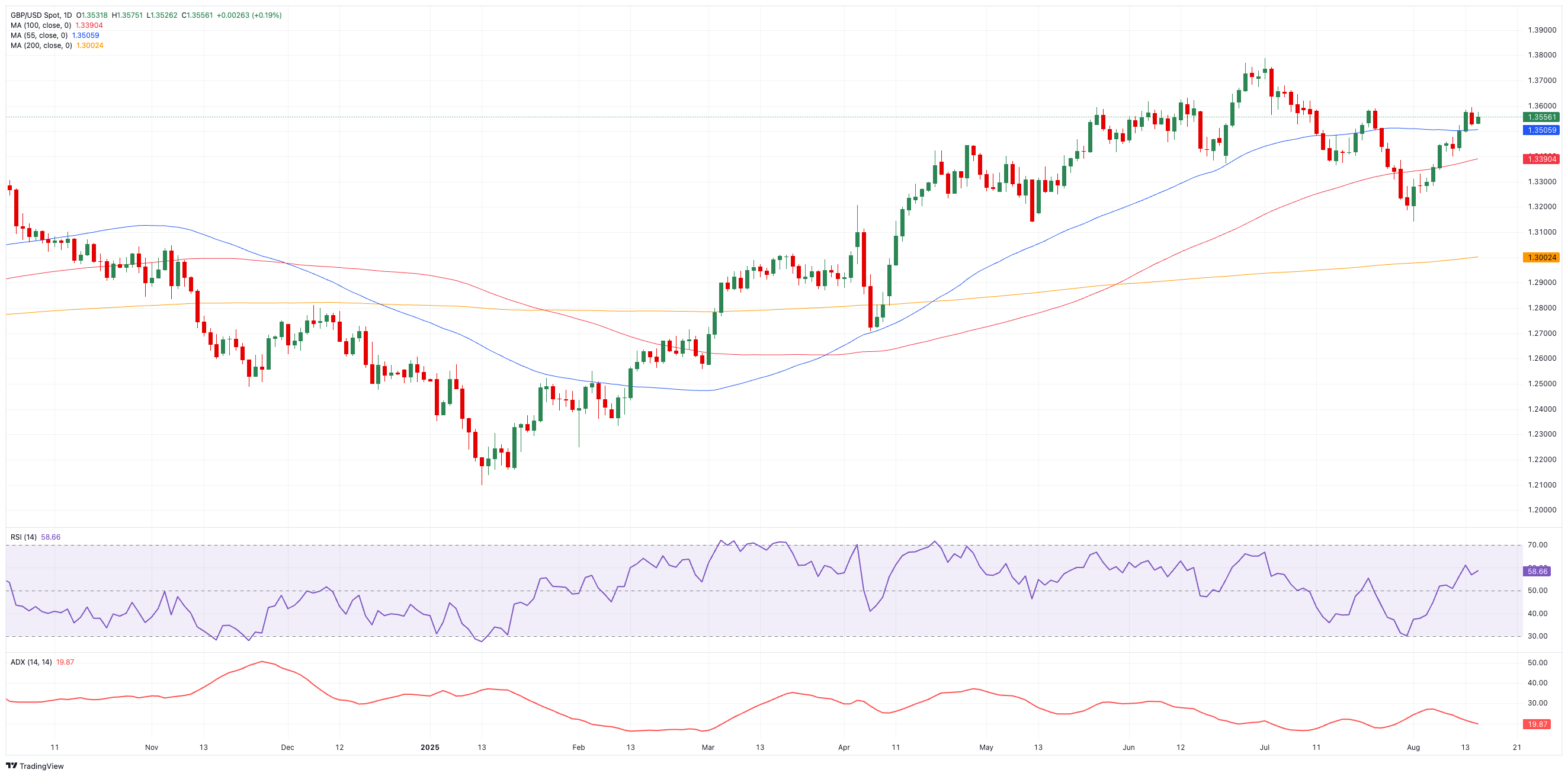
GBP/USD is expected to meet its next up barrier at its August top at 1.3594 (August 14). The surpassing of that level would pave the way for Cable to confront the weekly peak at 1.3588 (July 24), ahead of its 2025 ceiling at 1.3788 (July 1).
On the flip side, there is an interim support at the 100-day SMA at 1.3386, seconded by the August base of 1.3141 (August 1), which is closely followed by the May floor at 1.3139 (May 12). A breach below the latter would shift focus to the psychological 1.3000 threshold.
In the meantime, while above its 200-day SMA at 1.3003, GBP/USD should maintain its constructive outlook well in place.
Momentum indicators look mixed: The Relative Strength Index (RSI) near 60 keeps the door open to extra gains in the short-term horizon, although the Average Directional Index (ADX) below 20 is indicative that the trend lacks juice for now.
GBP/USD daily chart
All in all
Latest UK GDP figures showed the domestic economy is not faring as badly as many have expected, although the broader outlook remains far from bright. This, coupled with stubbornly elevated inflation and somewhat cooling labour market conditions, should keep bolstering the current cautious stance from the BoE going forward. And there is the fiscal front, with Chancellor Reeves in the eye of the storm. The British Pound should remain comfortable navigating against this backdrop, although bouts of instability surrounding trade and the potential Fed’s policy path carry the potential to make any march north in the quid at least bumpy for the time being.
Pound Sterling FAQs
The Pound Sterling (GBP) is the oldest currency in the world (886 AD) and the official currency of the United Kingdom. It is the fourth most traded unit for foreign exchange (FX) in the world, accounting for 12% of all transactions, averaging $630 billion a day, according to 2022 data. Its key trading pairs are GBP/USD, also known as ‘Cable’, which accounts for 11% of FX, GBP/JPY, or the ‘Dragon’ as it is known by traders (3%), and EUR/GBP (2%). The Pound Sterling is issued by the Bank of England (BoE).
The single most important factor influencing the value of the Pound Sterling is monetary policy decided by the Bank of England. The BoE bases its decisions on whether it has achieved its primary goal of “price stability” – a steady inflation rate of around 2%. Its primary tool for achieving this is the adjustment of interest rates. When inflation is too high, the BoE will try to rein it in by raising interest rates, making it more expensive for people and businesses to access credit. This is generally positive for GBP, as higher interest rates make the UK a more attractive place for global investors to park their money. When inflation falls too low it is a sign economic growth is slowing. In this scenario, the BoE will consider lowering interest rates to cheapen credit so businesses will borrow more to invest in growth-generating projects.
Data releases gauge the health of the economy and can impact the value of the Pound Sterling. Indicators such as GDP, Manufacturing and Services PMIs, and employment can all influence the direction of the GBP. A strong economy is good for Sterling. Not only does it attract more foreign investment but it may encourage the BoE to put up interest rates, which will directly strengthen GBP. Otherwise, if economic data is weak, the Pound Sterling is likely to fall.
Another significant data release for the Pound Sterling is the Trade Balance. This indicator measures the difference between what a country earns from its exports and what it spends on imports over a given period. If a country produces highly sought-after exports, its currency will benefit purely from the extra demand created from foreign buyers seeking to purchase these goods. Therefore, a positive net Trade Balance strengthens a currency and vice versa for a negative balance.
Author

Pablo Piovano
FXStreet
Born and bred in Argentina, Pablo has been carrying on with his passion for FX markets and trading since his first college years.

















