GBP/USD Weekly Forecast: 1.2550 back in sight ahead of BoE, US NFP
- GBP/USD sold off at 1.3000 as US Dollar bulls jumped back.
- Bank of England rate decision and US Nonfarm Payrolls will stand out in another busy week.
- GBP/USD sellers are likely to retain control as the daily technical setup turns bearish.

The Pound Sterling extended its correction against the United States Dollar (USD), sending GBP/USD back toward the 1.2700 round level before a late rebound on Friday. The additional downside in the pair, however, depends on the Bank of England (BoE) interest-rate decision and the US Nonfarm Payrolls data scheduled for the week ahead.
GBP/USD: What happened last week?
The GBP/USD pair enjoyed good two-way price action during the week, courtesy of the volatility surrounding the US Dollar amidst critical economic events in the United States. The UK calendar was relatively data-light but the disappointing preliminary S&P Global Purchasing Managers' Index (PMI) reports on Monday checked the rebound in the Pound Sterling from multi-day lows set at 1.2797 against the Greenback. The S&P Global/CIPS composite PMI showed a preliminary reading of 50.7, down from 52.8 in June in the biggest drop in 11 months.
However, the GBP/USD turnaround gathered steam during midweek after the US Federal Reserve (Fed) policy announcements were widely viewed as dovish, which smashed the US Dollar broadly alongside US Treasury bond yields. GBP/USD, therefore, extended gains and hit fresh six-day highs just shy of the 1.3000 mark before reversing sharply on Thursday.
Resurgent US Dollar demand across the board emerged as the main reason behind the pullback in the pair during the latter part of the week. Impressive US growth and jobs data added credence to signs of resilience in the world’s largest economy, reviving hawkish Fed expectations.
The US economy surprisingly accelerated to a 2.4% annualized growth rate in the June quarter against 1.8% expected and a 2% growth recorded in the first quarter. According to the US Department of Commerce, in seasonally adjusted terms Durable Goods Orders jumped 4.7% on a monthly basis to reach $302.5 billion. Meanwhile, the latest data published by the US Department of Labor (DOL) showed that Initial Jobless Claims decreased by 7,000 to 221,000 in the week ending July 22.
Unabated US Dollar buying led to a sharp decline in the GBP/USD pair, as Pound Sterling sellers retested the 1.2750 demand area on Friday. In the second half of the day, the US Dollar lost its strength and allowed the pair to stage a rebound. Inflation in the US, as measured by the change in Personal Consumption Expenditures (PCE) Price Index, fell to 3% on a yearly basis in June from 3.8% in May, the US Bureau of Economic Analysis reported. Core PCE Price Index, which excludes volatile food and energy prices, arrived at 4.1% on a yearly basis, down from 4.6% in May and below the market forecast of 4.2%.
Week ahead: BoE, US NFP eagerly awaited
With the Fed event out of the way, attention turns toward the critical BoE policy announcements and the United States employment report due later in the week ahead.
It’s another busy week, starting off with the Chinese official Manufacturing and Non-manufacturing PMI reports on Monday. That day, the UK and US economic docket is devoid of any top-tier data releases. Therefore, Tuesday’s ISM Manufacturing PMI and JOLTS Job Openings data could impact the US Dollar valuations as it will provide fresh cues on the health of the US economy. Traders will also look at the final S&P Global Manufacturing PMI readings from both economies on the second trading day of the week.
The UK calendar is data-empty on Wednesday but the US will feature the high-impact ADP Employment Change data, potentially triggering a big move in the Greenback and the GBP/USD pair. The next day is a ‘Super Thursday’, as the Bank of England (BoE) rate decision will be accompanied by the Minutes of the meeting and the Monetary Policy Report.
BoE Governor Andrew Bailey will hold a press conference at 11:30 GMT following the meeting. The central bank is in a dilemma whether to go for a 50 basis points (bps) or 25 bps rate hike, as economic growth remains fragile, the labor market is tight and inflation is cooling. Final S&P Global Services PMI reports from both sides of the Atlantic will be also reported on Thursday, and the ISM Services PMI will be closely watched in American trading.
On Friday, BoE Chief Economist Huw Pill will speak ahead of the all-important US Nonfarm Payrolls report. The Average Hourly Earnings, indicating wage inflation, will hold the key for fresh bets on the Fed’s interest-rate path.
Besides, Fed policymakers will return to the rostrum and their comments will help reprice market expectations over the Fed’s tightening outlook.

GBP/USD: Technical outlook
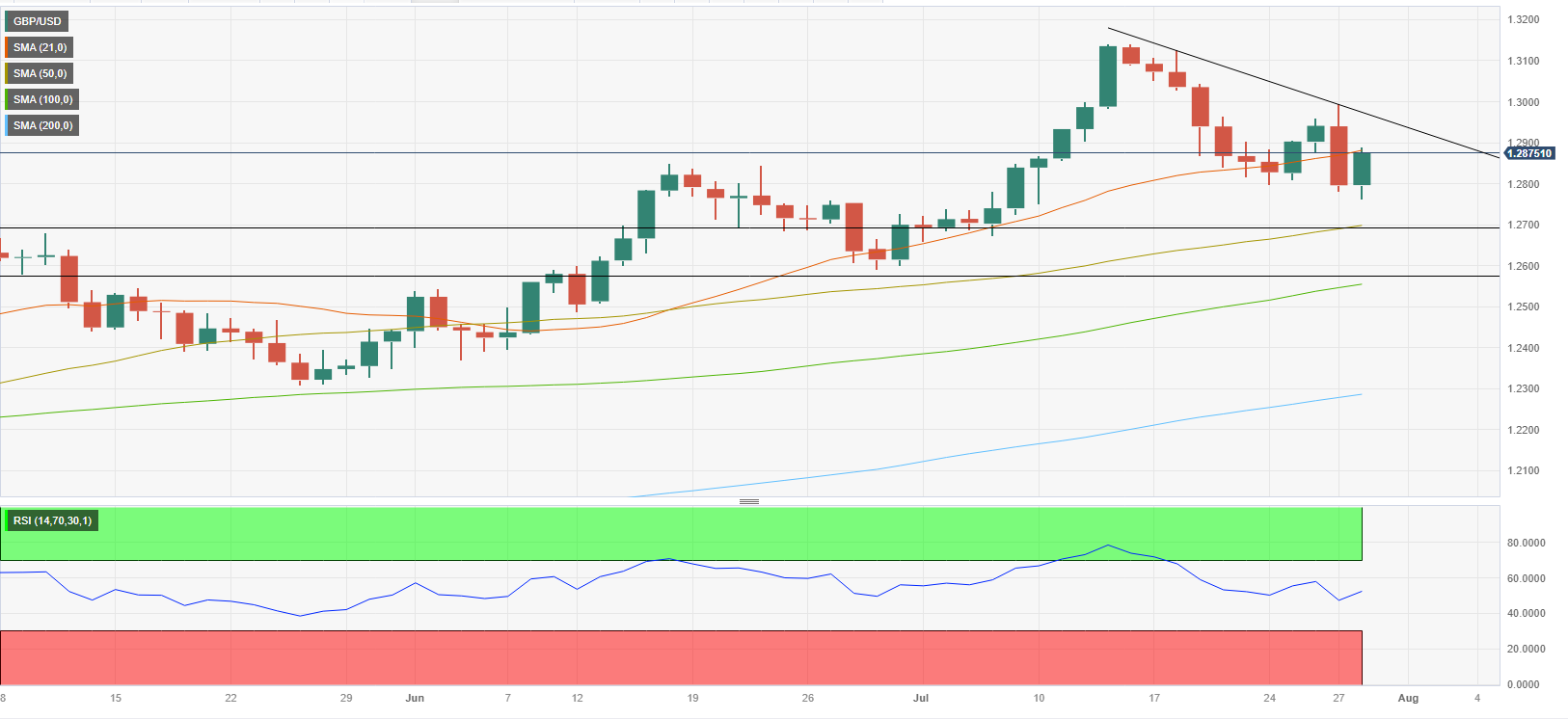
GBP/USD looks vulnerable heading into the BoE week, especially after it yielded a close below the critical short-term 21-Day Simple Moving Average (SMA) below 1.2900 on Thursday.
If the downside momentum gains traction, Pound Sterling buyers could look out for immediate support of the confluence zone around 1.2680, where the ascending 50-day SMA and the July 6 low coincide.
Additional support will be found at the June 29 low of 1.2591, below which a sharp sell-off toward the bullish 100-day SMA at 1.2553 will be inevitable. The move lower appears more compelling for GBP/USD, as the 14-day Relative Strength Index (RSI) indicator sits beneath the 50 threshold.
Conversely, a rebound attempt by the pair could run into stiff resistance at the 21-day SMA support-turned-resistance at around 1.2990, as observed on Friday. Pound Sterling buyers need to find a strong foothold above this level to resume their journey toward the descending trendline resistance at 1.2976.
Further up, the 1.3000 psychological level and the 15-month highs of 1.3142 will be on buyers’ radars.
GBP/USD: Forecast Poll
FXStreet Forecast Poll shows that a large portion of polled experts expect GBP/USD to edge lower next week. The one-month outlook, however, paints a mixed picture, with the average target aligning slightly above 1.2800.
 12.32.20-638261551493135470.png)
Author

Dhwani Mehta
FXStreet
Residing in Mumbai (India), Dhwani is a Senior Analyst and Manager of the Asian session at FXStreet. She has over 10 years of experience in analyzing and covering the global financial markets, with specialization in Forex and commodities markets.