GBP/USD quantum microstructure

Executive overview: Beyond linear technical noise
While retail chartists continue to debate subjective trendlines and lagging oscillators, the microstructure of GBP/USD on the Daily horizon is executing an exact mathematical trajectory governed by multi-dimensional liquidity balance and kinetic energy conservation.
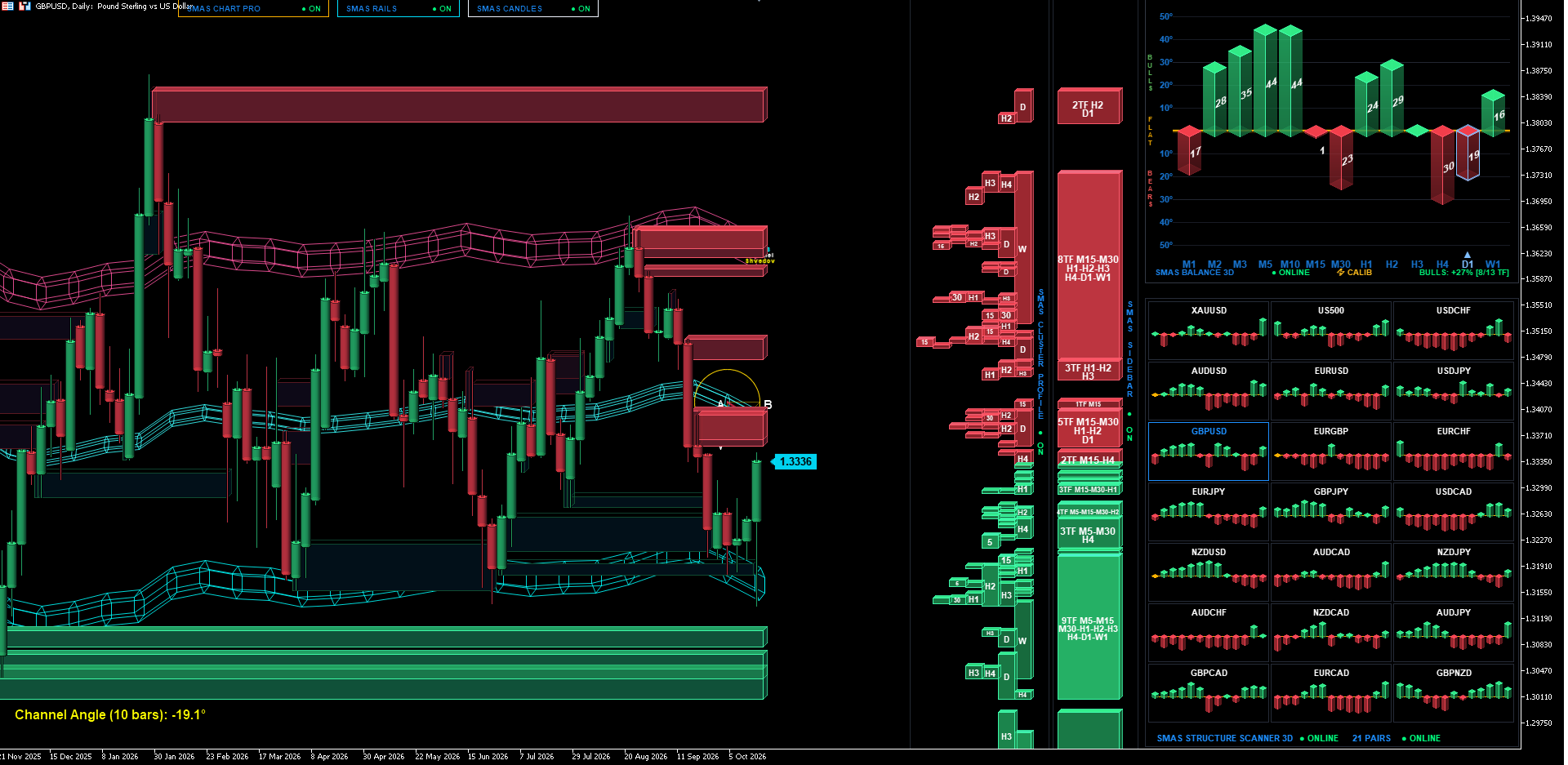
Utilizing the SMAS 3D, we strip away the surface noise of chronological candlesticks and project market forces onto an invariant multi-scale spatial manifold. The current telemetry across our 14-timeframe structural tensor reveals a profound macroeconomic inflection point: a verified -19.1° directional slope driving price into a massive downward liquidity vacuum, bounded by two multi-order continental plates of institutional capital.
Structural trajectory: The -19.1° Gauss regression vector
Examining the central kinetic conduit via the SMAS Structure Engine 3D, the structural equilibrium spine has broken away from the multi-month distribution ceiling and is locked into an invariant downward gradient of -19.1° (measured via radial circular topology A−B−V).
- Kinetic displacement: Price action at 1.3336 has breached the median equilibrium spine and is accelerating through laminar downward flow.
- No curve-fitting: Unlike lagging moving averages that balloon upon volatility spikes, the 3D Gaussian rails remain rigidly calibrated to institutional base centroids, projecting an unpolluted, noise-free vector of capital reallocation out of Sterling into the US Dollar.
The overhead ceiling: The 8th-order super-cluster (1.3620 – 1.3850)
Looking directly into the vertical liquidity distribution via the SMAS Sidebar 3D and Cluster Profile 3D, the institutional battlefield becomes crystal clear:
Overhead price territory is fortified by a monumental 8th-Order Super-Cluster (8TF: M15-M30-H1-H2-H3-H4-D1-W1) anchored between 1.3620 and 1.3850.
- Microstructure meaning: Eight completely independent temporal horizons have converged their accumulation centroids at this exact price coordinate.
- The verdict: The probability of retail buying pressure overcoming an 8th-order titanium plate without a massive central bank monetary shock is statistically less than 1%. Any relief rallies into the 1.3450–1.3500 intermediate cluster (5TF/3TF) represent high-convexity institutional liquidity harvesting to feed additional short positions.
The downward liquidity vacuum: Gravitational pull toward the 9TF Massif
Beneath current price action (1.3336), the Sidebar 3D reveals an Asymmetric Structural Void. Minor intraday demand pockets have experienced volume exhaustion, leaving price in a frictionless gravitational slide.
- The ultimate attractor: Deep at the bottom of the spatial manifold lies the supreme institutional boundary: an extraordinary 9th-Order Super-Massif (9TF: M5-M15-M30-H1-H2-H3-H4-D1-W1) resting at 1.2970 – 1.3120.
- In stochastic physics, when an energetic particle breaks through intermediate resistance in a vacuum, it is magnetically drawn to the nearest high-density gravitational basin. The market is traversing this corridor toward the 1.3050–1.2980 terminal boundary.
Phase telemetry: The spring compression divergence
Scanning the top-right SMAS Balance 3D multi-timeframe histogram, we observe a classic Phase Desynchronization pattern:
- Micro-scale counter-current: Junior slices (M1, M2, M3, M5, M10) show temporary green luminescence (Bulls +27% across 8/13 TF with micro-angles reaching +28∘⋯+44∘).
- Macro domination: Concurrently, the senior continental massifs (H4 at -30°, D1 at -19°) remain firmly anchored in negative structural territory.
- Interpretation: This is not a structural trend reversal. It is the textbook Spring Compression Divergence—intraday short-covering absorbing residual floating supply before the senior macro-locomotive reasserts its dominant downward thrust.
Actionable institutional strategy and key coordinates
Based on the synthesis of the 5D manifold, professional desks should align exclusively with the dominant macro vector:
- Primary trajectory: Bearish continuation toward the 9th-Order terminal demand floor.
- Optimal short staging corridor: Pullbacks into the intermediate 3TF/5TF cluster at 1.3420 – 1.3475.
- Structural invalidation (stop-loss): Strictly beyond the senior cluster ceiling above 1.3520 (limiting risk to a narrow, mathematically defined corridor).
- Primary target 1: 1.3180 (Upper boundary of the macro demand shelf).
Terminal target 2: 1.3020 – 1.2980 (Full collision with the 9TF Titanium Super-Massif, where 95.45% of kinetic energy will deplete, signaling total profit realization and preparing for a major structural bounce).
Author

Andrey Shvedov
SMAS Quantum Research
Andrey Shvedov is an active quantitative trader, software architect, and financial market researcher with over 24 years of live market microstructure experience.