GBP/USD Price Forecast: Bulls shrug off dismal UK data amid weaker USD; not out of the woods yet
- GBP/USD reverses an intraday dip on Thursday as the USD selling remains unabated.
- Economic concerns and Fed rate cut bets continue to undermine demand for the buck.
- The disappointing UK macro data reaffirms dovish BoE expectations and caps the GBP.

The GBP/USD pair attracts some dip-buyers near the 1.3100 mark during the early European session on Thursday, and for now, seems to have snapped a two-day losing streak amid the underlying bearish sentiment surrounding the US Dollar (USD). That said, the disappointing release of UK macro data reaffirms dovish Bank of England (BoE) bets, which, along with concerns about the UK's fiscal situation, could act as a headwind for the British Pound (GBP) and cap gains for the currency pair.
US President Donald Trump signed a stopgap spending bill to reopen the federal government, ending the longest shutdown in American history. The USD selling bias, however, remains unabated amid concerns about weakening economic momentum on the back of a record 43-day US government shutdown. In fact, economists estimate that the prolonged government closure might have already shaved approximately 1.5 to 2.0% off quarterly GDP growth. Moreover, signs of a deteriorating US labor market back the case for more policy easing by the Federal Reserve (Fed), which keeps the USD depressed near a two-week low.
Meanwhile, preliminary figures published by the UK Office for National Statistics showed that the economy grew a meager 0.1% in the July to September period, down from 0.3% in the previous quarter and missing estimates for a 0.2% rise. Furthermore, the monthly GDP print revealed that the UK economy actually contracted by 0.1% in September. The data reaffirmed expectations that the BoE will cut interest rates next month. This might keep a lid on the GBP and the GBP/USD pair as investors await details on the widely anticipated tax increases when UK Chancellor Rachel Reeves presents the budget on November 26. Hence, it will be prudent to wait for strong follow-through selling before confirming that the currency pair has bottomed out.
With government agencies expected to reopen soon, the blackout on key US economic data will also come to an end. Market participants expect long-delayed reports to roll out over the next week, which might offer the real picture of how the economy held up through the shutdown. In the meantime, speeches from a slew of influential FOMC members for cues about the Fed's rate-cut path. This, in turn, will play a key role in driving the USD demand later during the North American session and providing some impetus to the GBP/USD pair. The aforementioned fundamental backdrop, however, warrants caution for bullish traders.
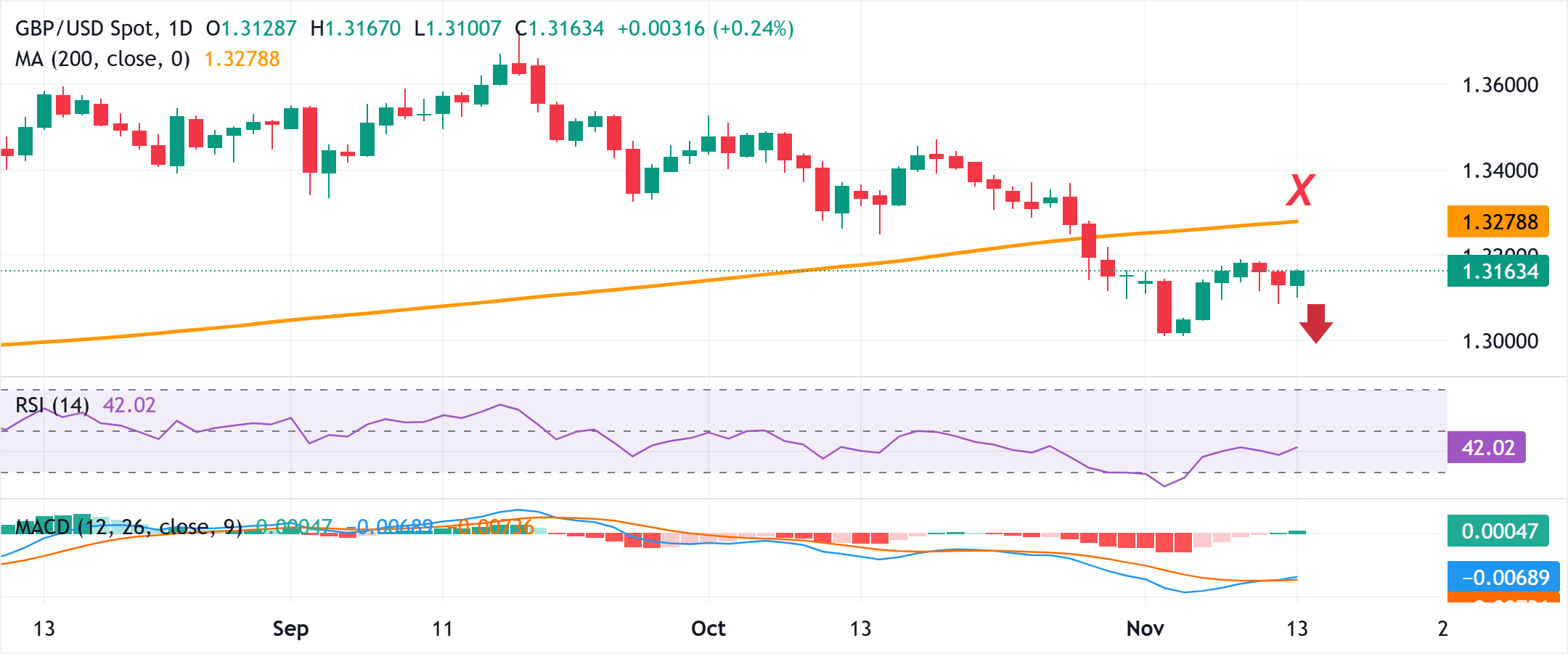
GBP/USD daily chart
Technical Outlook
The recent breakdown below a technically significant 200-day Simple Moving Average (SMA) was seen as a key trigger for the GBP/USD bears. Moreover, the daily Relative Strength Index (RSI) has moved out of the oversold territory, which, along with negative oscillators on the daily chart, suggests that the recovery from the vicinity of the 1.3000 psychological mark could fizzle out rather quickly.
Hence, it will be prudent to wait for some follow-through buying beyond the weekly swing high, around the 1.3190 region, before positioning for further gains. The GBP/USD pair might then aim towards challenging the 200-day SMA, currently pegged near the 1.3275-1.3280 region, which should act as a key pivotal point for short-term traders.
On the flip side, the 1.3100-1.3085 zone could act as an immediate support, below which the GBP/USD pair could aim to retest the 1.3000 mark, or the lowest level since April, touched last week. Some follow-through selling should pave the way for deeper losses towards the 1.2950 intermediate support before spot prices eventually drop to sub-1.2900 levels.
Author

Haresh Menghani
FXStreet
Haresh Menghani is a detail-oriented professional with 10+ years of extensive experience in analysing the global financial markets.