GBP/USD Outlook: Lack of buying favours bearish traders close to key 200-day SMA
- GBP/USD fails to attract any meaningful buying despite a modest USD weakness.
- Diminishing odds for more aggressive BoE rate hikes undermine the British Pound.
- Uncertainty over the Fed rate-hike path weighs on the buck and lends support.

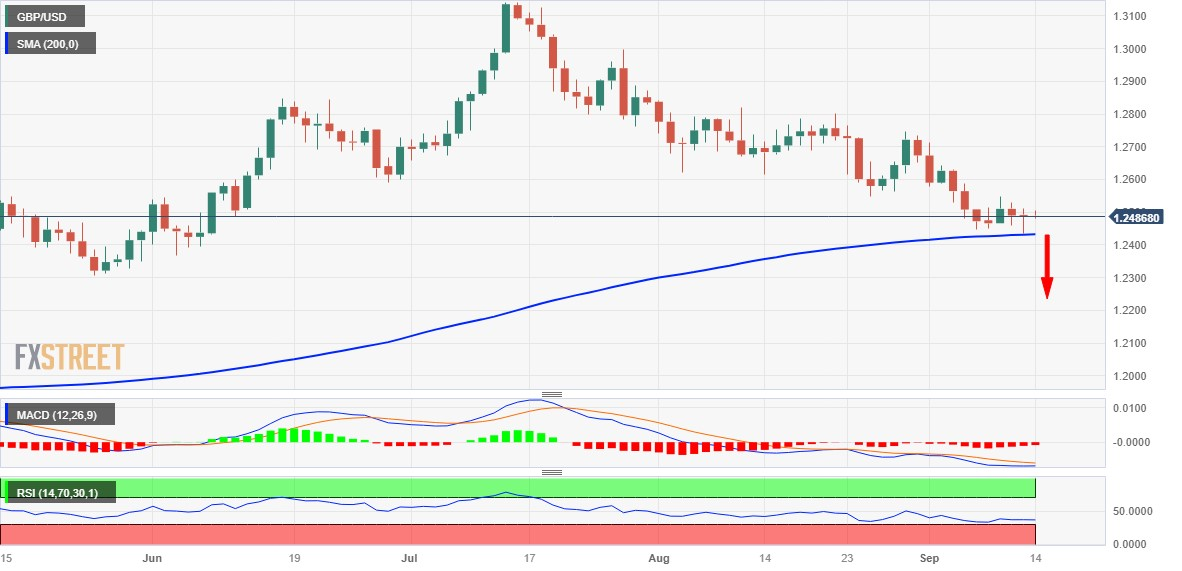
The GBP/USD pair struggles to capitalize on the overnight bounce from the vicinity of a technically significant 200-day Simple Moving Average (SMA) and oscillates in a narrow range on Thursday. Spot prices remain below the 1.2500 psychological mark through the early part of the European session and well within the striking distance of over a three-month trough touched on Wednesday.
The British Pound (GBP) continues with its relative underperformance in the wake of diminishing odds for a more aggressive policy tightening by the Bank of England (BoE), which is seen acting as a headwind for the GBP/USD pair. The Office for National Statistics reported that Britain’s economy shrank at the quickest pace in seven months in July, by 0.5%, reviving recession fears. This, along with signs that the UK labour market is cooling, puts pressure on the BoE to pause its rate-hiking cycle.
Markets, however, are still pricing in a greater chance of a 25 bps lift-off at the September 21 BoE meeting. Moreover, the odds for another rate hike in November are around 30% and the first rate cut is still not priced in until H2 2024. In contrast, the US consumer inflation figures released on Wednesday added to the thesis that the Federal Reserve (Fed) will keep interest rates steady at next week's policy meeting. This prompts fresh US Dollar (USD) selling and is seen lending support to the GBP/USD pair.
The US Bureau of Labor Statistics (BLS) reported that the headline US CPI increased to 3.7% on a yearly basis in August from 3.2% in July, slightly above expectations for a reading of 3.6%. The monthly print, however, matched forecasts and came in at 0.6%. Meanwhile, the core CPI, which strips out volatile items like food and fuel, matched estimates and rose by the 4.3% YoY rate. In the absence of any major surprises, the data suggests that the Fed will maintain the status quo.
Inflation in the US, however, remains well above the Fed's stated 2% target. Moreover, the recent rally in Crude Oil prices has fueled concerns about the inflation outlook and might force the Fed to keep interest rates higher for longer. This could help limit any deeper USD losses and keep a lid on the GBP/USD pair. Traders look to the US key macro data – the Producer Price Index (PPI) and Retail Sales figures. Apart from this, the post-ECB volatility should influence the GBP/USD pair.
Technical Outlook
From a technical perspective, the overnight bounce from the very important 200-day SMA support makes it prudent to wait for some follow-through selling below the 1.2430-1.2425 region before placing fresh bearish bets. This is closely followed by the 1.2400 round figure, which if broken decisively will set the stage for an extension of a two-month-old downtrend, from the 1.3140 area, or the highest level since April 2022. The GBP/USD pair might then accelerate the fall towards the May monthly swing low, around the 1.2310-1.2300 area, and then test the next relevant support near the 1.2280-1.2275 zone.
On the flip side, any subsequent strength beyond the 1.2500 psychological mark might still be seen as a selling opportunity and remain capped near the weekly high, around the 1.2545-1.2550 region. A sustained strength beyond, however, might trigger a short-covering rally and push the GBP/USD pair to the 1.2600 mark en route to the 100-day SMA, currently near mid-1.2600s. The latter should act as a pivotal point, which if cleared decisively will suggest that the downtrend has run its course and pave the way for some meaningful near-term appreciating move.
Author

Haresh Menghani
FXStreet
Haresh Menghani is a detail-oriented professional with 10+ years of extensive experience in analysing the global financial markets.
















