|

GBP/USD forecast: remains overbought despite yesterday's sharp retreat

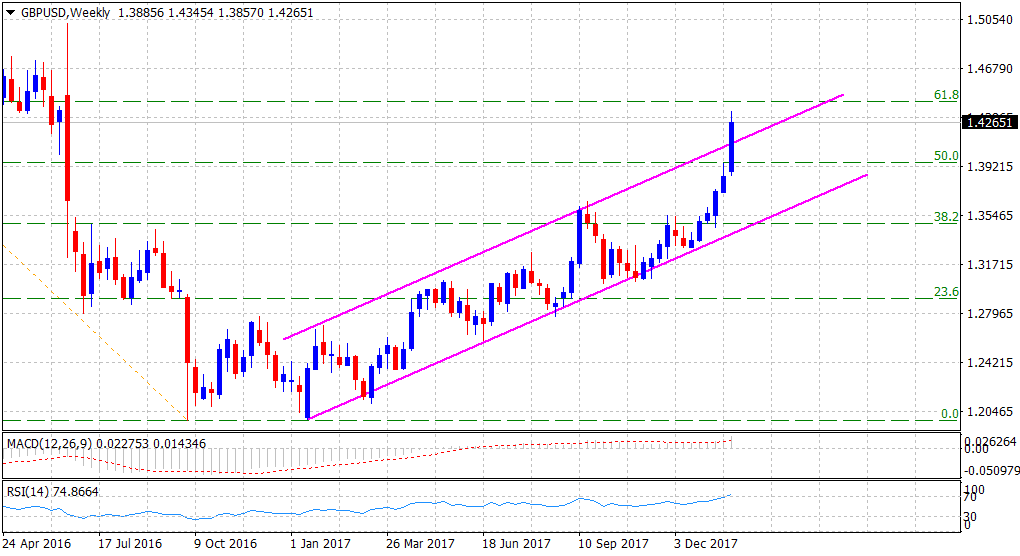
The GBP/USD pair steadily moved higher through the European session on Friday and recovered a major part of previous session's sharp retracement of over 250-pips from fresh post-Brexit highs. A goodish overnight US Dollar recovery, supported by the US President Donald Trump's pro-dollar comments, ran out of steam on Friday and triggered the initial leg of up-move from sub-1.4100 level.

The up-move got an additional boost after the prelim UK GDP growth estimates showed economic growth stood at 0.4% q-o-q during the fourth quarter of 2017. Meanwhile, the y-o-y growth rate bettered expectations and came in at 1.5% as compared to 1.4% anticipated. The up-move, however, stalled ahead of the 1.4300 handle as investors now look forward to the advance US GDP growth figures and durable goods orders data for fresh impetus. 

Meanwhile, technical indicators on daily and weekly charts continue to suggest near-term overbought conditions. This coupled with Thursday's retracement from an intermediate hurdle near mid-1.4300s, which pointed to some initial signs of bullish exhaustion, adds to the credence that any further up-move is more likely to be short-lived and is unlikely to get extended far beyond the 1.4400 handle. 

Hence, even a modest USD rebound, supported by slightly better-than-expected economic data, might prompt some aggressive long-unwinding trade on the last trading day of the week. Immediate support is now pegged near 1.4240 level and is followed by the 1.4200 round figure mark. Subsequent weakness below the mentioned support might now turn the pair vulnerable to slide towards 1.4135 intermediate support en-route the 1.4100 handle. The corrective slide could further get extended back towards the key 1.40 psychological mark.
Author

Haresh Menghani

Haresh Menghani is a detail-oriented professional with 10+ years of extensive experience in analysing the global financial markets.


More from Haresh Menghani
Share:

Markets move fast. We move first.

Orange Juice Newsletter brings you expert driven insights - not headlines. Every day on your inbox.

By subscribing you agree to our Terms and conditions.

Editor's Picks

EUR/USD falls toward 1.1700 on broad USD recovery

EUR/USD turns south and declines toward 1.1700 on Wednesday. The US Dollar gathers recovery momentum and forces the pair to stay on the back foor, as traders look to USD short-covering ahead of US inflation report on Thursday. However, the downside could be capped by hawkish ECB expectations. 

GBP/USD trades deep in red below 1.3350 after soft UK inflation data

GBP/USD stays under strong selling pressure midweek and trades below 1.3350. The UK annual headline and core CPI rose by 3.2% each, missing estimates of 3.5% and 3.4%, respectively, reaffirming dovish BoE expectations and smashing the Pound Sterling across the board ahead of Thurday's BoE policy announcements. 

Gold clings to moderate daily gains above $4,300

Following Tuesday's volatile action, Gold regains its traction on Wednesday and trades in positive territory above $4,300. While the buildup in the USD recovery momentum caps XAU/USD's upside, the cautious market stance helps the pair hold its ground.

Bitcoin risks deeper correction as ETF outflows mount, derivative traders stay on the sidelines

Bitcoin (BTC) remains under pressure, trading below $87,000 on Wednesday, nearing a key support level. A decisive daily close below this zone could open the door to a deeper correction.

Monetary policy: Three central banks, three decisions, the same caution

While the Fed eased its monetary policy on 10 December for the third consecutive FOMC meeting, without making any guarantees about future action, the BoE, the ECB and the BoJ are holding their respective meetings this week. 

AAVE slips below $186 as bearish signals outweigh the SEC investigation closure

Aave (AAVE) price continues its decline, trading below $186 at the time of writing on Wednesday after a rejection at the key resistance zone. Derivatives positioning and momentum indicators suggest that bearish forces still dominate in the near term.















