|

GBP/USD Forecast: Pound Sterling turns fragile as safe-haven flows return

  • GBP/USD declined to the 1.2300 area in the European morning on Tuesday.
  • The US Dollar gathers strength amid souring market mood.
  • Sellers could remain interested in case GBP/USD fails to stabilize above 1.2300.

GBP/USD came under pressure and declined to the 1.2300 area in the European session on Tuesday. The pair's near-term technical outlook points to a bearish tilt. In the absence of high-impact data releases, the risk perception could impact GBP/USD action in the second half of the day.

After advancing to its strongest level since mid-September at 1.2428 on Monday, GBP/USD turned south and closed in negative territory. The recovery seen in the US Treasury bond yields helped the US Dollar (USD) find demand and didn't allow the pair to build on earlier gains.

At the time of press, US stock index futures were down around 0.3% on the day, reflecting a cautious market stance. In case safe-haven flows dominate the action following Wall Street's opening bell, the USD could continue to gather strength and force GBP/USD to stay on the back foot.

News of the UN Security Council failing to reach an agreement on a draft resolution to end the conflict in Gaza seem to be causing investors to stay away from risk-sensitive assets.

Earlier in the day, the data from the UK revealed that Halifax House Prices rose by 1.1% on a monthly basis in October but this reading did not trigger a noticeable market reaction.

GBP/USD Technical Analysis
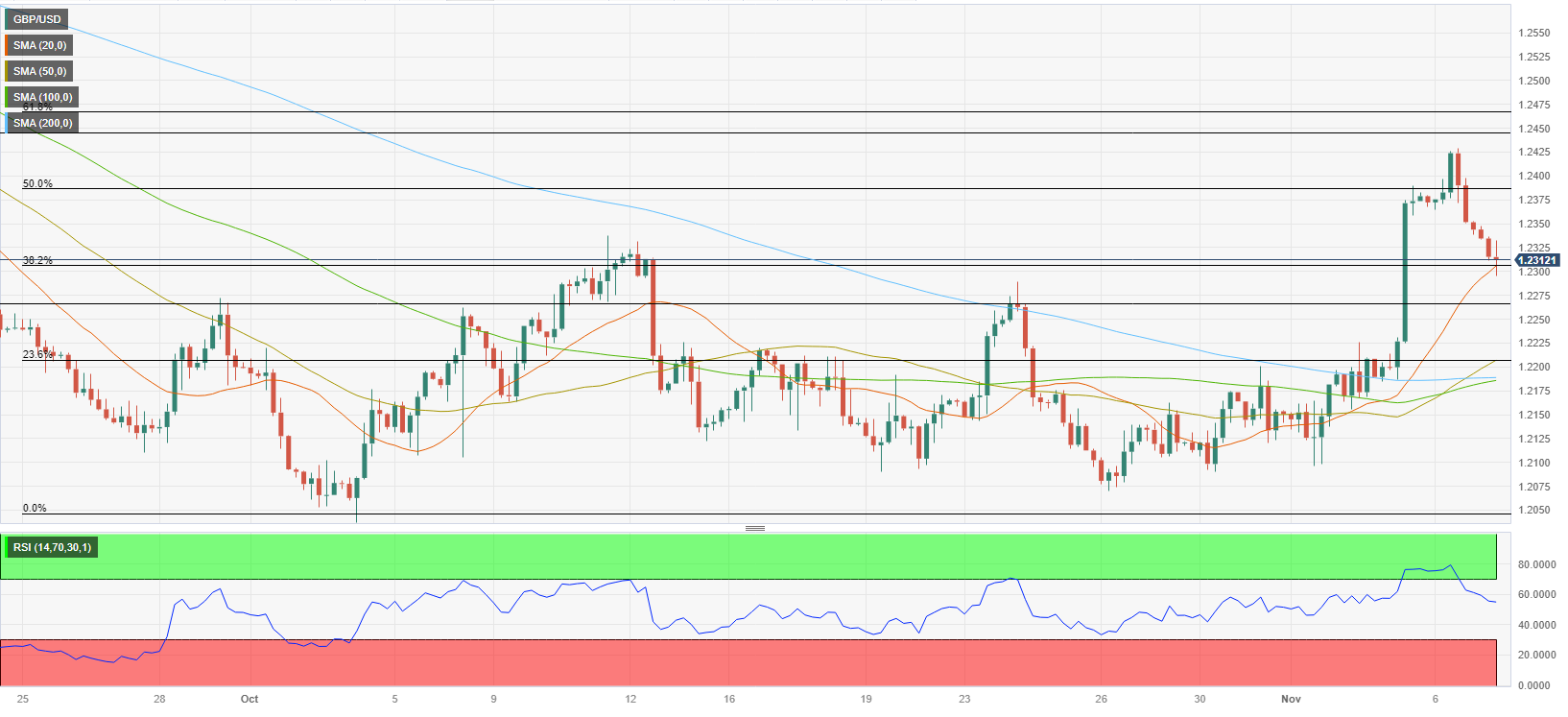
GBP/USD was last seen trading within a touching distance of 1.2300, where the Fibonacci 38.2% retracement of the latest downtrend and the 20-period Simple Moving Average (SMA) on the 4-hour chart align. If the pair drops below that level and confirms it as resistance, additional losses toward 1.2260 (static level) and 1.2200 (Fibonacci 23.6% retracement, 50-period SMA) could be witnessed.

On the upside, resistances are located at 1.2340 (static level), 1.2400 (Fibonacci 50% retracement) and 1.2440 (static level).

Author

Eren Sengezer

As an economist at heart, Eren Sengezer specializes in the assessment of the short-term and long-term impacts of macroeconomic data, central bank policies and political developments on financial assets.


More from Eren Sengezer
Share:

Editor's Picks

GBP/USD hangs close to 1.3500, awaits fresh impetus from US CPI

GBP/USD keeps its range around 1.3500 in Wednesday's European trading. The pair continues to trade with caution as the US Dollar (USD) holds ground ahead of a crucial US consumer inflation report. Investors are watching this upcoming reading closely, as it is expected to play a major role in shaping the Federal Reserve’s next interest rate decision and the USD valuation.

EUR/USD consolidates below 1.1550 ahead of US CPI

EUR/USD struggles to gain any meaningful traction and holds steady around 1.1550 in the European trading hours on Wednesday, maintaining a familiar range held over the past week or so. Traders keenly await the release of the key US inflation data and further developments surrounding the Middle East crisis before placing fresh directional bets.

Gold retakes $4,400, eyes two-month high as traders look to US CPI for Fed hike cues

Gold attracts fresh buyers during the Asian session on Wednesday and climbs back above the $4,400 mark, closer to its highest level since June 5, which was touched the previous day. Traders now look to the US Consumer Price Index report for more cues about the US Federal Reserve's future policy path amid inflation risks stemming from volatile oil prices.

Crypto Overview: Bitcoin loses $64,000 – LINK, DOGE sustain gains

Bitcoin is trading below $64,000 amid a broader market risk-off sentiment. Emerging as top performers over the last 24 hours, Chainlink and Dogecoin sustain gains, hinting at an extended recovery. CoinMarketCap’s Fear and Greed Index at 38 reflects persistent risk-averse sentiment in the crypto market.

AI defies the disinflationary playbook: Why lower oil prices might not be enough to cool core inflation
The global economic landscape has been fixated on the Middle East since the US-Iran war started in late February, reacting to significant changes in crude Oil prices and assessing how they could influence inflation dynamics and growth outlook.
9-3: Is the Federal Reserve’s vote tally Warsh's new forward guidance?
The rate did not move. Neither did the statement, and that’s the more interesting fact. Set the July 29 Federal Open Market Committee (FOMC) statement beside the one issued on June 17, and the two documents are identical apart from a single verb and a paragraph at the bottom naming three dissenters.