GBP/USD Forecast: Pound Sterling needs to stabilize above 1.2450 to stretch higher
- GBP/USD has lost its traction after having climbed to the 1.2450 area.
- The pair's bullish bias stays intact despite the latest pullback.
- UK PM Sunak faces pressure to boost investment and growth.


GBP/USD has lost its traction and retreated to the 1.2400 area after having climbed toward 1.2450 during the Asian trading hours on Monday. The near-term technical picture suggests that the pair is staging a technical correction. In the absence of high-impact data releases, the US Dollar's valuation could continue to impact GBP/USD's action.
The US Dollar started the new week on the back foot and the US Dollar Index dropped below 102.00. Growing concerns over a recession in the US limit the US Treasury bond yields' upside and doesn't allow the currency to stay resilient against its rivals. Following Friday's nearly-3% rebound, the benchmark 10-year US Treasury bond yield struggles to reclaim 3.5% early Monday.
In the meantime, US stock index futures trade virtually unchanged on the day. In case Wall Street's main indexes gain traction after the opening bell, GBP/USD could start pushing higher during the American trading hours. Nevertheless, the current market positioning doesn't offer any directional clues for the time being.
Later in the day, Confederation of British Industry Director-General Tony Danker is set to deliver a speech and reportedly accuse British prime Minister Rishi Sunak of causing Britain to fall behind its peers to spur economic growth. Danker will urge Sunak to boost investment and eliminate uncertainty for UK firms that will come with the scrapping of hundreds of EU laws.
Although it's difficult to assess the potential impact of this speech on the Pound Sterling's valuation or the Bank of England's policy outlook, political jitters could limit the currency's gains, at least in the near term.
GBP/USD Technical Analysis
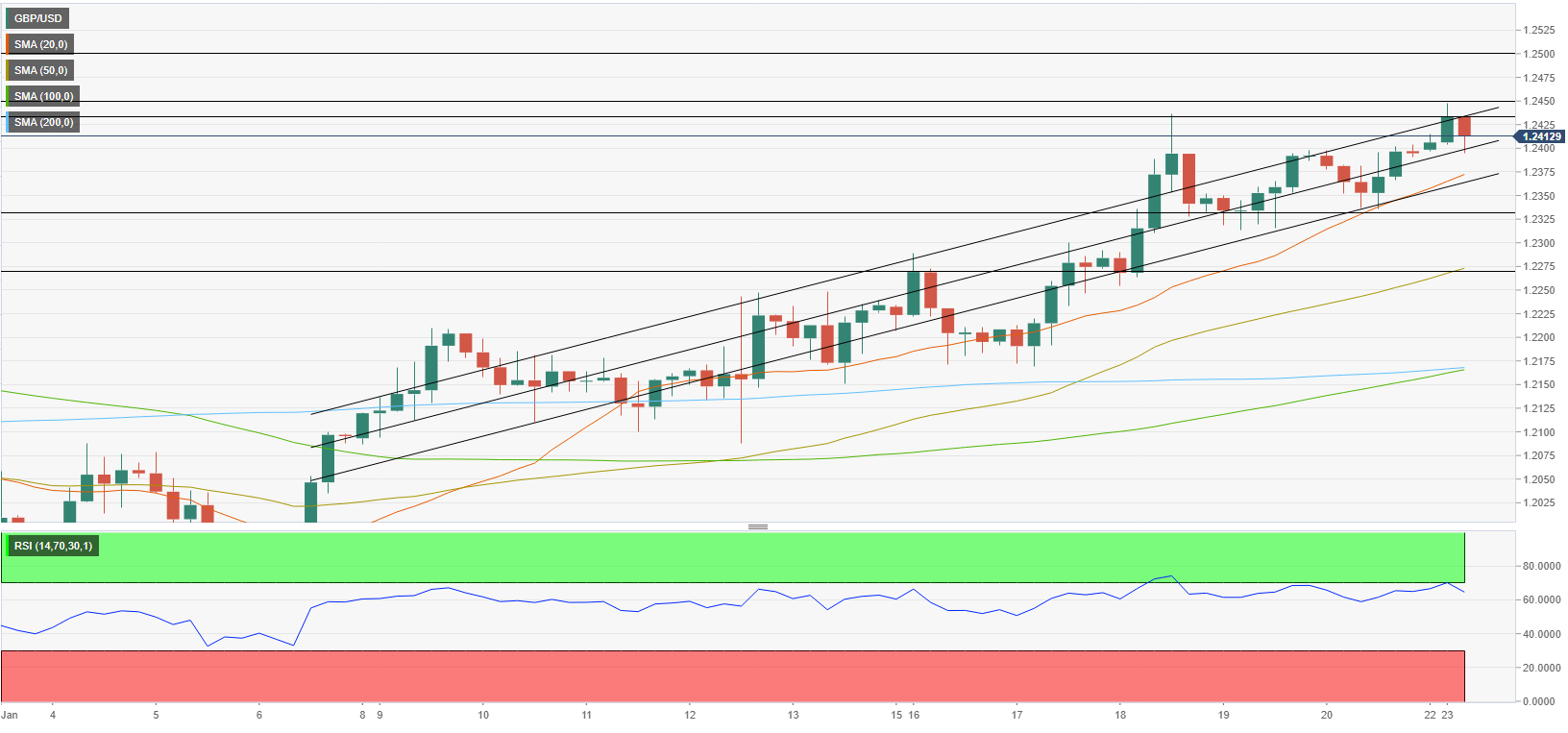
GBP/USD continues to trade within the ascending regression channel coming from early January and the Relative Strength Index (RSI) indicator holds comfortably above 50. Both of these technical developments suggest that the pair's bullish bias stays intact and the latest pullback is a part of a technical correction.
On the downside, 1.2400 (mid-point of the ascending channel, psychological level, static level) aligns as initial support. With a four-hour close below that level, additional losses toward 1.2370 (lower limit of the ascending channel, 20-period Simple Moving Average) could be witnessed. The failure of the latter support could open the door for additional losses toward 1.2330 (static level).
1.2430 (upper-limit of the ascending channel) forms strong resistance before 1.2450 (static level, daily high). Once the pair completes its correction and stabilized above 1.2450, it could target 1.2500 (psychological level, static level).
Premium
You have reached your limit of 3 free articles for this month.
Start your subscription and get access to all our original articles.
Author
Eren Sengezer
FXStreet
As an economist at heart, Eren Sengezer specializes in the assessment of the short-term and long-term impacts of macroeconomic data, central bank policies and political developments on financial assets.