GBP/USD Forecast: Pound Sterling faces key resistance at 1.2825
- GBP/USD recovered above 1.2750 in the European morning on Wednesday.
- 1.2825 aligns as strong resistance for the pair.
- Investors will keep a close eye on risk perception amid a lack of data releases.

After dropping below 1.2700 during the European trading hours on Tuesday, GBP/USD managed to erase a large portion of its daily losses before closing the day slightly above 1.2740. Supported by the positive shift seen in risk mood early Wednesday, GBP/USD extended its recovery beyond 1.2750. Although the technical outlook shows that sellers struggle to dominate action, the pair could find it difficult to rise steadily unless it clears the strong resistance that seems to have formed at 1.2825.
The bearish opening in Wall Street allowed the US Dollar (USD) to continue to find demand as a safe haven on Tuesday. After Philadelphia Federal Reserve Bank President Patrick Harker noted that they could probably start lowering the policy rate next year, however, the 10-year US Treasury bond yield declined sharply toward 4% and limited USD's gains.
Early Wednesday, US stock index futures are up between 0.2% and 0.4%, while the UK's FTSE 100 Index gains more than 0.5%, reflecting an improvement in market sentiment.
Pound Sterling price today
The table below shows the percentage change of Pound Sterling (GBP) against listed major currencies today. Pound Sterling was the strongest against the Japanese Yen.
| USD | EUR | GBP | CAD | AUD | JPY | NZD | CHF | |
| USD | -0.17% | -0.10% | -0.05% | -0.39% | 0.01% | -0.38% | -0.09% | |
| EUR | 0.17% | 0.07% | 0.11% | -0.23% | 0.19% | -0.22% | 0.11% | |
| GBP | 0.09% | -0.08% | 0.04% | -0.31% | 0.11% | -0.28% | 0.01% | |
| CAD | 0.04% | -0.12% | -0.04% | -0.35% | 0.06% | -0.32% | 0.00% | |
| AUD | 0.38% | 0.21% | 0.29% | 0.33% | 0.38% | 0.00% | 0.33% | |
| JPY | -0.01% | -0.19% | -0.15% | -0.05% | -0.37% | -0.43% | -0.10% | |
| NZD | 0.38% | 0.21% | 0.29% | 0.32% | -0.02% | 0.39% | 0.31% | |
| CHF | 0.08% | -0.08% | 0.00% | 0.03% | -0.29% | 0.08% | -0.29% |
The heat map shows percentage changes of major currencies against each other. The base currency is picked from the left column, while the quote currency is picked from the top row. For example, if you pick the Euro from the left column and move along the horizontal line to the Japanese Yen, the percentage change displayed in the box will represent EUR (base)/JPY (quote).
Since the US economic docket will not be featuring any high-tier data releases that could impact the USD's valuation, market participants are likely to continue to react to changes in risk perception. If main equity indexes in the US open in positive territory and continue to stretch higher, the USD is likely to stay on the back foot.
It's worth mentioning that the US Bureau of Labor Statistics will release Consumer Price Index (CPI) data for July on Thursday. Investors could move to the sidelines ahead of this inflation report, making it hard for GBP/USD to make a decisive move in either direction in the near term.
GBP/USD Technical Analysis
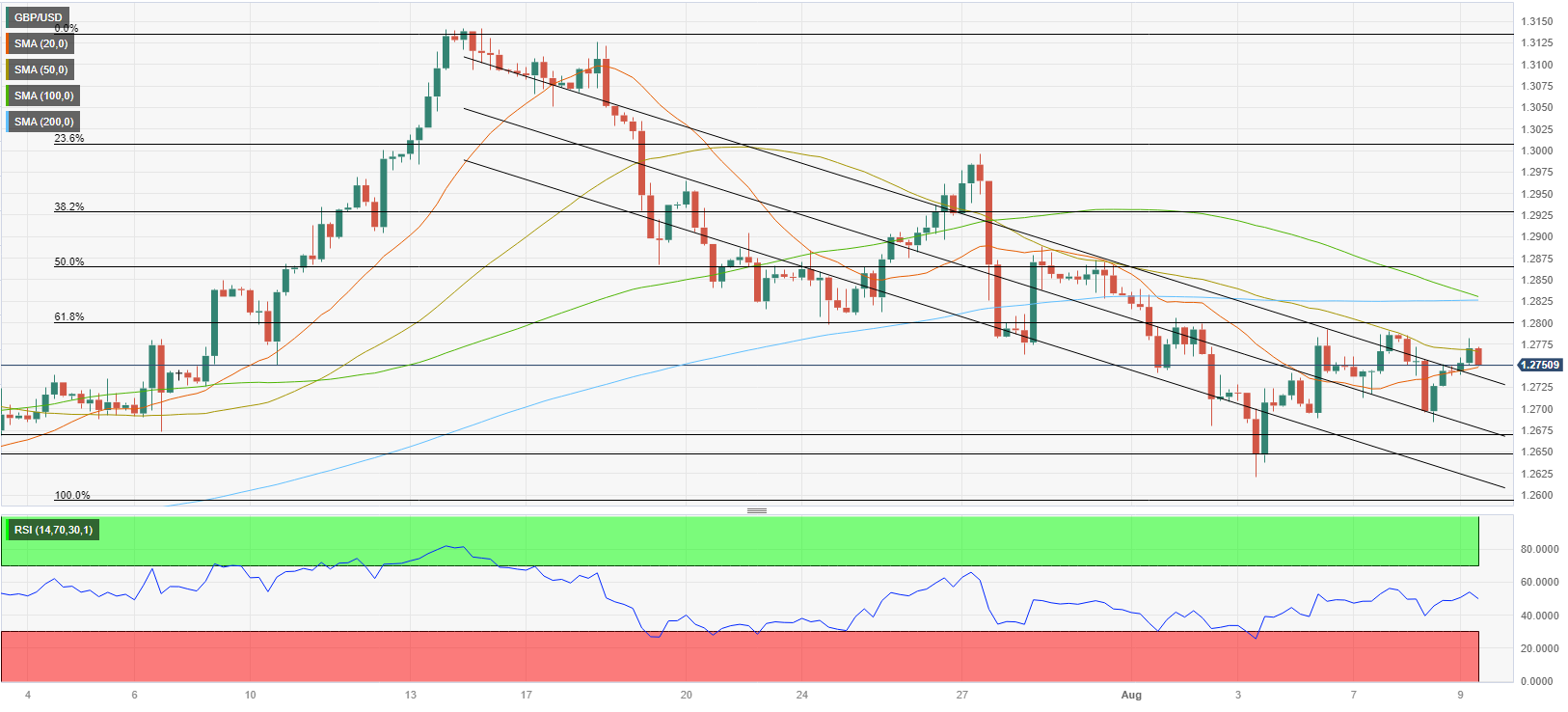
GBP/USD trades slightly above the upper limit of the descending regression channel and the Relative Strength Index (RSI) indicator on the 4-hour chart stays near 50, pointing to a neutral stance for the time being.
On the upside, 1.2800 (psychological level, Fibonacci 61.8% retracement of the latest uptrend) could be seen as first resistance ahead of 1.2825, where the 100-period and 200-period Simple Moving Averages align. A 4-hour close above the latter could attract bulls and open the door to an extended recovery to 1.2870 (Fibonacci 50% retracement).
If GBP/USD returns within the descending channel by falling below 1.2720, 1.2660 (mid-point of the regression channel, static level) and 1.2600 (static level, beginning point of the latest uptrend).
Author

Eren Sengezer
FXStreet
As an economist at heart, Eren Sengezer specializes in the assessment of the short-term and long-term impacts of macroeconomic data, central bank policies and political developments on financial assets.

















