|

GBP/USD Forecast: Pound Sterling could face strong resistance at 1.2200

  • GBP/USD recovered above 1.2150 in the European session on Thursday.
  • 1.2200 aligns as a critical technical resistance for the pair.
  • A correction in US T-bond yields could weigh on the USD.

GBP/USD came within a touching distance of 1.2100 on Wednesday and spent the Asian session in a tight channel on Thursday. In the European morning, the pair gathered recovery momentum and climbed above 1.2150.

US Treasury bond yields' rally continued mid-week as markets reacted to the lack of progress in US budget negotiations. Unless Republicans and Democrats reach an agreement to fund the government before the October 1 deadline, investors could refrain from betting on a risk rally. Reflecting the cautious market mood, US stock index futures trade virtually unchanged in the European session.

Top Senate Democrat Chuck Schumer said the next procedural vote on the Senate stopgap funding bill is expected to take place on Thursday. 

Later in the day, the US economic docket will feature the final revision to the second-quarter Gross Domestic Product (GDP) growth and the weekly Initial Jobless Claims data. Market participants, however, are likely to stay focused on the action in the bond markets. A correction in US T-bond yields could hurt the USD and help GBP/USD edge higher. If the deadlock between the House and the Senate remains unresolved, the pair's technical correction could remain limited in the near term.

GBP/USD Technical Analysis
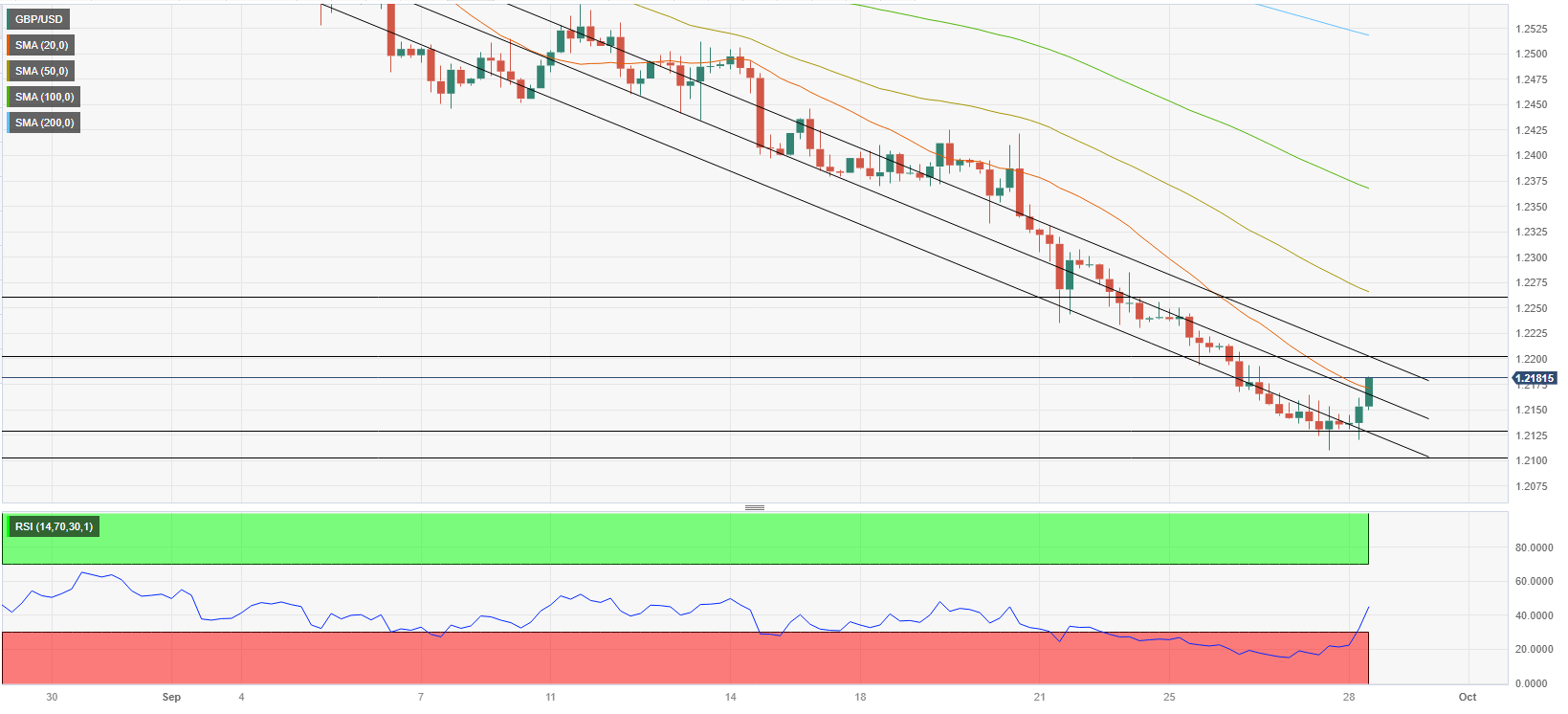
The Relative Strength Index (RSI) indicator on the 4-hour chart finally moved above 30, suggesting that the pair started to correct its oversold condition. The upper limit of the descending regression channel aligns as key resistance at 1.2200. In case GBP/USD manages to stabilize above that, 1.2260 (50-period Simple Moving Average (SMA), static level) and 1.2300 (psychological level, static level) could be set as next recovery targets.

On the downside, first support is located at 1.2150 (mid-point of the descending channel) before 1.2100 (psychological level, static level) and 1.2050 (static level).

Author

Eren Sengezer

As an economist at heart, Eren Sengezer specializes in the assessment of the short-term and long-term impacts of macroeconomic data, central bank policies and political developments on financial assets.


More from Eren Sengezer
Share:

Editor's Picks

GBP/USD: Daily gains remain capped by 1.3650

GBP/USD leaves behind Monday’s pessimism and advances marginally on Tuesday. Cable’s humble gains, however, appear to have met quite a decent resistance in the 1.3650 zone for now, in a context of a slight selling pressure hovering around the Greenback.

EUR/USD struggles to regain pace; gyrates around 1.1670

EUR/USD clinches humble gains around 1.1670 following Tuesday’s close on Wall Street. Indeed, marginal losses in the US Dollar encourages spot to set aside two dauly pullbacks in a row and maintain the 1.1700 barrier on the cross-hairs for now. Moving forward, US inflation tracked by the PCE and another revision of Q2 GDP data should keep investors entertained on Wednesday.

Gold steadies near $4,650, eyes multi-month high ahead of US PCE

Gold stabilizes around $4,650 after the previous day's two-way swings as traders await the US PCE data, due later this Wednesday, for cues about the Fed's policy path. The outlook will drive the US Dollar and the non-yielding bullion. Meanwhile, renewed hopes for a US-Iran peace deal, weak oil prices, sliding US bond yields and diminishing odds of an immediate tightening by the Fed undermine the USD. This keeps the precious metal close to its highest level since May 14, set on Tuesday.

Ethereum rally calms after reclaiming $2,300 on-chain cost basis
After a +30% gain last week, Ethereum (ETH) broke above its realized price, or average on-chain cost basis, at $2,306. That move also pushed it above the realized price of different wallet cohorts. Historically, profit-taking often increases when prices break above investors' average on-chain cost basis for the first time after an extended bearish period.
Canada hits US goods with tariffs; The rate market sees a problem
On September 8, Canada begins charging its own importers 15%, 25% and 50% on roughly 700 lines of American goods. The measure is billed as dollar for dollar, and on the arithmetic of covered trade it is. What it is not is a tax on the United States.
Canada hits US goods with tariffs; The rate market sees a problem
On September 8, Canada begins charging its own importers 15%, 25% and 50% on roughly 700 lines of American goods. The measure is billed as dollar for dollar, and on the arithmetic of covered trade it is. What it is not is a tax on the United States.















