|premium|

GBP/USD Forecast: Pound needs to clear 1.3370 hurdle to stretch higher

  • GBP/USD has gone into a consolidation phase following Thursday's rally.
  • BOE hiked its policy rate by 15 basis points as it expects inflation to peak at 6% in April.
  • GBP/USD could gather additional bullish momentum if it manages to clear 1.3370.

GBP/USD has gone into a consolidation phase below 1.3350 on Friday after closing the previous three trading days in the positive territory. The British pound gathered strength on Thursday after the Bank of England (BOE) decided to hike its policy rate by 15 basis points but needs to hold above 1.3370 to convince buyers of a steady advance.

In its policy statement, the BOE warned that inflation could hit 6% in April. Following the BOE's policy announcements, "We're concerned about inflation in the medium term. And we're seeing things now that can threaten that. So that's why we have to act," Governor Andrew Bailey explained. Moreover, the bank is worried about wage inflation feeding into more persistent price pressures in 2022. 

The CME Group's BOEWatch Tool shows that markets are currently pricing a 60% chance of another 15 basis points rate hike in March. 

In the meantime, the data from the UK showed on Friday that Retail Sales increased by 4.7% on a yearly basis in November after declining by 1.5% in October. Nonetheless, investors showed little to no reaction to this reading.

There won't be any high-tier macroeconomic data releases from the US on Friday and investors will keep a close eye on how the pair moves near key technical levels.

GBP/USD Technical Analysis
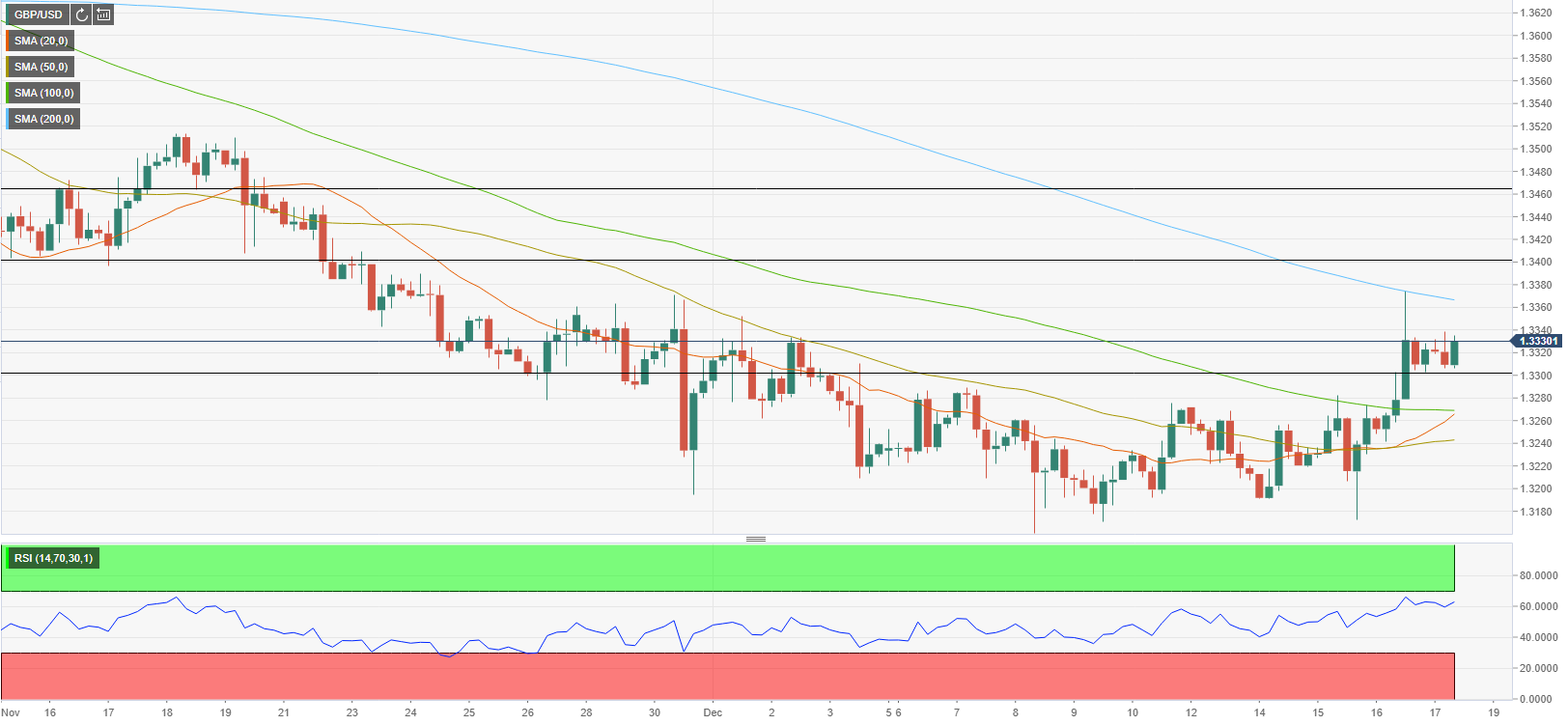
With the initial reaction to the BOE's hawkish policy outlook, GBP/USD jumped to its strongest level since November 24 at 1.3376 but the 200-period SMA on the four-hour chart acted as strong resistance near that level. If buyers manage to flip that level into support, the next target on the upside is located at 1.3400 (psychological level) ahead of 1.3460 (static level). 

On the downside, interim support seems to have formed at 1.3300 (static level, psychological level) before 1.3270 (100-period SMA, 20-period SMA) and 1.3240 (50-period SMA).

Premium

You have reached your limit of 3 free articles for this month.

Start your subscription and get access to all our original articles.

Subscribe to PremiumSign In

Author

Eren Sengezer

As an economist at heart, Eren Sengezer specializes in the assessment of the short-term and long-term impacts of macroeconomic data, central bank policies and political developments on financial assets.


More from Eren Sengezer
Share:

Editor's Picks

AUD/USD looks weaker, focus is back to 0.7100

AUD/USD reverses Tuesday’s gains and retreats markedly toward four-day troughs in the low 0.7100s ahead of the opening bell in Asia. The firmer tone in the Greenback weighs on the risk complex amid unabated tensions on the US-Iran front, prompting the Aussie to shed part of recent gains and refocus on the downside. Moving forward, Australian trade balance results should entertain investors early on Thursday.

Japanese Yen bounces up from lows after Japan PM Takaichi’s intervention warnings

The Japanese Yen bounced up from five-week lows against the US Dollar, turning positive on the daily chart, as Japan’s Prime Minister Sanae Takaichi warned that Tokyo is ready to take action against Yen weakness. The USD/JPY pair has pulled back from the 160.00 level, considered a line in the sand for Japanese authorities, to hit session lows at 159.55.

Gold slumps to near $4,450 as strong US jobs data reinforce higher-rate bets

Gold price falls to around $4,450 during the early Asian session on Thursday. The precious metal attracts some sellers amid rising expectations that the US Federal Reserve will raise interest rates this year.


XRP eyes rebound despite muted ETF demand
Ripple (XRP) rebounds above $1.23 from support at $1.20 at the time of writing on Wednesday, as the broader cryptocurrency market pares losses triggered by escalating tensions in the Middle East. Appetite for risk assets remains generally low as the United States (US) and Iran exchange fire amid a fragile ceasefire and peace negotiations.
The upside-down math of debt
In 2010, Professors Carmen Reinhart and Kenneth Rogoff published a paper, Growth in a Time of Debt, which instantly went viral. The main thesis of the paper was that once a government's debt-to-GDP ratio crosses above 90%, a financial crisis and default are around the corner.
Recession on paper: What really moves the Canadian Loonie now?

Statistics Canada handed the headline writers a gift and the analysts a headache. Real GDP shrank 0.1% on an annualized basis in the first quarter, and with the fourth quarter of 2025 revised down to a 1.0% contraction, that is two negative quarters in a row, the textbook definition of a technical recession and Canada's first since the pandemic.