GBP/USD Forecast: Next resistance for Pound Sterling aligns at 1.2630
- GBP/USD entered a consolidation phase near 1.2600 early Wednesday.
- The 100-day SMA aligns as next resistance at 1.2630.
- April inflation data from the US could ramp up the USD volatility.

GBP/USD declined toward 1.2500 in the early American session on Tuesday but managed to reverse its direction. Supported by the selling pressure surrounding the US Dollar (USD), the pair climbed above 1.2550 and closed the day in positive territory. Early Wednesday, the pair stays relatively quiet near 1.2600 as investors await key April inflation data from the US.
British Pound PRICE This week
The table below shows the percentage change of British Pound (GBP) against listed major currencies this week. British Pound was the strongest against the Japanese Yen.
| USD | EUR | GBP | JPY | CAD | AUD | NZD | CHF | |
|---|---|---|---|---|---|---|---|---|
| USD | -0.50% | -0.58% | 0.23% | -0.27% | -0.61% | -0.58% | -0.09% | |
| EUR | 0.50% | -0.11% | 0.73% | 0.21% | -0.14% | -0.09% | 0.38% | |
| GBP | 0.58% | 0.11% | 0.81% | 0.37% | -0.01% | 0.03% | 0.50% | |
| JPY | -0.23% | -0.73% | -0.81% | -0.54% | -0.81% | -0.87% | -0.32% | |
| CAD | 0.27% | -0.21% | -0.37% | 0.54% | -0.31% | -0.32% | 0.08% | |
| AUD | 0.61% | 0.14% | 0.01% | 0.81% | 0.31% | -0.06% | 0.52% | |
| NZD | 0.58% | 0.09% | -0.03% | 0.87% | 0.32% | 0.06% | 0.47% | |
| CHF | 0.09% | -0.38% | -0.50% | 0.32% | -0.08% | -0.52% | -0.47% |
The heat map shows percentage changes of major currencies against each other. The base currency is picked from the left column, while the quote currency is picked from the top row. For example, if you pick the British Pound from the left column and move along the horizontal line to the US Dollar, the percentage change displayed in the box will represent GBP (base)/USD (quote).
The USD weakened against its rivals on Tuesday as the market mood improved following the producer inflation data, which showed that the Producer Price Index (PPI) rose 2.2% on a yearly basis in April as forecast. Later in the session, Federal Reserve (Fed) Chairman Jerome Powell noted that the PPI data was "quite mixed." Powell repeated that it was unlikely that the next move would be a rate hike, adding that they were more likely to hold the policy rate where it is.
The US Bureau of Labor Statistics (BLS) will publish the Consumer Price Index (CPI) figures for April later in the session. On a yearly basis, the core CPI, which excludes volatile food and energy prices, is anticipated to rise 3.6% following the 3.8% increase recorded in March. On a monthly basis, the core CPI is forecast to increase 0.3%.
Investors could react to a surprise in the monthly core CPI reading. A strong increase of 0.4% or more could revive expectations over a Fed policy hold in September and trigger a USD rally, forcing GBP/USD to turn south. On the other hand, a soft reading is likely to have the opposite impact on the USD's valuation and allow the pair to extend its uptrend.
GBP/USD Technical Analysis
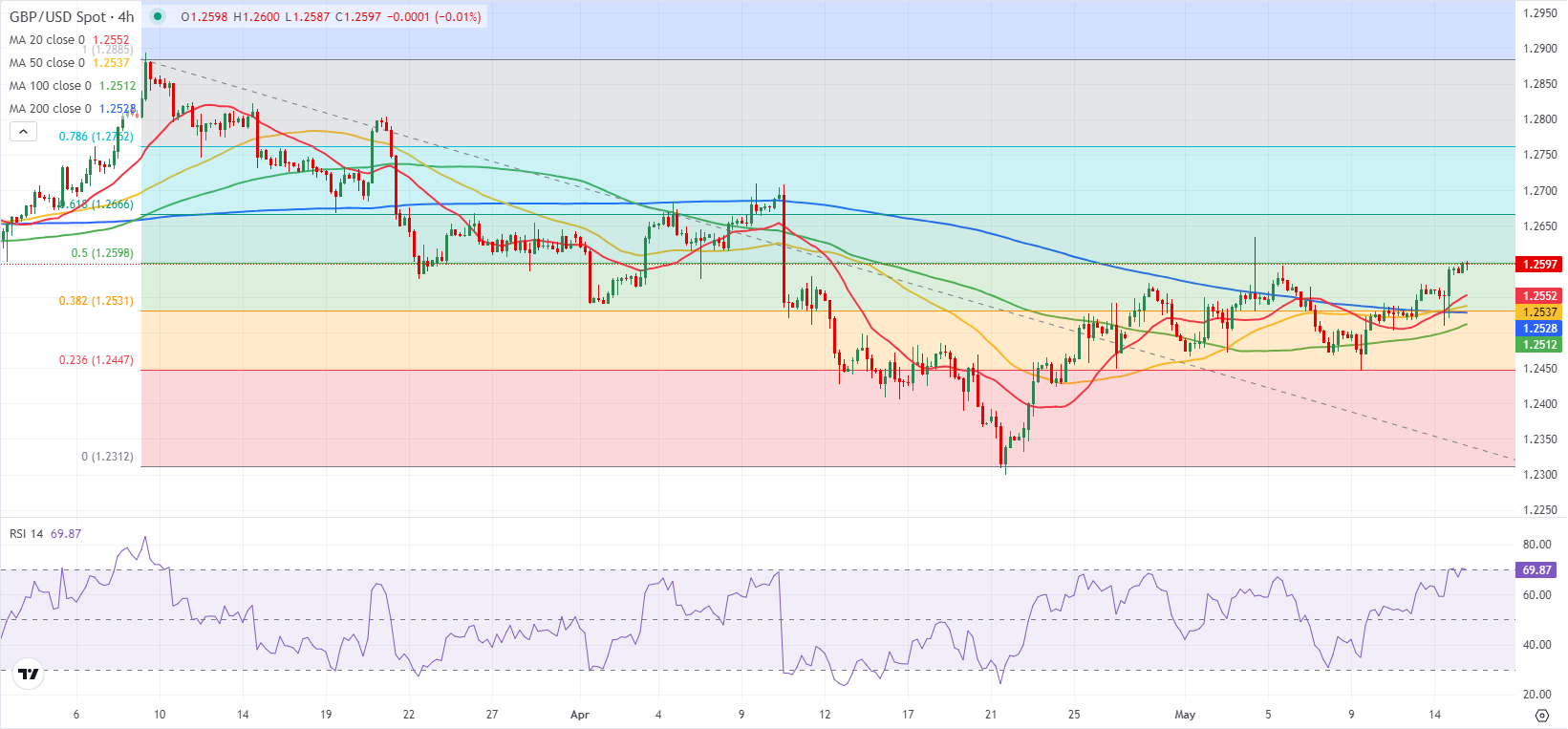
After closing above the 200-day Simple Moving Average (SMA), currently located at 1.2540, on Monday, GBP/USD continued to pull away from that key level, reflecting buyer interest. The Fibonacci 0.5% retracement of the latest downtrend aligns as immediate resistance at 1.2600. Once the pair stabilizes above this level, it could face stiff resistance at 1.2630 (100-day SMA) before targeting 1.2670 (Fibonacci 61.8% retracement).
On the downside, 1.2540 (200-day SMA) aligns as key support before 1.2500 (psychological level, static level) and 1.2450 (Fibonacci 23.6% retracement).
Economic Indicator
Consumer Price Index ex Food & Energy (MoM)
Inflationary or deflationary tendencies are measured by periodically summing the prices of a basket of representative goods and services and presenting the data as the Consumer Price Index (CPI). CPI data is compiled on a monthly basis and released by the US Department of Labor Statistics. The MoM print compares the prices of goods in the reference month to the previous month.The CPI Ex Food & Energy excludes the so-called more volatile food and energy components to give a more accurate measurement of price pressures. Generally speaking, a high reading is seen as bullish for the US Dollar (USD), while a low reading is seen as bearish.
Read more.Next release: Wed May 15, 2024 12:30
Frequency: Monthly
Consensus: 0.3%
Previous: 0.4%
Source: US Bureau of Labor Statistics
The US Federal Reserve has a dual mandate of maintaining price stability and maximum employment. According to such mandate, inflation should be at around 2% YoY and has become the weakest pillar of the central bank’s directive ever since the world suffered a pandemic, which extends to these days. Price pressures keep rising amid supply-chain issues and bottlenecks, with the Consumer Price Index (CPI) hanging at multi-decade highs. The Fed has already taken measures to tame inflation and is expected to maintain an aggressive stance in the foreseeable future.
Author

Eren Sengezer
FXStreet
As an economist at heart, Eren Sengezer specializes in the assessment of the short-term and long-term impacts of macroeconomic data, central bank policies and political developments on financial assets.