GBP/USD Forecast: Is BoE's message strong enough for a steady pound recovery?
- GBP/USD trades in positive territory near 1.0800 on Tuesday.
- BoE says it won't hesitate to raise rates as much as needed to return inflation to 2%.
- The pair seems to have gone into a technical correction phase.

GBP/USD has managed to pull away from the all-time low it touched at 1.0340 at the beginning of the week. The pair was last seen rising nearly 1% on the day at 1.0800 but it might need further reassurance from the Bank of England (BoE) for an extended rebound.
Following the British pound's significant depreciation, the BoE released a statement late Monday and noted that they were monitoring the developments in financial markets closely. The BoE added that they won't hesitate to raise interest rates by "as much as needed" to return inflation to the 2% target. However, the bank also said that they welcome the government’s commitment to sustainable economic growth, which was why GBP fell sharply in the first place.
Investors are concerned that tax cuts will fuel inflation while putting the UK public finances on an unsustainable path. The UK's FTSE 100 Index trades in negative territory early Tuesday, reflecting markets' cautious stance.
Nevertheless, futures markets are currently pricing in an 80% chance that the BoE will raise rates to 3.5% by November from 2.25%, according to Reuters.
Later in the day, BoE Chief Economist Huw Pill will be delivering a speech. In case Pill suggests that the BoE could still go for an unscheduled rate hike to limit the GBP's losses, GBP/USD could gather further recovery momentum.
August Durable Goods Orders and New Home Sales data from the US will be looked upon for fresh impetus in the American session. The Conference Board will release the September Consumer Confidence data as well. US stock index futures post strong gains and unless these data cause the market mood to sour in the second half of the day, risk flows could help the pair hold its ground.
GBP/USD Technical Analysis
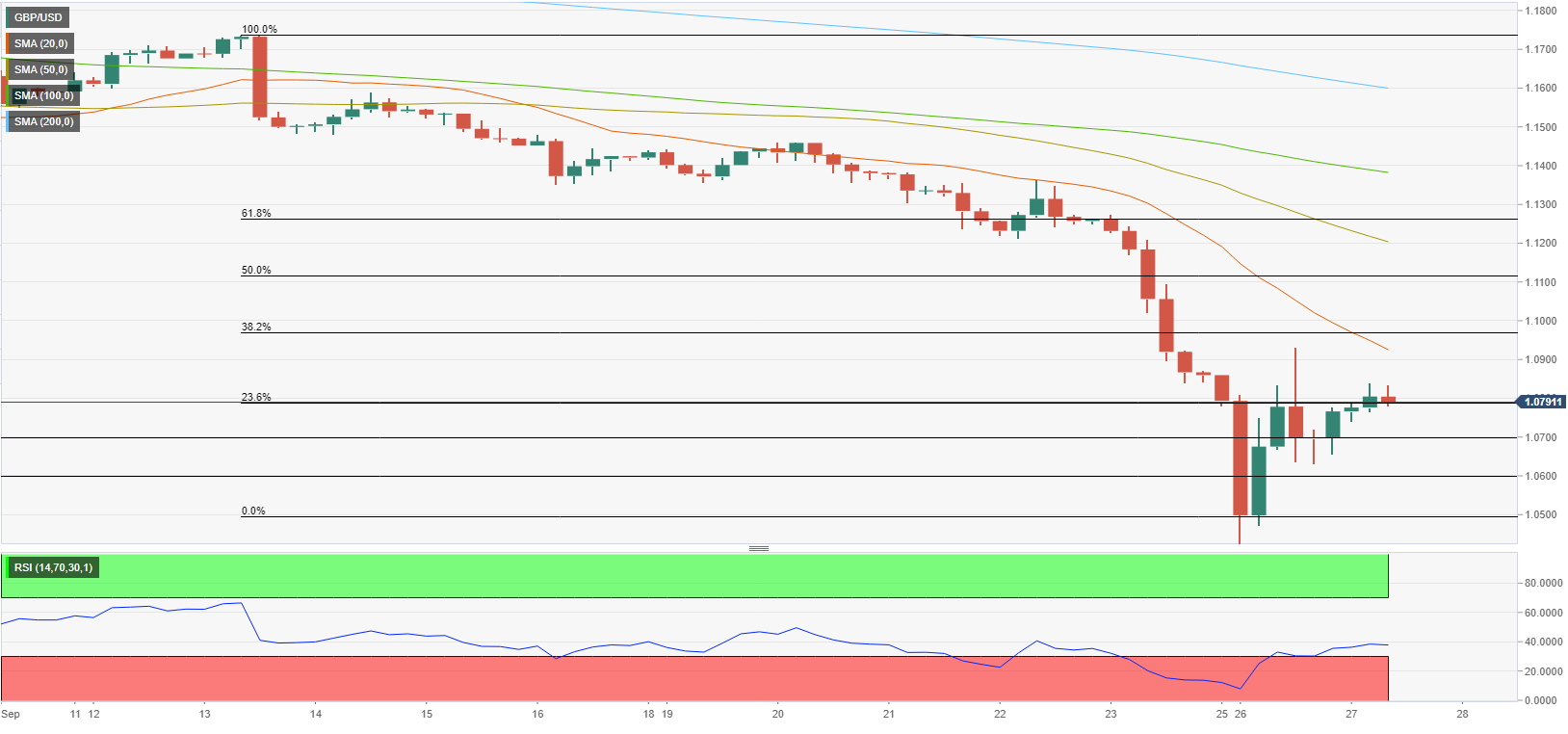
As long as GBP/USD holds above 1.0790 (Fibonacci 23.6% retracement of the two-week-old downtrend), it could extend its correction toward 1.0900 (20-period SMA on the four-hour chart), 1.0970 (Fibonacci 38.2% retracement) and 1.1000 (psychological level).
On the downside, supports align at 1.0700 (psychological level, static level), 1.0600 (psychological level) and 1.0500 (static level, psychological level).
In the meantime, the Relative Strength Index (RSI) indicator stays below 50 after having recovered above 30 late Monday, confirming the view that GBP/USD is in a technical correction stage.
Author

Eren Sengezer
FXStreet
As an economist at heart, Eren Sengezer specializes in the assessment of the short-term and long-term impacts of macroeconomic data, central bank policies and political developments on financial assets.














