|

GBP/USD Forecast: defends 1.32 handle as focus shifts to Thursday’s BoE decision

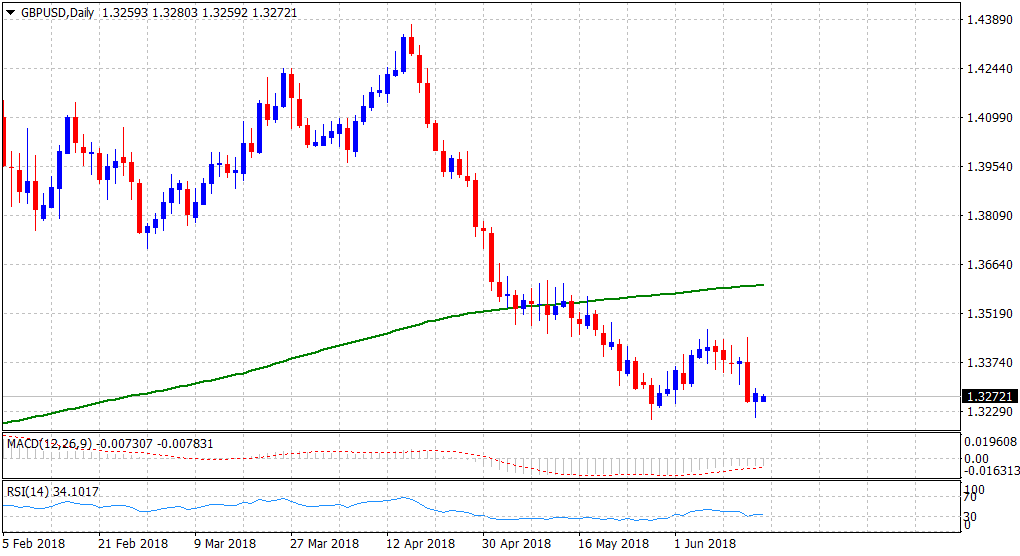
The GBP/USD pair once again found some support ahead of the 1.3200 handle on Friday and jumped back to the 1.3300 neighborhood, albeit lacked any strong follow-through. Reemerging hard Brexit concerns and fading prospects for an eventual BoE rate hike move in the near future did little to provide any additional boost to the British Pound. Traders also shrugged off escalating US-China trade tensions, especially after the US President Donald Trump approved a tariff of 25% on about $50 billion worth of Chinese imports, with persistent US Dollar strength further collaborating towards keeping a lid on any meaningful up-move.

The pair held weaker below the 1.3300 handle at the start of a new trading week as investors now start repositioning for the BoE June monetary policy decision on Thursday. Against the backdrop of steady inflationary pressure, the UK central bank is widely expected to maintain status quo and would make the vote count even more relevant. This coupled with the BoE Governor Mark Carney's scheduled speech late Thursday would further help investors determine the next leg of a directional move for the major.

From a technical perspective, the pair managed to settle just above the 1.3200 handle and hence, it would be prudent to wait for a follow-through weakness before favouring any further near-term downside. A convincing break below the mentioned support is likely to accelerate the fall towards 1.3135 horizontal support before the pair eventually breaks below the 1.3100 handle and aim towards testing its next support near the 1.3075 region.

On the upside, recovery beyond the 1.3300-1.3310 immediate hurdle is likely to confront immediate resistance near mid-1.3300s, above which the pair is likely to make an attempt towards reclaiming the 1.3400 handle. Any subsequent up-move might remain capped near the 1.3425-30 supply zone ahead of this week's key event risk.
Author

Haresh Menghani

Haresh Menghani is a detail-oriented professional with 10+ years of extensive experience in analysing the global financial markets.


More from Haresh Menghani
Share:

Editor's Picks

AUD/USD falls to near 0.7100 after slipping below 50-day EMA

AUD/USD depreciates after registering minor gains in the previous day, trading around 0.7120 during the Asian hours. The technical analysis of the daily chart shows the pair consolidating sideways within a rectangle pattern, as neither bulls nor bears gain control. The AUD/USD pair is holding a slight bearish tone however as it sits beneath both the nine-day and 50-day EMAs.

160.00: USD/JPY back near intervention territory after upbeat US jobs report

US Nonfarm Payrolls beat expectations by a wide margin in May, with 172K jobs added. The US Dollar rebounds after the release, helping USD/JPY recover from its intraday lows. Warnings from Japanese authorities continue to limit upside potential near the 160.00 threshold.

Gold targets $4,300 amid stronger Dollar

Gold faces increasing selling interest and navigates the area of three-month lows near the $4,300 mark per troy ounce on Friday. The precious metal’s decline comes as traders assess the stronger-than-expected NFP, while the bid bias in the Greenback and higher US Treasury yields also collaborate with the retracement.

Cardano hits five-year low even as Hoskinson clarifies "break" isn't an exit

Cardano (ADA) price is down 10% at press time on Friday, extending losses over 30% so far this week amid Charles Hoskinson's clarification that "break" isn't an exit.

Week ahead – Fed countdown begins amid US inflation data and geopolitical risks

Fed Chair Warsh’s first meeting approaches as key US inflation data could reshape expectations. Oil prices remain elevated as US-Iran talks continue; tariffs also return to the spotlight. ECB is expected to hike; will it be a one-off move or is July live?

The US economy defies the rules: 100 days into the Oil shock and the recession signal is still missing

More than three months after the start of the Iran war and the resulting disruption to global energy markets, the US economy continues to display remarkable resilience. The conflict has triggered a sharp rise in Oil prices, reignited inflationary pressures and fueled widespread concerns about a potential economic slowdown.