GBP/USD flat with tension rising before UK budget and US data surge
- GBP/USD steady as traders await UK Autumn Budget and weigh risks of potential Japanese FX intervention.
- Fed’s Waller backs December rate cut but says January remains uncertain amid continued labor-market softening.
- Heavy US data slate ahead before Fed blackout period.


The GBP/USD remains subdued during the North American session, trading unchanged at around 1.3088 as traders wait for the release of the UK’s budget amid a shortened week due to the Thanksgiving holiday in the US.
Sterling stays muted with DXY steady above 100, markets brace for a heavy US data slate and UK fiscal tightening.
The Dollar remains solid as depicted by the US Dollar Index (DXY), which measures the buck’s performance against six currencies. The DXY is flat at 100.21, capped by fears of a possible intervention of Japanese authorities in the FX markets.
Federal Reserve Governor Christopher Waller support a December rate cut, but a move in January is more uncertain. Waller added “most of the private sector and anecdotal data that we've gotten is that nothing has really changed. The labor market is soft. It's continuing to weaken,” said in a Fox Business interview.
Besides this, the US economic docket will be packed as ADP Employment Change 4-week average is awaited, the Producer Price Index, and Retail Sales on Tuesday. By Wednesday, Durable Goods Orders and Initial Jobless Claims could set the stage ahead of Fed officials entering their blackout period.
In the UK, traders are bracing for the release of the Autumn budget. Recently, Sky News revealed that the Office for Budget Responsibility (OBR) expects growth to be lower in 2026 and for every parliament year in the budget. Chancellor Rachel Reeves is expected to hike taxes to fund an expected £20-30 billion hole hit to the public finances, as the OBR downgrades growth forecasts.
Pound Sterling Price This Month
The table below shows the percentage change of British Pound (GBP) against listed major currencies this month. British Pound was the strongest against the New Zealand Dollar.
| USD | EUR | GBP | JPY | CAD | AUD | NZD | CHF | |
|---|---|---|---|---|---|---|---|---|
| USD | 0.37% | 0.53% | 1.88% | 0.91% | 1.66% | 2.53% | 0.82% | |
| EUR | -0.37% | 0.15% | 1.50% | 0.54% | 1.28% | 2.15% | 0.45% | |
| GBP | -0.53% | -0.15% | 1.36% | 0.39% | 1.12% | 2.00% | 0.31% | |
| JPY | -1.88% | -1.50% | -1.36% | -1.00% | -0.26% | 0.61% | -1.09% | |
| CAD | -0.91% | -0.54% | -0.39% | 1.00% | 0.67% | 1.60% | -0.08% | |
| AUD | -1.66% | -1.28% | -1.12% | 0.26% | -0.67% | 0.88% | -0.78% | |
| NZD | -2.53% | -2.15% | -2.00% | -0.61% | -1.60% | -0.88% | -1.66% | |
| CHF | -0.82% | -0.45% | -0.31% | 1.09% | 0.08% | 0.78% | 1.66% |
The heat map shows percentage changes of major currencies against each other. The base currency is picked from the left column, while the quote currency is picked from the top row. For example, if you pick the British Pound from the left column and move along the horizontal line to the US Dollar, the percentage change displayed in the box will represent GBP (base)/USD (quote).
GBP/USD Price Forecast: Technical outlook
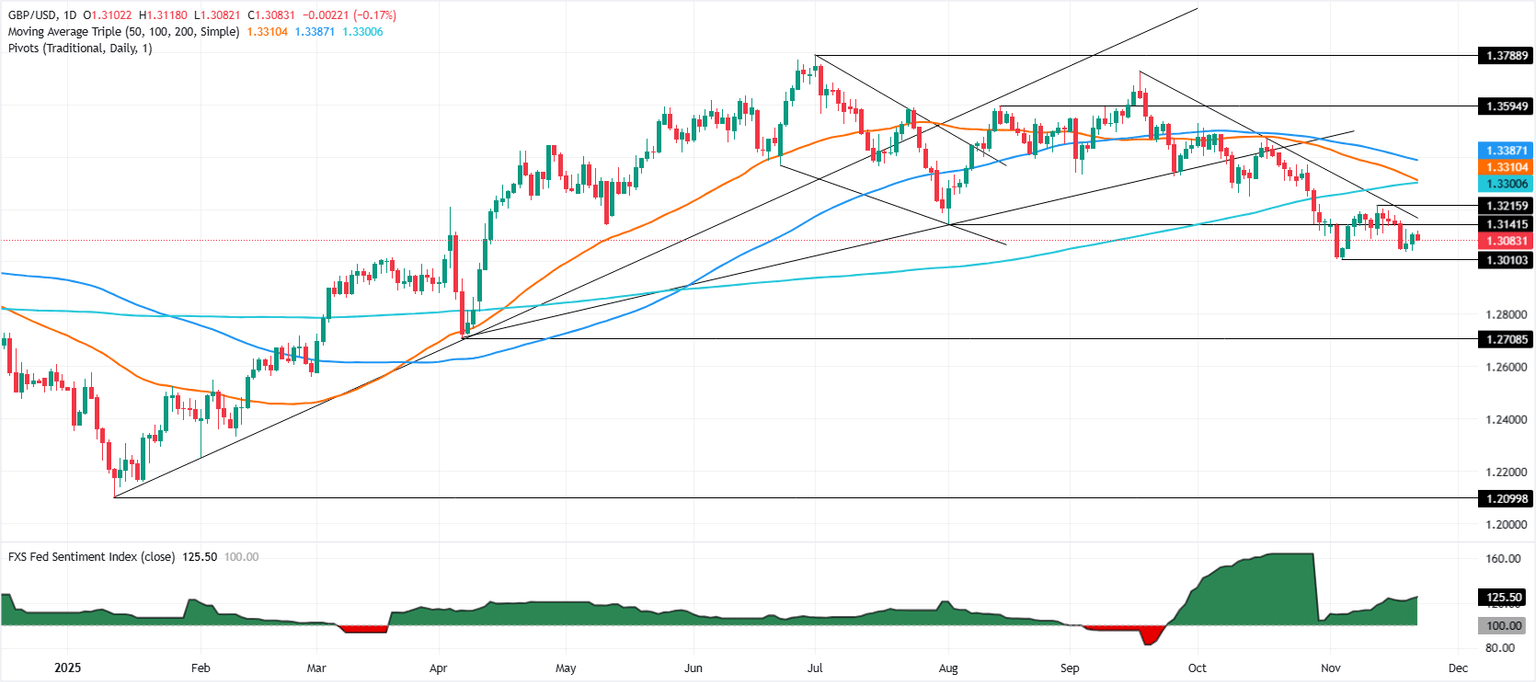
The technical picture shows the GBP/USD trading sideways, but tilted to the downside as buyers must reclaim the latest cycle high of 1.3215, the November 13 high. Momentum shows that bears remain in control as portrayed by the Relative Strength Index (RSI).
That said, if GBP/USD falls below November 20 low of 1.3037, this opens the door to test 1.30. A breach of the latter will expose April 7 daily low of 1.2707. For a bullish resumption, traders must clear 1.3100, followed by the 20-day SMA at 1.3134.
Pound Sterling FAQs
The Pound Sterling (GBP) is the oldest currency in the world (886 AD) and the official currency of the United Kingdom. It is the fourth most traded unit for foreign exchange (FX) in the world, accounting for 12% of all transactions, averaging $630 billion a day, according to 2022 data. Its key trading pairs are GBP/USD, also known as ‘Cable’, which accounts for 11% of FX, GBP/JPY, or the ‘Dragon’ as it is known by traders (3%), and EUR/GBP (2%). The Pound Sterling is issued by the Bank of England (BoE).
The single most important factor influencing the value of the Pound Sterling is monetary policy decided by the Bank of England. The BoE bases its decisions on whether it has achieved its primary goal of “price stability” – a steady inflation rate of around 2%. Its primary tool for achieving this is the adjustment of interest rates. When inflation is too high, the BoE will try to rein it in by raising interest rates, making it more expensive for people and businesses to access credit. This is generally positive for GBP, as higher interest rates make the UK a more attractive place for global investors to park their money. When inflation falls too low it is a sign economic growth is slowing. In this scenario, the BoE will consider lowering interest rates to cheapen credit so businesses will borrow more to invest in growth-generating projects.
Data releases gauge the health of the economy and can impact the value of the Pound Sterling. Indicators such as GDP, Manufacturing and Services PMIs, and employment can all influence the direction of the GBP. A strong economy is good for Sterling. Not only does it attract more foreign investment but it may encourage the BoE to put up interest rates, which will directly strengthen GBP. Otherwise, if economic data is weak, the Pound Sterling is likely to fall.
Another significant data release for the Pound Sterling is the Trade Balance. This indicator measures the difference between what a country earns from its exports and what it spends on imports over a given period. If a country produces highly sought-after exports, its currency will benefit purely from the extra demand created from foreign buyers seeking to purchase these goods. Therefore, a positive net Trade Balance strengthens a currency and vice versa for a negative balance.
Premium
You have reached your limit of 3 free articles for this month.
Start your subscription and get access to all our original articles.
Author
Christian Borjon Valencia
FXStreet
Markets analyst, news editor, and trading instructor with over 14 years of experience across FX, commodities, US equity indices, and global macro markets.

















