|

GBP/USD ends 2023 in bullish area

  • GBP/USD finds strong resistance near 200-week EMA.

  • Technical signals are negative.

  • Will 2024 be a negative year for the pair?

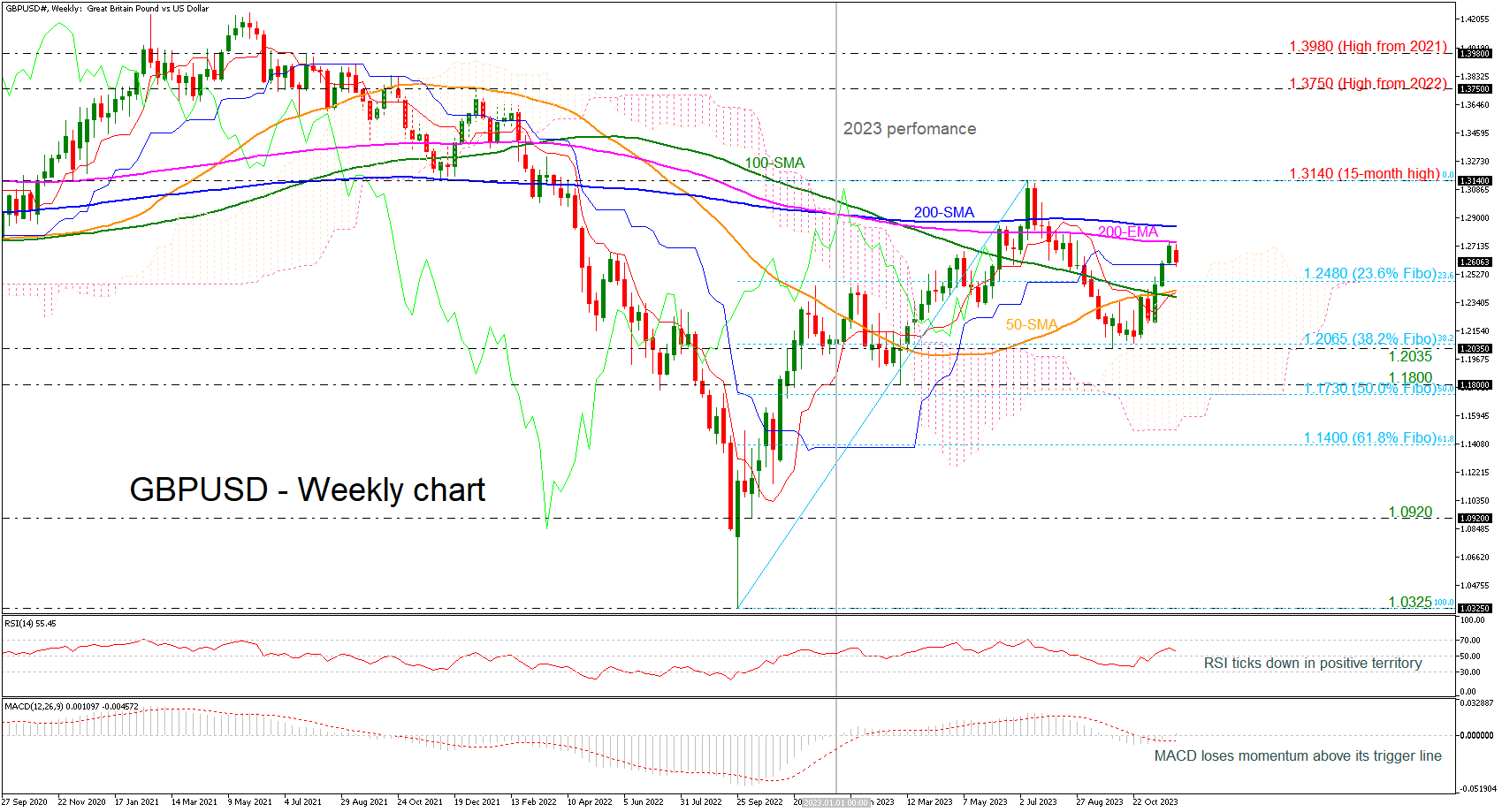
With the year 2023 drawing to a close, GBPUSD could not carry the impressive rally of the last three weeks above the bullish crossover within the 50- and the 100-week simple moving averages (SMAs) and the 23.6% Fibonacci retracement level of the upward wave from 1.0325 to 1.3140 at 1.2480. Also, the pair found strong resistance near the 200-week exponential moving average (EMA), sending prices lower this week so far.

Currently, the market price is holding above the opening price from last January. However, the technical oscillators are suggesting a weakening momentum. Specifically, the RSI is pointing south in the bullish region, while the MACD is flattening above its trigger line and near the zero level.  

The market structure is positive in the long-term picture as the pair keeps fluctuating within a bullish territory. Hence, even if downside pressures resume, the pair will remain attractive unless it exits the bullish formation below the 38.2% Fibonacci of 1.2065. If that bearish scenario unveils, selling forces could intensify towards the 1.1800 mark and the 50.0% Fibonacci of 1.1730. Then, additional losses from there could test the 61.8% Fibonacci of 1.1400.

In the event the price stays resilient above the 200-week EMA and the 200-week SMA, the bulls might push for a close above the 15-month high of 1.3140. Therefore, a successful move higher could immediately shift the attention to the 1.3750 barricade, registered in 2022.

In a nutshell, GBPUSD may remain supported in the coming sessions, especially if it jumps beyond the immediate moving averages. However, a bearish round cannot be excluded from the table as the oscillators suggest a bearish structure in the near future. 
GBPUSD

Author

Melina Deltas, CFTe

Melina joined XM in December 2017 as an Investment Analyst in the Research department. She can clearly communicate market action, particularly technical and chart pattern setups.


More from Melina Deltas, CFTe
Share:

Editor's Picks

EUR/USD holds firm above 1.1900 as US NFP looms

EUR/USD holds its upbeat momentum above 1.1900 in the European trading hours on Wednesday, helped by a broadly weaker US Dollar. Markets could turn cautious later in the day as the delayed US employment report for January will takes center stage. 

GBP/USD remains above nine-day EMA near 1.3650

GBP/USD recovers its recent losses from the previous session, trading around 1.3680 during the European hours on Wednesday. The technical analysis of the daily chart indicates a sustained bullish bias, as the pair trades within an ascending channel pattern.

Gold sticks to gains near $5,050 as focus shifts to US NFP

Gold holds moderate gains near the $5,050 level in the European session on Wednesday, reversing a part of the previous day's modest losses amid dovish US Federal Reserve-inspired US Dollar weakness. This, in turn, is seen as a key factor acting as a tailwind for the non-yielding yellow metal ahead of the critical US NFP release. 

US Nonfarm Payrolls expected to show modest job gains in January

The United States Bureau of Labor Statistics will release the delayed Nonfarm Payrolls data for January on Wednesday at 13:30 GMT. Investors expect NFP to rise by 70K following the 50K increase recorded in December.

S&P 500 at 7,000 is a valuation test, not a liquidity problem

The rebound from last week’s drawdown never quite shook the sense that it was being supported by borrowed conviction. The S&P 500 once again tested near the 7,000 level (6,986 as the high watermark) and failed, despite a macro backdrop that would normally be interpreted as supportive of risk.

Bitcoin price slips below $67,000 ahead of US Nonfarm Payrolls data

Bitcoin price extends losses, and trades below the lower consolidating boundary at $67,300 at the time of writing. A firm close below this level could trigger a deeper correction for BTC. Despite the weakness in price action, institutional demand shows signs of support, recording mild inflows in ETFs so far this week.