GBP/USD: BoE decision sets the stage for a December rate cut
The Bank of England left rates on hold this month at 4.0%, but the tone of the meeting was unmistakably dovish. The 5–4 vote split underscores just how divided the Monetary Policy Committee is—and how much now depends on Governor Andrew Bailey’s stance heading into December.
Bailey’s comments after the meeting were telling: while he acknowledged September’s encouraging inflation data, he emphasized that it’s just one data point. Yet, his increasing sympathy with the dovish camp—who see the risks to inflation as now balanced—suggests he’s preparing to vote for a rate cut next month.
With two inflation prints and the Autumn Budget still to come, the data flow will likely confirm the BoE’s shift toward easing. The Bank itself expects headline CPI to fall toward 3.5%, even as food inflation remains sticky. On the fiscal side, the Treasury’s apparent commitment to front-loaded tax hikes (~£15bn per year) adds another dovish layer, reinforcing the likelihood of a December rate cut.
Markets seem to agree. Sonia futures rallied 4–5bps at the short end, Gilts steepened bullishly, and Sterling softened modestly, reflecting the market’s view that the BoE’s terminal rate could fall to 3.25% by next summer.
GBP/USD technical reaction
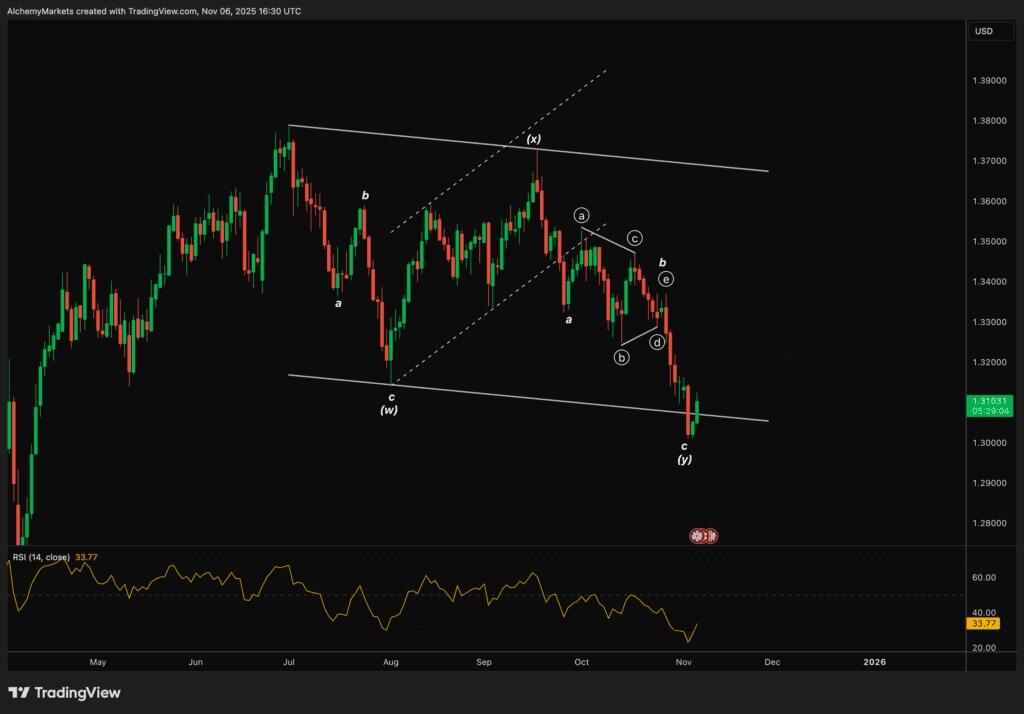
Today’s GBP/USD chart reflects that dovish shift perfectly.
As shown in the Elliott Wave structure above, the pair has likely completed a double complex correction (W–X–Y)within a broad descending channel. The latest leg lower—wave (y)—appears to have found support around 1.3050, coinciding with the lower channel boundary.
Momentum indicators, such as the RSI (14) hovering near 33, signal that the pair is entering oversold territory, increasing the odds of a short-term bullish reversal.
If the structure holds, GBP/USD could now be primed for a corrective rebound or even the start of a new impulsive recovery wave, targeting the 1.3350–1.3450 zone initially. A sustained break above 1.3500 would confirm that the market has turned the page on its correction and is transitioning into a new bullish phase.
Outlook
Fundamentally, the stars are aligning for a December rate cut, which should keep the macro backdrop dovish for the pound in the near term. However, given the scale of the correction and growing expectations of easing already priced in, GBP/USD may not have much more downside left.
Technically and sentiment-wise, this could mark the inflection point for a medium-term turnaround—especially if next week’s inflation data comes in softer and Governor Bailey cements his dovish bias.
Author

Zorrays Junaid
Alchemy Markets
Zorrays Junaid has extensive combined experience in the financial markets as a portfolio manager and trading coach. More recently, he is an Analyst with Alchemy Markets, and has contributed to DailyFX and Elliott Wave Forecast in the past.
















